Cash Flow Hedges
Cash flow hedges are hedges against exposure to volatility (that are attributable to particular risks) in the cash flows of either:
-
Recognized assets or liabilities.
-
Forecasted transactions.
The main purpose of a cash flow hedge is to link a hedging instrument and a hedged item in situations where you expect changes in cash flows to offset one another. Under FAS 133, to achieve this offsetting of cash flows, changes in the fair value of a derivative instrument that is designated and effective as a cash flow hedge must be:
-
Initially reported as a component of Other Comprehensive Income (OCI) outside earnings.
-
Later reclassified as earnings in the same periods during which the hedged transaction affects earnings (for example, when a forecasted sale actually happens).
Capture changes in the derivative instrument's fair value using effectiveness testing, which creates OCI accounting events. These events, in turn, generate an audit trail and become available for public reporting. Report OCI in the equity section of the balance sheet.
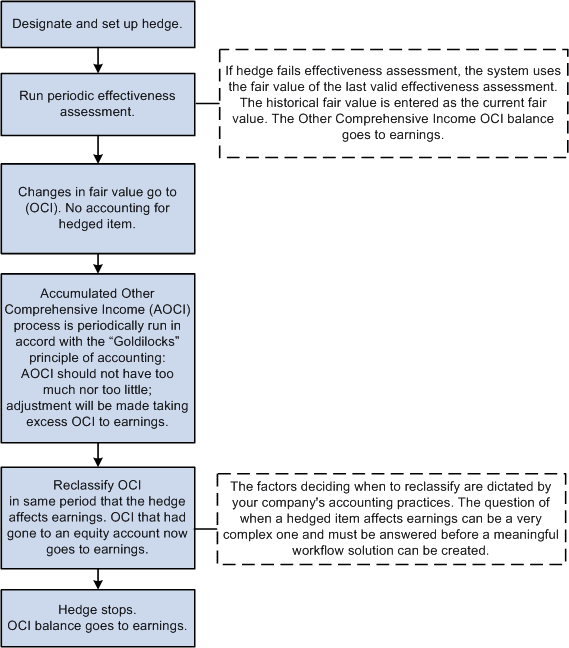
This flowchart shows the cash flow hedge occurring in time.
Derivatives Implementation Group Issues
When calculating the amount of ineffectiveness of a cash flow hedge according to ¶ 30(b), the guidance in Derivatives Implementation Group (DIG) Issue G7 applies.
See G7 - Cash Flow Hedges: Measuring the Ineffectiveness of a Cash Flow Hedge of Interest Rate Risk, When the Shortcut Method Is Not Applied, published by Rutgers University.
The issue lists three methods. Risk Management supports only the calculations of Methods 2 and 3.
Method 1: The Change in Variable Cash Flows method involves the following amounts that need to be calculated using an analytic:
-
Cumulative change in fair value of the swap.
-
Present value of the cumulative change in the cash flow on the floating leg of the swap.
-
Present value of the cumulative change in the expected future interest cash flows on the floating rate debt.
Method 2: The Hypothetical Derivative method involves the following amounts that must be calculated using an analytic:
-
Cumulative change in fair value of the actual swap.
-
Cumulative change in fair value "hypothetical" swap that mirrors the floating rate debt.
The change in the fair value of the "perfect" hypothetical swap can be regarded as a proxy for the present value of the cumulative change in expected future cash flows on the hedged transaction, as described in ¶ 30(b)(2).
With the analytic used to value the forecasted transaction, you calculate the second amount in the previous list: the cumulative change in fair value "hypothetical" swap that mirrors the floating rate debt.
Method 3: Change in Fair Value method involves the following amounts that must be calculated using an analytic:
-
Cumulative change in fair value of the actual swap.
-
Present value of the cumulative change in the expected future interest cash flows on the floating rate debt.