Fair Value Hedges
Fair value hedges are hedges against exposure to changes (that are attributable to a particular risk) in the fair value of either of the following:
-
Recognized assets or liabilities on your balance sheet.
-
Unrecognized firm commitment and specific business commitments having significant financial relevance to your organization, but whose quantitative value does not go to your general ledger.
Firm Commitments
You hedge firm commitments in fair value hedges and in foreign currency cash flow hedges.
See "Fair Value Hedges: Firm Commitments—Statutory Remedies for Default Constituting a Disincentive for Nonperformance" published by Rutgers University.
Note:
540 defines a Firm Commitment as the following: "An agreement with an unrelated party, binding on both parties and usually legally enforceable, with the following characteristics: (a) The agreement specifies all significant terms, including the quantity to be exchanged, the fixed price, and the timing of the transaction. The fixed price may be expressed as a specified amount of an entity's functional currency or of a foreign currency. It may also be expressed as a specified interest rate or specified effective yield. (b) The agreement includes a disincentive for nonperformance that is sufficiently large to make performance probable."
Under FAS 133, gains and losses on qualifying fair value hedges should follow these accounting guidelines:
-
They must recognize the hedging instrument's gain or loss in current earnings.
-
The gain or loss (that is, the change in fair value) on the hedged item attributable to the hedged risk must adjust the carrying amount of the hedged item and be recognized in current earnings.
Note:
From ¶ 19 of FAS 133: "The change in fair value of an entire financial asset or liability for a period refers to the difference between its fair value at the beginning of the period (or acquisition date) and the end of the period, adjusted to exclude (a) changes in fair value due to the passage of time and changes in fair value related to any payments received or made, such as in partially recovering the asset or partially settling the liability."
Here is an example of how this works:
With regression testing of a fair value hedge, the hedge is considered effective if its period ratio is between 80 and 125 basis points (0.8 to 1.25).
Period ratio equals the difference between the fair value change of hedging instrument (change in swap value) and the fair value change of hedged item (change in debt value).
| Period 1 | Period 2 | Net Difference | |
|---|---|---|---|
|
Change in swap value (hedging instrument) |
10 |
-7 |
17 |
|
Change in debt value (hedged item) |
-9 |
5 |
14 |
|
Difference in fair value |
1 |
-2 |
3 |
|
Period ratio |
-1.11 passes regression test ratio is within 0.8 to 1.25 |
-1.4 fails regression test terminate hedge |
|
Note:
DIG's Fair Value Hedges: Basing the Expectation of Highly Effective Offset on a Shorter Period Than the Life of the Derivative states: "In documenting its risk management strategy for a fair value hedge, an entity may specify an intent to consider the possible changes (that is, not limited to the likely or expected changes) in value of the hedging derivative and the hedged item only over a shorter period than the derivative's remaining life in formulating its expectation that the hedging relationship will be highly effective in achieving offsetting changes in fair value for the risk being hedged. The entity does not need to contemplate the offsetting effect for the entire term of the hedging instrument."
The functionality of Risk Management is not intended for formulating the prospective consideration that a hedge will be effective.
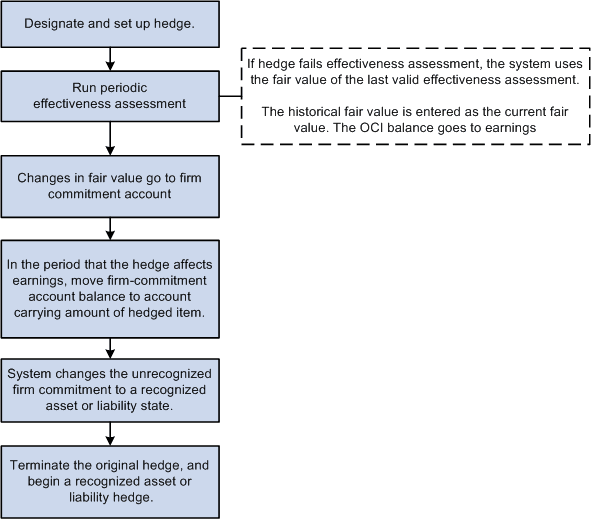
This illustration shows the fair value hedge in time.
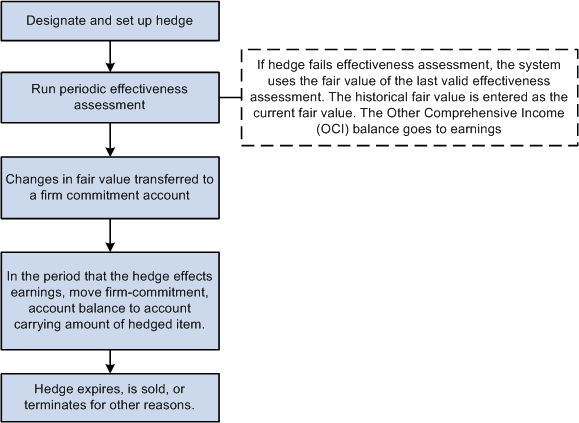
This illustration shows the life of an unrecognized firm commitment set up as a fair value hedge.