The Organizational Structure
The Global Payroll core application determines the organizational structure for payroll processing.
This diagram shows the hierarchy of components in the organizational structure.
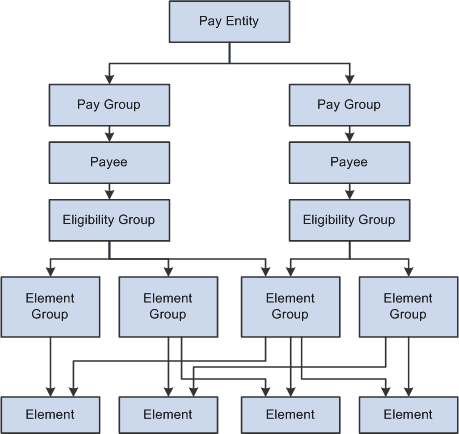
Pay Entity
Pay entity defines the organization making payments to payees. It also defines the type of currency to be used as the processing currency for every calculation.
Only one processing currency can be defined in Pay Entity. However, you can have multiple types of currency used as input and output. For example, you could enter your data in one type of currency and have 50 percent paid in one currency and 50 percent in another currency, regardless of the processing currency defined in pay entity.
The processing currency defined in pay entity is the currency that is used to generate reports.
A pay entity can be linked to one or more pay groups. However, each pay group is linked with only one pay entity.
You associate a specific country with each pay entity. This country designation is important for many features in Global Payroll such as the groups of calendars with a single calendar group ID, retroactive methods, and trigger definitions.
Pay Group
Global Payroll uses a logical grouping, called pay group, to qualify individuals for payment. Typically, all individuals in a pay group have something in common that causes them to be processed at the same time in the payroll system.
Common examples of pay groups are salaried and hourly pay. You can assign a payee's default earnings and deductions based on pay group if you select this option at installation time. A pay group can be associated only with a single pay entity.
Each pay group has a default eligibility group associated with it. This is traditionally the default earnings and deductions for the pay group population. The default eligibility group that is associated with a pay group is used as the payee level default. You can override these defaults.
Pay groups are ultimately associated with pay calendars to process a payroll. It is important to group payees who are paid with the same pay frequency—weekly, monthly, and so on—as well as payees who typically receive the same type of earnings and deductions.
Payee
Payees are the people in your organization that you want to pay.
Payees who are included in a pay group definition can be members of different eligibility groups. The only link between pay groups and eligibility groups is from a default perspective. The eligibility group that is defined on the Pay Group page is used as an initial default for the payee. You can override the default.
Eligibility Group
An eligibility group is a grouping of element groups. Eligibility groups indicate the specific elements for which a certain payee population is eligible. The default eligibility group is defined at the pay group level. A payee is assigned to an eligibility group through the default that is defined at the pay group level. You can override the default value.
For example, let's say that you have a pay group for all payees who are paid monthly. Of those payees, 99 percent are regular, salaried payees who are eligible for regular earnings. However, you also have 10 executives whom you want to pay in that same pay group. These executives are eligible for a slightly different set of earnings and deductions. You can override their eligibility group and assign them to the EXEC EARNINGS eligibility group. You can have only one default eligibility group for each pay group.
Element Group
Element groups provide a method of assigning a large number of elements (like taxes) to many eligibility groups without repeating the elements in each and every eligibility group. Element groups provide a means for grouping these elements. You can assign any number of element groups to an eligibility group.
Elements
Elements are the basic building blocks of Global Payroll. The organizational structure of the system begins with the definition of these basic payroll components.