Multiple Employment Records Compared to Multiple Jobs

A person can have multiple ERNs without holding multiple jobs.

A person does not have multiple jobs when they have:

  • A contingent worker and an employment instance.

    The two organizational instances have their own job records, each identified by a unique ERN.

  • A substantive job and a temporary job where the substantive job is suspended.

People have multiple jobs when they have:

  • More than one active contingent worker organizational instance.

  • More than one active employment organizational instance.

  • A substantive job and an additional assignment where the substantive job is not suspended.

Note:

Multiple jobs processing does not apply to person of interest job records.

Examples of multiple jobs include these methods:

Multiple Job Method Description

Concurrent Jobs (separate job instances)

  • Tracks multiple permanent employment relationships.

  • Each instance is entirely separate – terminating one has no affect on the other. There is no linkage between the two employment records.

  • Each instance is created with the HIR action (or ADD if a contingent worker).

  • Each instance can be of a permanent or a temporary nature.

  • Each instance has its own payroll and compensation data. Either, both, or none can be paid.

  • Benefits data can be combined using the Benefits Rcd Nbr.

  • Both employment record numbers are available for matching processes in PeopleSoft.

  • Both employment records are active.

Additional Assignment

  • The additional assignment is linked to the permanent job (instance). The new employment record is linked to an existing employment records.

  • The additional assignment is created with the ADL action.

  • An additional assignment can only be active if the first instance is active (Active, Leave of absence, Leave with Pay, Suspended, Short Work Break).

  • An additional assignment is automatically terminated when the main instance is terminated. The new employment record can only be active during the time period that the existing employment records is active.

  • An additional assignment can be completed and reactivated at any time during its controlling instance's active status period.

  • An additional assignment must be of the same organizational relationship type as its controlling instance.

  • An additional assignment can be promoted to its own instance if needed (but the history of its linkage to the original instance is lost).

  • Both employment records are available for matching processes in PeopleSoft.

  • Either, both, or none can be paid.

  • Both employment records can be active at the same time.

Global Assignment

  • Tracks temporary assignments while maintaining the employee's relationship with their home (or permanent) job.

  • Provides additional information tracking for vehicles, dependents, schools, homes, travel details, and additional earnings and deductions.

  • The additional (host) assignment is linked to the home job. The new employment record is linked to an existing employment record.

  • The host assignment is created with the ASG action.

  • A host assignment can only be active if the home instance is active.

  • A host assignment is automatically terminated when the home instance is terminated. If the existing employment record is terminated, this new one is terminated as of the same day.

  • A host assignment can be completed and reactivated at any time during its controlling instance's active status period.

  • A host assignment is only available for the Employee relationship.

  • A host assignment can be promoted to its own instance, but the history of its relationship to the original home instance is lost – except within the actual Track Global Assignments Assignment record.

  • Host assignments do not have their own compensation data.

  • Both jobs are available for matching.

  • Both employment records are active.

Temporary Assignment

  • Enables the tracking of temporary assignments while maintaining the employee's relationship with their permanent job.

  • The original instance is copied to a temporary employment record and is put in a suspended status. Changes can still be applied to this suspended assignment including position incumbent updates – but payroll is never run on this assignment. Only the temporary employment record can be paid.

  • The temporary assignment data is loaded into the original instance employment record.

  • When the temporary assignment ends, the suspended instance data is copied back into the original employment record from its latest effective date (only the latest effective date row is copied – the history of changes made to it are still kept in the suspended employment record, like a mass pay change).

  • The data on the existing employment record is suspended for the duration of the temporary one.

This chart provides information about multiple jobs methods and the relationship between the initial job instance and the concurrent job:

New Assignment Type Both Jobs Can Be Active Primary Instance (Home) Must Be Active Both Jobs Can Be Paid Job History Job Status Automation Process Both Can Be Matched in the Career Matching Processes

New Instance

Yes

N/A

Yes

Separate

No

Yes

Additional Assignment

Yes

Yes

Yes

Separate

Additional job is terminated if the primary instance is terminated

Yes

Global Assignment

Yes

Yes

Home only

Separate

Host is terminated if Home is terminated.

Yes

Temporary Assignment

Yes

No – Temporary assignment only

Temporary only

Temp data is captured in Instance History

Suspended job can be automatically reactivated when the temporary is done.

No

See Multiple Jobs.

Example: A Person with Multiple Jobs

As of February 1, 2019, when Jan Smith begins her contingent worker relationship with the organization, Jan Smith does not have multiple jobs. She has an active employment job record and an active contingent worker job record, distinguished in the system by their ERNs. On February 1, 2020, when Jan has held the consulting job at the subsidiary company as a contingent worker for a year, management decides to make the job permanent. This requires creating a new employment job record in addition to the original job record. Jan Smith now has multiple jobs. This diagram illustrates Jan Smith's organizational relationships and job records after the changes of February 1, 2020. A second employment instance has been added alongside the existing employment instance and contingent worker instances. The new employment instance has its own ERN and event history:
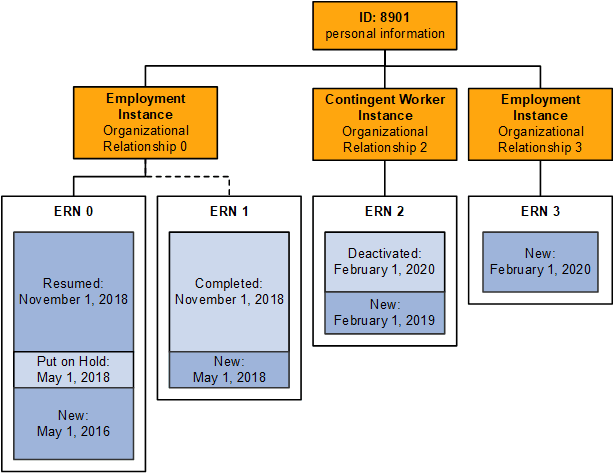
Jan Smith's job records from May 1, 2016 to February 1, 2020