Manage Professional Compliance Business Process Structure
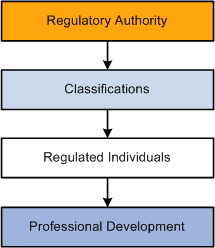
The Manage Professional Compliance business process can be divided into four main levels:
-
Regulatory authority
This is the body or organization that defines the compliance rules, standards, and regulations for certifying that individuals are qualified in a particular field. The regulatory authority does not have to be defined as an external organization, but it can be set up for use with compliance models that are entirely internal to a company.
-
Classifications
Classifications are the different categories that a regulatory authority uses to define individuals within the compliance process. The levels of classification can be simple or complex, reflecting various levels of compliance with the requirements for engaging in different professional activities. For example, an individual could be level one or level two compliant, classified as competent, or classified as a supervisor or a manager, and each of these classifications could be associated with a different set of certification requirements.
-
Regulated individuals (RIs)
RIs are the workers within a company who are involved in the compliance process.
-
Professional development
The compliance process concerns individuals obtaining minimum standards of competence to attain a classification level. To obtain these standards, individuals undergo a process of professional development, which may include coursework, testing, mandatory periods of supervision followed by performance reviews, and so forth.
This diagram provides an overview of the Manage Professional Compliance structure:
This diagram provides an overview of the Manage Professional Compliance structure.