Setting Up ACA Time Reporting Codes
The employer can use the Time Reporting Codes table to capture the Time Reporting Codes (TRCs) to be used to calculate the average service hours. Enter the following data in the table:
-
Workgroup
-
Effective Date
and
-
Time Reporting Codes.
Pages Used to Set Up ACA Time Reporting Codes
| Page Name | Definition Name | Usage |
|---|---|---|
|
ACA_TL_TBL |
Define the TRCs for workgroups within the employee population subject to the ACA. |
|
|
TL_GROUP_D1 |
Define the criteria to select the members of the group. |
ACA Time Reporting Codes Page
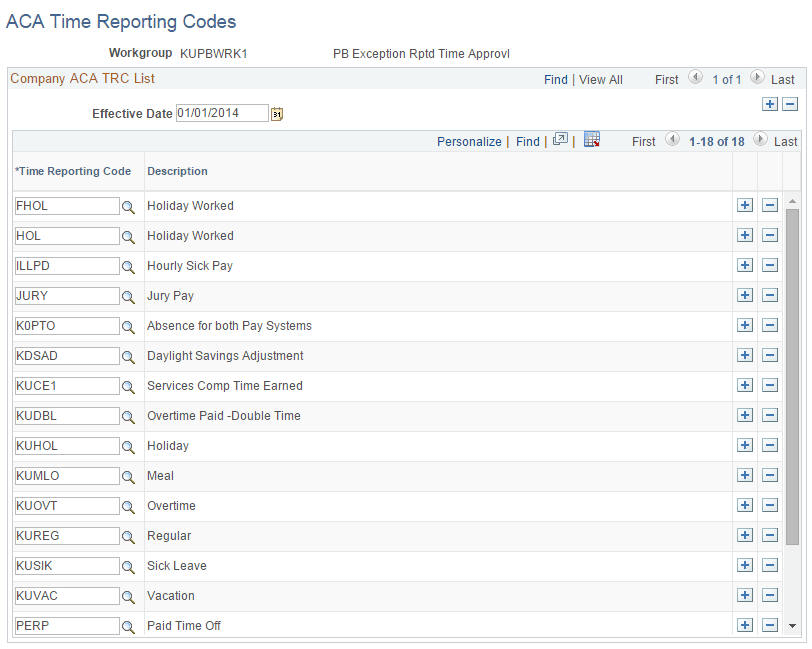
Use the ACA Time Reporting Codes page (ACA_TL_TBL) to define the Time Reporting Codes (TRCs) that are used to calculate the average number of hours for ACA eligibility.
Navigation:
This example illustrates the fields and controls on the ACA Time Recording Codes Page. You can find definitions for the fields and controls later on this page.
| Field or Control | Description |
|---|---|
|
Workgroup |
Specify a workgroup that the employee population uses which is subject to the ACA regulations. You need to define TRCs for all applicable workgroups. |
|
Effective Date |
The effective date of the defined group of TRCs. |
|
Time Reporting Code |
Specify all of the TRCs for calculating ACA eligibility for employees belonging to the workgroup. |
Time and Labor Groups Page
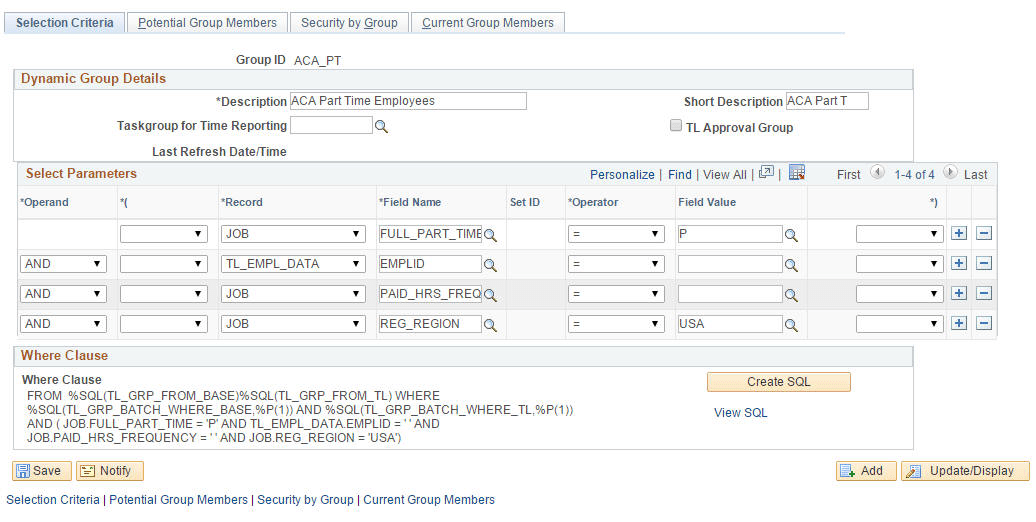
Use the Time and Labor Groups (TL_GROUP_D1) page to segregate your employee categories to which different measurement and stability periods are applied.
Note:
Both static and dynamic groups have to be set up according to the need. This page description explains how to set up the dynamic groups.
Navigation:
This example illustrates the fields and controls on the Dynamic Group - Selection Criteria page.
| Field or Control | Description |
|---|---|
|
Group ID |
Specify a workgroup that the employee population uses which is subject to the ACA regulations. You need to define TRCs for all applicable workgroups. |
|
Taskgroup for Time Reporting |
The effective date of the defined group of TRCs. |
This allows the separation of employee populations using the following categories:
-
salaried employees and hourly employees
-
employees whose primary places of employment are in different states
-
collectively bargained employees
-
non-collectively bargained employees
-
each group of collectively bargained employees covered by a separate collective bargaining arrangement.