Understanding PeopleCode and Application Engine Programs
Inserting PeopleCode into Application Engine programs enables you to reuse common function libraries and improve performance. In many cases, a small PeopleCode program used instead of Application Engine PeopleCode is an excellent way to build dynamic SQL, perform simple If/Else edits, set defaults, and perform other tasks that do not require a trip to the database.
Scope of Variables
This table presents the different types of variables typically used in Application Engine programs and their scope:
| Type of Variable | Scope | Comments |
|---|---|---|
|
State record (work record) |
Transaction (unit of work) |
Using a work record as your Application Engine state record means that the values in the work record cannot be committed to the database. Commits happen as directed, but any values in work records are not retained after a commit. |
|
State record (database record) |
Application Engine program |
Using a database record as your Application Engine state record preserves the values in the state record on commit, and the committed values are available in the event of a restart. |
|
Local PeopleCode variables |
PeopleCode program |
Local PeopleCode variables are available only for the duration of the PeopleCode program that is using them. |
|
Global PeopleCode variables |
Application Engine program |
Global PeopleCode variables are available during the life of the program that is currently running. Any global PeopleCode variables are saved when an Application Engine program commits and checks points; therefore, they are available in the event of a restart. |
|
Component PeopleCode variables |
Application Engine program |
Component PeopleCode variables act like global variables in Application Engine. |
Action Execution Order
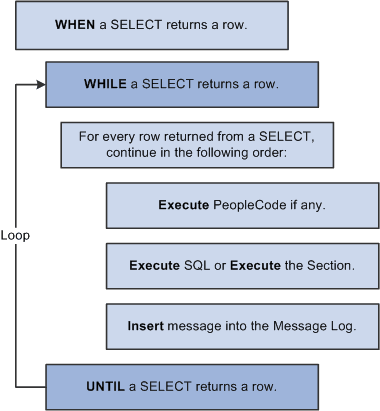
A step can contain only one PeopleCode action because no other types of actions are required within a step in conjunction with a PeopleCode action (or program). If you include other actions with your PeopleCode action within the same step, keep in mind the hierarchy when you run it.
With PeopleCode actions, Application Engine runs the PeopleCode program before the SQL, Call Section, or Log Message actions, but a PeopleCode program runs after any program flow checks.
Because multiple action types exist, they must execute in agreement within a system; therefore, the order in which actions execute is significant. At runtime, actions defined for a given step are evaluated based on their action type. All of the action types exist within a strict hierarchy of execution. For example, if both a Do When action and a PeopleCode action exist within a given step, then the Do When action always runs first.
The following example shows the sequence and level of execution for each type of action:
This is an example of action execution hierarchy.