Using the Strings Table for Language-Sensitive Text in Reports
The PeopleTools Strings table (STRINGS_TBL) stores text strings used for language-sensitive labels and other text for PS/nVision and SQR reports. This avoids hard-coding labels into the report files themselves. The use of strings rather than hard-coded text in reports enables translators to translate the report layout in the database without editing the report’s code itself. This enables you to run a single copy of a report in multiple languages while avoiding the duplication of code and report logic.
The Strings table stores string text of three different string types:
-
A short field description (RFT Short).
-
A long field description (RFT Long). Only strings of this type can have translated values.
-
A free-form text string (Text).
The Strings table is keyed by PROGRAM_ID plus the STRING_ID, which enables you to classify strings into groups that are used in similar reports. PROGRAM_ID can refer to a specific SQR or PS/nVision report name, or it can be a mnemonic for a group of common strings that are shared between reports. For RFT Short or RFT Long, the STRING_ID is the field name (validated against the PSDBFIELD or PSDBFIELDLANG table).
For example, PS/nVision string variables include the string ID and the program ID as follows:
%.StringID,ProgramID%
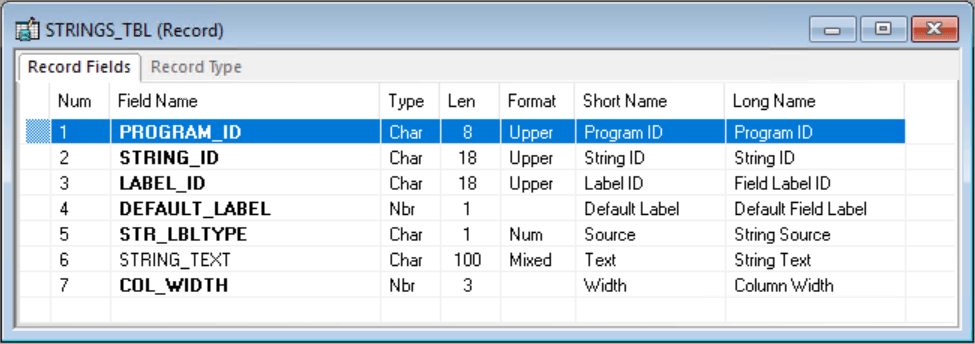
The following example shows the Use Display view for the STRINGS_TBL record definition in Application Designer with PROGRAM_ID and STRING_ID identified as the key fields:
This example illustrates the fields and controls on the STRINGS_TBL record definition.
If the language of the requested report is a non-base language and only if the requested string is a long field description type, the system returns the translated string from the related-language table (STRINGS_LNG_TBL) if a translation is available. If no translation exists, the base language string is returned.
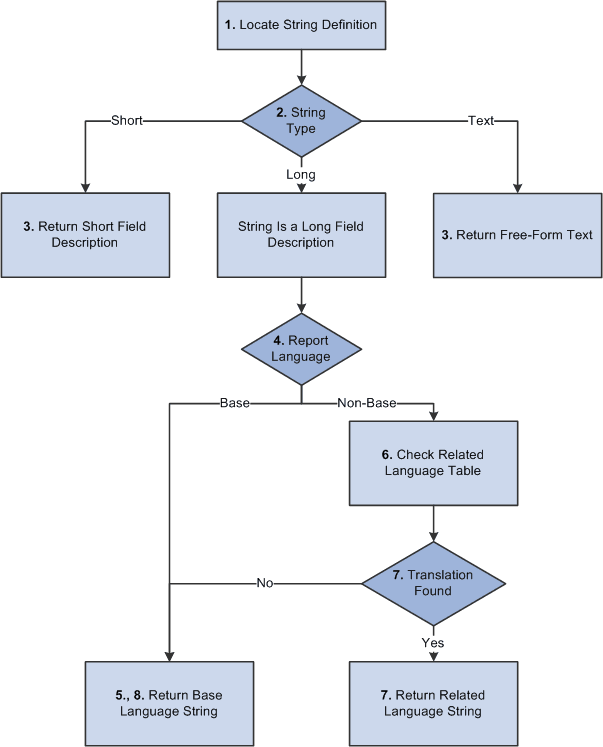
The return of language-sensitive string data follows this sequence as shown in the following diagram:
-
The system locates a string definition in the base language Strings table by using the program ID and string ID.
The text string stored in the base language Strings table can be a short or long field description or a free-form text string that is not associated with a field.
-
The system determines the string type: short, long, or text.
-
If the string type is short or text, the system returns the string text directly from the base language Strings table.
-
The system determines the language of the report request.
Note:
If the value is unspecified, the system uses the user’s current language preference setting.
-
If the language is the system’s base language, the system returns the string value from the base language Strings table.
-
If the language of the report is a non-base language, the system looks in the related-language table (STRINGS_LNG_TBL) for a row with the program ID, string ID, and correct language code.
-
If an appropriate row exists in the related-language table, the system returns the translation.
-
If no translation exists in the related-language table, the system returns the string from the base language table.
This diagram illustrates the return of language sensitive string data
Related Topics