Understanding Outbound User Authentication
The outbound user authentication process determines the user ID to identify and attach to the outbound service operation. If the receiving system is a PeopleSoft system, the system validates the user ID and if the user ID belongs to the permission list to which the service operation is assigned, the service operation can be invoked.
The PeopleSoft system sets the user ID based on whether the sending node type is a PeopleSoft node (PIA) and by user ID information that may be defined in the SOAP message included with the service operation.
Outbound User Authentication: Sending Node is PeopleSoft Node Type
The following diagram illustrates the user authentication process when the local sending node is a PeopleSoft node:
The following diagram illustrates the user authentication process when the local sending node is a PeopleSoft node.
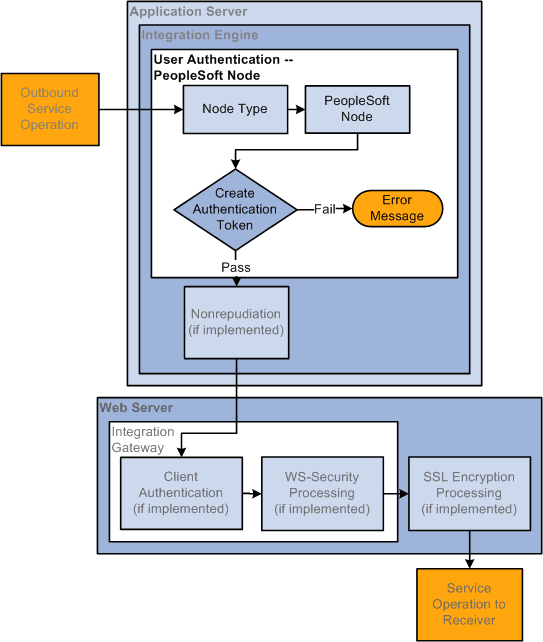
When the sending node is a PeopleSoft node, the user authentication process creates an authentication token to include in the transaction. The token is used on the receiving system to identify the sending node.
Note:
The sending node must be defined as a trusted node on the receiving system for the PeopleSoft authentication token to be validated.
Outbound User Authentication: Sending Node is not PeopleSoft Node Type
The following diagram illustrates the user authentication process when the local sending node is not a PeopleSoft node type:
The following diagram illustrates the user authentication process when the local sending node is not a PeopleSoft node type.
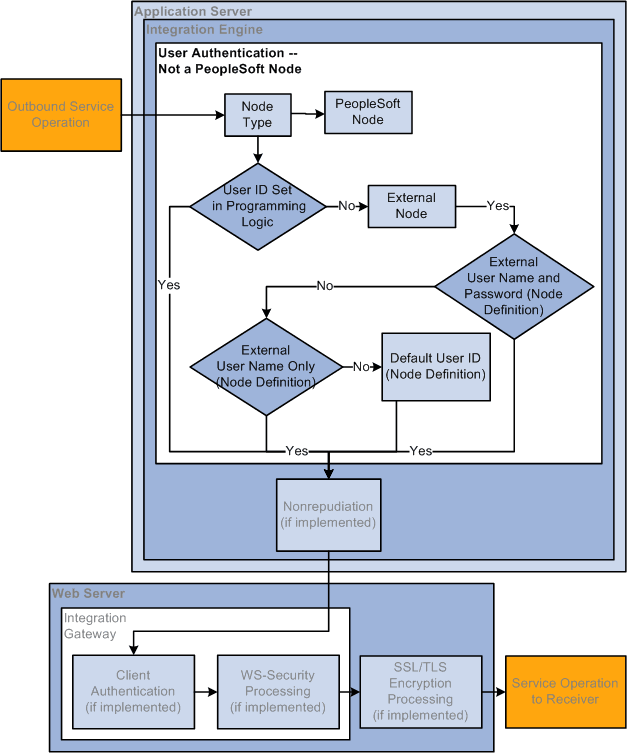
When the sending node is not a PeopleSoft node, the system first looks at the SOAP message associated with the service operation to see if an external user ID or external user ID and password have been provided programmatically in the outbound SOAP message header. If so, the system uses that user ID/password and the service operation passes user authentication.
If an external user ID or external user ID and password are not specified programmatically in the SOAP message header, the system looks on the external node definition for user ID and password information. The system first looks for user ID and password information in the External User ID and External Password fields on the Node Definition page. If no External User ID or no External User ID/External Password is set, the system uses the Default User ID set on the Node Definitions page.
To summarize, when the sending node is not a PeopleSoft node type, the system follows this precedence for setting the user ID in the outbound service operation:
-
User ID/password set in SOAP message header.
-
User ID and password set in External User ID and External Password fields on the local external node definition.
-
User ID set in the External User ID field on the local external node definition.
-
User ID set in the Default User ID field on the local external node definition.