Specifying Scroll Types
If an organization chart is larger than the viewable area, the user needs to scroll to view other areas of the chart. You can specify whether the organization chart will use scroll bars or alternative scrolling.
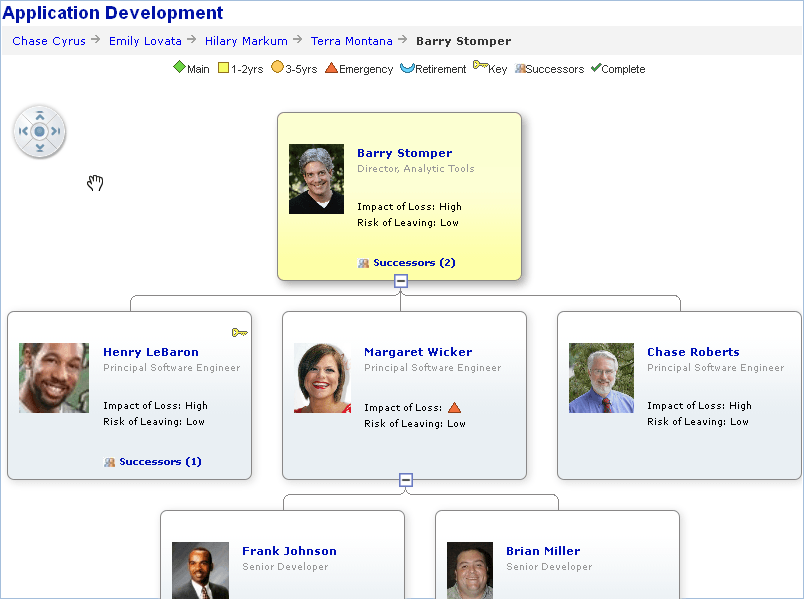
If you specify alternative scrolling, a scroll navigator and a hand cursor appear instead of vertical and horizontal scroll bars.
Note:
On an Apple iPad a user navigates using two fingers on a touch screen, so scroll bars, the scroll navigator, and mouse hand features are not displayed on an Apple iPad.
The arrows on the scroll navigator enable the user to quickly position the right, left, top, or bottom of the chart in the viewable area.
If the user scrolls the chart, the center button of the scroll navigator returns the chart to its initial display position. If the user changes focus by selecting a different node, the chart centers on that node. The center button then returns the chart to display centered on the focus node.
If alternative scrolling is implemented, the user can dismiss a drop-down menu only by clicking within the node areas in the chart unless no scrolling is needed, in which case the user can click on the background or on a node to dismiss the menu.
Note:
If the breadcrumbs and chart legend are so large that there is not sufficient room to display the scroll navigator in the upper left portion of the chart, it will appear in the lower left corner.
The hand cursor enables the user to grab the background of the chart and move it within the viewable area.
Note:
When using the hand cursor to scroll, you must position the hand cursor in the chart area outside the chart nodes and popup nodes. Scrolling does not work if the hand cursor is positioned within a chart node or pop-up node.
Use the ChartScrollType property: OrgChart class property to specify which type of scrolling to use. The default is scroll bars.