Administering OpenSearch Using the OpenSearch Interact Page

OpenSearch provides several REST APIs that can be used to obtain details of a cluster or index in the PeopleSoft implementation. In the absence of a default user interface to administer OpenSearch, PeopleSoft provides a user interface (called OpenSearch Interact) that enables you to choose the cluster and index level options on which you want to obtain information from the search engine. Based on the selected options, PeopleSoft Search Framework generates a URL, which is submitted to OpenSearch, and the response is displayed on the OpenSearch Interact page. The OpenSearch Interact page is accessible from the Search Instance Properties page, and it provides administration requests only for those cluster and index validations that are exposed by PeopleSoft.

Access the OpenSearch Interact page (PeopleTools, and then Search Framework, and then Search Admin Activity Guide, and then Configuration, and then Search Instance) by selecting an OpenSearch search instance, and then selecting the OpenSearch Interact link on the Search Instance Properties page.

This example illustrates the fields and controls on the OpenSearch Interact page (initial). You can find definitions for the fields and controls later on this page.
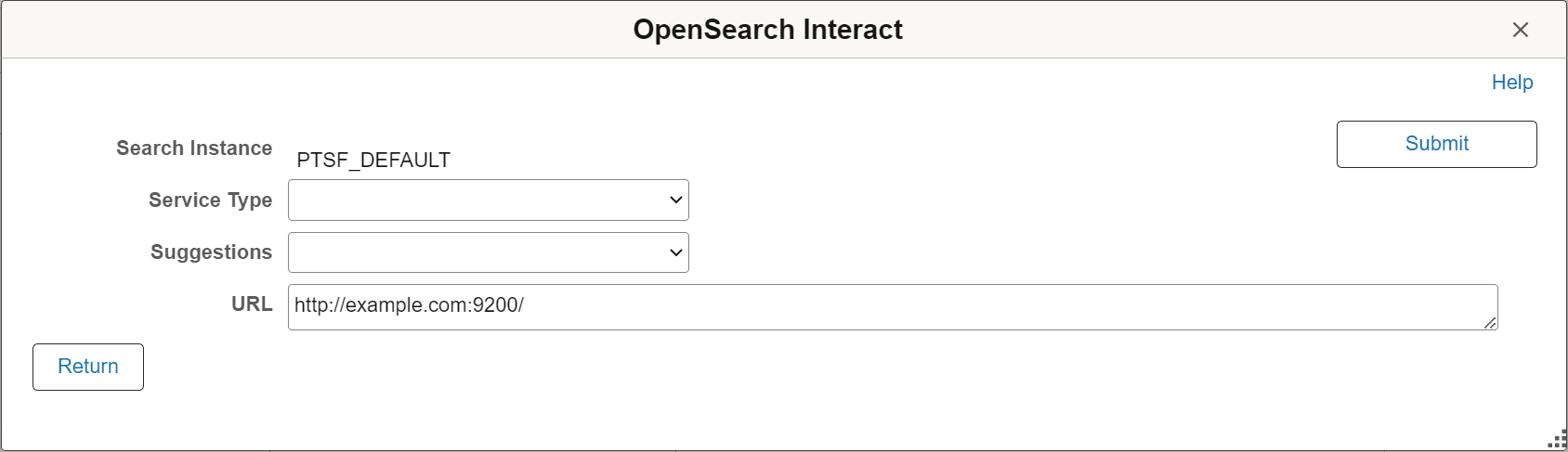
OpenSearch Interact page (initial)

This example illustrates the fields and controls on the OpenSearch Interact page after selecting an option from the Service Type drop-down list. You can find definitions for the fields and controls later on this page.
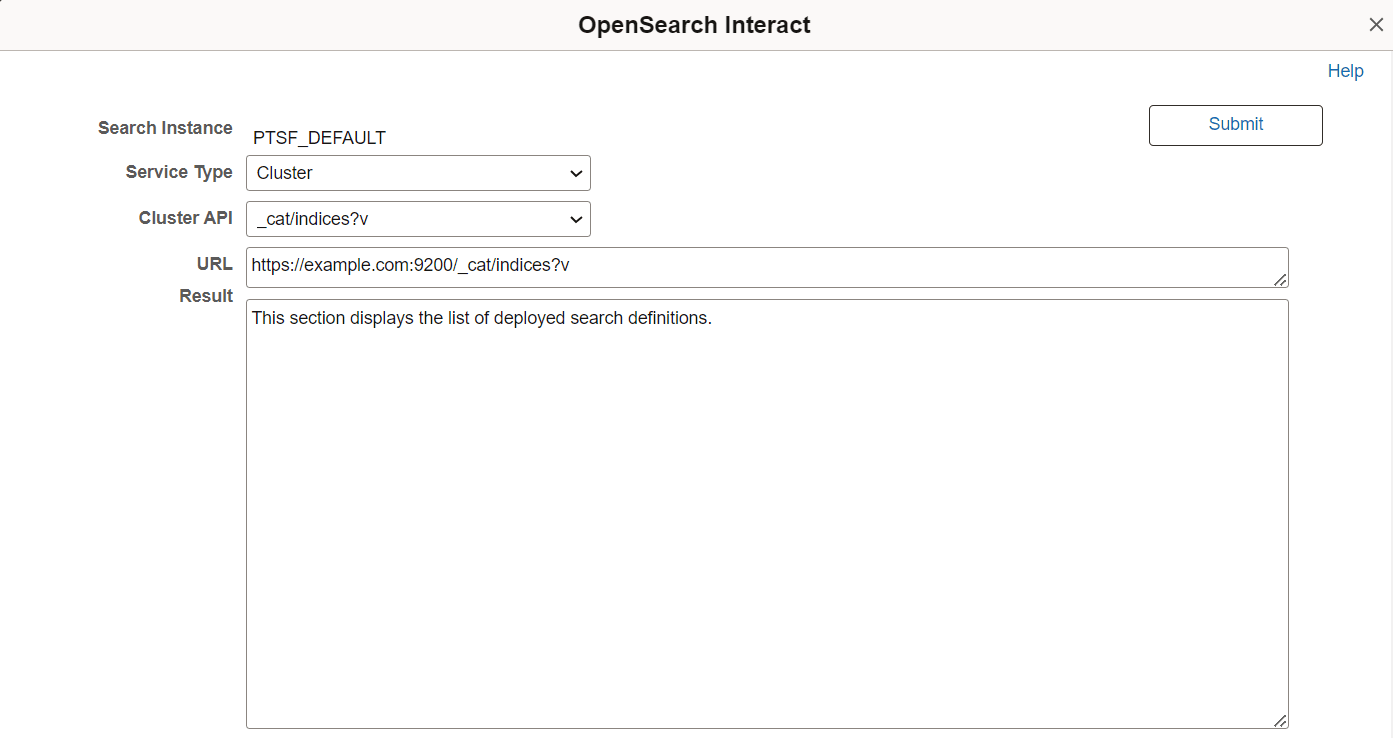
OpenSearch Interact page
Field or Control Description

Search Instance

The search instance name.

Service Type

Displays a list of service type groups.

The following service type groups are available:

  • Cluster - Use the Cluster service type to retrieve information related to the OpenSearch cluster.

  • Count - Use the Count service type to retrieve the number of indexed documents related to search definitions.

  • Mapping - Use the Mapping service type to retrieve the attribute mapping information related to search definitions.

  • Search - Use the Search service type to retrieve index-level information related to search categories.

Suggestions

The Suggestions field displays on the initial OpenSearch Interact page and it changes based on the service type you select.

The Suggestions field changes to the following:

  • When you select Cluster as service type, the Suggestions field changes to Cluster API, which provides cluster related options:

    • Aliases - provides information on currently configured aliases, which includes indices, filter, and routing information.

    • Allocation - provides a summary of the number of shards allocated to each data node and the disk space used.

    • Count - provides the document count of the entire cluster or individual indices. The document count includes only live documents, that is, the document count does not include deleted documents that have not yet been cleaned up by the merge process.

    • Health - provides the general health of a cluster. The information is similar to the cluster information when you select the /_cluster/health option.

    • Indices - provides a cross-section of each index, and it spans nodes.

    • Nodes - provides a topology of the cluster, which includes the OpenSearch version, JVM version, heap, memory, load, uptime of a node, etc.

    • Plug ins - provides a list of running plug-ins in each node.

    • Shards - provides a detailed view of shards in a node. The detailed information includes whether its a primary or replica, the number of documents, the size of the shard in bytes, etc.

    • Cluster health - provides the general health of a cluster. It uses the color codes of green, yellow, and red.

      For a description of the color codes used for cluster health in OpenSearch, see Verifying the Cluster and its Nodes.

    • Cluster statistics - provides cluster-wide statistics. The statistics include basic index metric (such as shard numbers, store size, memory usage) and information about the current nodes that form the cluster (such as number of nodes, roles, operating system, JVM versions, memory usage, CPU, and installed plugins).

    • Nodes statistics - provides statistics of all nodes in a cluster. By default, all statistics of a node are displayed.

  • When you select Count or Mapping as service type, the Suggestions field changes to Search Definition, which provides a list of deployed search definitions in the search instance.

  • When you select Search as service type, the Suggestions field changes to Search Category, which provides a list of deployed search categories in the search instance.

Method

The Method field is displayed when the service type is Search. Choose the type of HTTP request that needs to be issued to the search server.

Valid options are:

  • GET

  • POST

URL

The URL is automatically formed based on the selected options. For example, if you select Cluster as service type and select cat/indices as the cluster API, the URL is automatically formed:

http://example.com:9200/_cat/indices?v

Note: The URL cannot be modified. To modify the URL, you need to change the options you have selected.

Body

The Body field appears when you select POST as a method. This field must contain a JSON request.

The contents of the Body field are passed along with the request to the search engine.

Result

The Result area displays the response from the search engine for each request. PeopleSoft Search Framework displays the response from the search engine as is.