Physically Separate Server Configuration
A physically separate server configuration means that the web server, application server, and database serer each reside on separate machines. The following diagram depicts a physically separate server configuration:
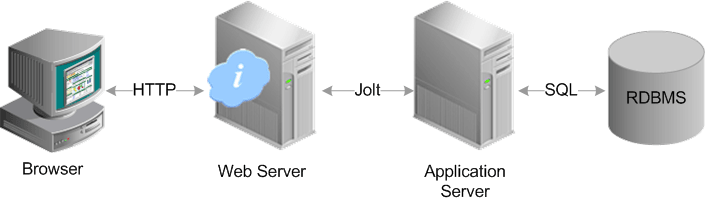
If the application server and database server don't reside on the same machine, then the application server and the database server should be connected to the same high-performance, backbone network. This ensures optimum performance.
Regarding performance, one advantage to keeping the architecture elements separate is that as demand on your system increases, you can add more server machines at each 'tier' to house more application servers or web servers in a modular fashion. If the server elements are installed onto a single machine, your options of increasing system performance are limited by the resources of that machine.
The following diagram illustrates how you can add multiple web servers and application servers when increased demand has pushed previous hardware to its limits.
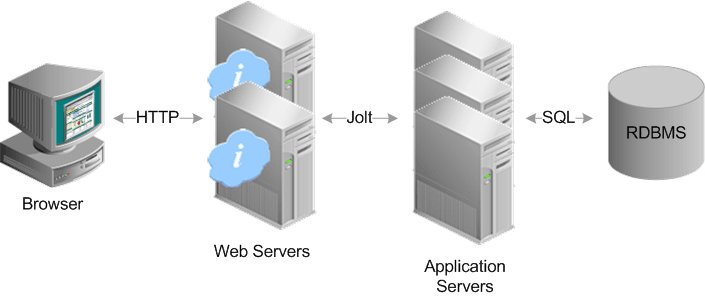
Within a PeopleSoft system, you can configure multiple PeopleSoft Internet Architecture installations on a web server as well as configure multiple domains on a single application server machine. If you reach the resource limits of a single server machine, you can incorporate more server machines to house additional PeopleSoft Internet Architecture installations or application server domains. Incorporating multiple, physically separate server machines provides increased:
-
scalability
-
fail-over
-
availability