Understanding Standard Detail Trees
In the most basic type of tree, the lowest level – that is, the level farthest to the right in the tree – holds detail values. The next level is made up of tree nodes that group together the detail values, and each subsequent level defines a higher-level grouping of the tree nodes. This kind of tree is called a detail tree.
In a detail tree, the lowest level in the hierarchy consists of the detail values, which are represented by leaves; (these trees are sometimes called summer trees.) You can use a detail tree to represent account hierarchies, product hierarchies, business unit hierarchies, and so on.
Detail trees are used most often for nVision reporting from the General Ledger.
This example illustrates a detail tree.
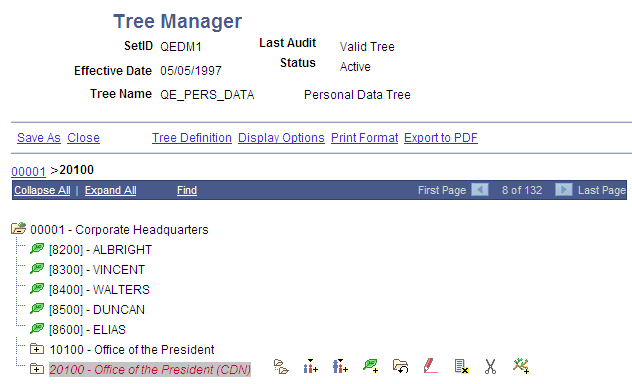
In this example, the Corporate Headquarters node is at the highest level and it has details such as Albright, Vincent, Walters, and so on. These details are at the lowest level of hierarchy and in this case denote individual employees in the Corporate Headquarters. Apart from details, this tree also has nodes such as Office of the President and Office of the President (CDN), which itself contains details.