Use the Delimited Document Standard

You can create customized document definitions using the Delimited document standard in B2B for Oracle Integration.

Note:

You must first create a Delimited schema before you can create a document definition that uses the Delimited standard. See Create a New B2B Schema.
  1. Create a document.

    Note:

    The Delimited document standard is supported in both B2B trading partner mode and B2B standalone mode.
    1. To create a document in a project in B2B trading partner mode.
      1. In the navigation pane, click Projects.
      2. Click the project in which to create the document.
      3. Click B2B B2B icon.
      4. In the Documents section, click Add.
    2. To create a document in B2B standalone mode.
      1. In the navigation pane, click B2B, then Documents.
      2. On the Documents page, click Create.
  2. In the Create document pane, enter the following details.
    Element Description
    Name Enter a document name.
    Identifier This field is automatically populated with the document name. You can manually change this value.
    Description Enter an optional description of the customization details for this document.
    Use a shared document

    Select to use a shared document. Selecting this option enables a Shared document list to be displayed for you to select the shared document to use. Shared documents only available in a different project are displayed. Documents created in a standalone environment (that is, outside a project) are not available for selection.

    After creation, an Override label appears below the document name in the Documents section to indicate that it is shared.

    To understand how shared documents work, see What's Supported in Projects for B2B.

    Note:

    This option is only available within projects in B2B trading partner mode. It is not supported in B2B standalone mode.
    Available to other projects

    Select to make this document available for use in other projects.

    After creation, a Shared label appears below the document name in the Documents section to indicate that it is available for use in other projects.

    Note:

    Before you make the document available to other projects, ensure that the document uses a shared schema. For details on how to create a shared schema, see Create a New B2B Schema.

    Note:

    This option is only available within projects in B2B trading partner mode. It is not supported in B2B standalone mode.
    Document standard Select Delimited from the drop-down list.
    Document version

    Manually enter a new value or select an existing value from the drop-down list.

    Document type

    Manually enter a new value or select an existing value from the drop-down list.

    Document schema

    Select an existing delimited schema. If a delimited schema does not exist, you cannot create a document definition. See Create a New B2B Schema.

  3. Click Create.

    The document details page for your new B2B document using the Delimited standard is displayed.
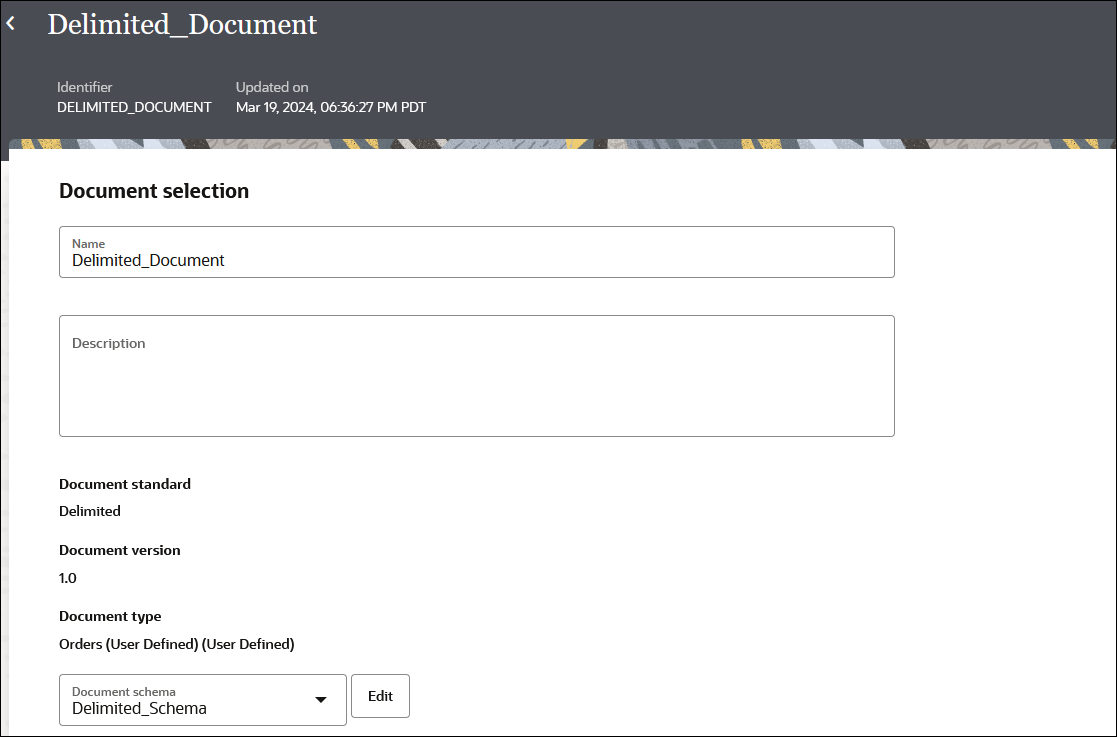

    The page shows the Identifier and Updated by labels at the top. In the Document Selection section are fields for Name and Description. Below this are the values selected for Document standard, Document version, and Document type. Below this is a list for Document schema and the Edit button.

  4. If you want to use a different document schema, select an existing schema from the Document schema drop-down list or click Edit to upload a new schema file.

    You can also define document properties for the schema.

  5. In the Document property section, define document properties for the schema.
    1. Expand Business identifiers, and add at least one identifier (primary). You can also add a second and third identifier to associate with this document. The business identifier names and expressions enable filtering by the identifiers on the Instances page when this document is sent or received.
    2. In the Expression field, click to select a business identifier expression path.
    3. Expand Translation identifier, and select an element and identification value. This identifier is used to identify the document at runtime.
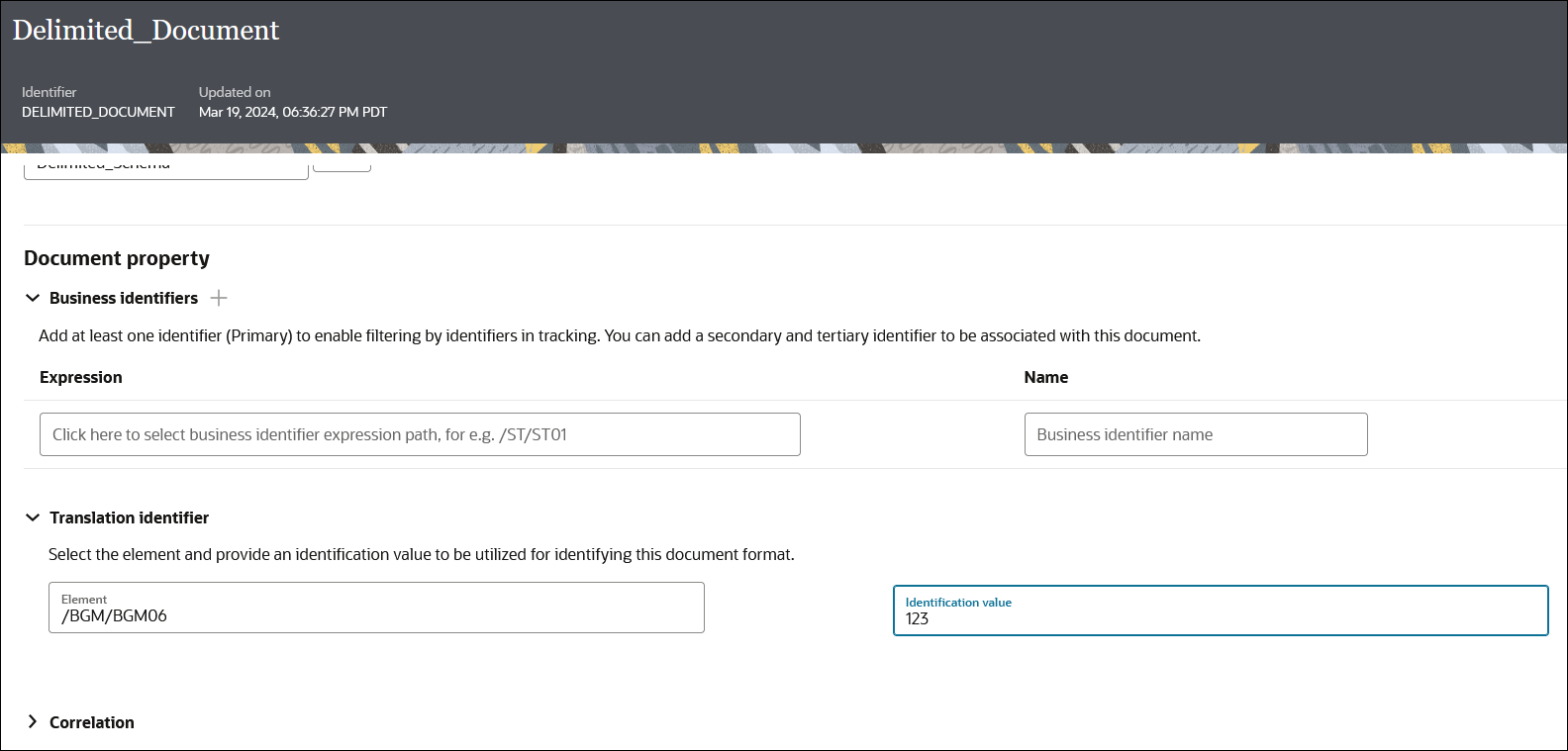

      The Document property section is shown. This section includes the Business Identifiers subsection, with fields for Expression and Name. Below this is the Translation Identifier subsection, with fields for Element and Identifier type. Below this is the Correlation subsection.

    4. Expand Correlation, and select either Correlation from or Correlation to from the drop-down list. Enter an XPath name, and then enter a XPath expression. These values enable you to correlate related documents in business transactions.

      You can only select one option: Correlation from or Correlation to.

      • The Correlation from XPath retrieves the value from the payload to initiate the correlation.
      • The Correlation to XPath retrieves the value from the payload for correlation.
  6. Click Save.