Save Form Input File
This file, referenced in requirement.csv to support the saving of forms,
includes POV, and cell input values in the following format. If business rules are
associated with the form, this file also includes the runtime prompts for those business
rules.
A sample input file:
pov=[DIM 1:MEMBER1],[DIM 2:MEMBER2],[DIM 3:MEMBER3],…;cells=[CELL COLUMN HEADER 1->CELL COLUMN HEADER 2->CELL COLUMN HEADER 3->..|CELL ROW HEADER 1-> CELL ROW HEADER 2->CELL ROW HEADER 3->..|CELL 1 DATA],[CELL COLUMN HEADER 11->CELL COLUMN HEADER 22->CELL COLUMN HEADER 33->..|CELL ROW HEADER 11->CELL ROW HEADER 22->CELL ROW HEADER 33->..|CELL 2 DATA];rtp=[BUSINESS RULE NAME1[RTP1:VALUE1][RTP2:VALUE2]],[BUSINESS RULENAME2[RTP3:VALUE3,VALUE4,VALUE5]]..In this example:
- DIM indicates the name of a dimension and MEMBER indicates a dimension member value.
- CELL COLUMN HEADER identifies the name of the column header and CELL ROW HEADER identifies the name of a row header.
- BUSINESS RULE NAME indicates the name of the business rule, RTP indicates the runtime prompt name, and VALUE indicates its value. RTP VALUE can take more than one value separated by comma. RTP is not required if no business rule is associated with the form or if you want to use the default runtime prompt value present in the form.
For example:
pov=[Version View:Working],[Sales Entity:International Sales];cells=[FY16->x---------x->Pct|P293:Maintenance->4120:Support|1];rtp=[Services Revenue - Forecast[Department:000,001,002][Scenario:Plan]],[Allocate Plan Targets[TargetVersion:Baseline]]Note:
You must also createUserVarMemberMapping.csv if the forms you
specify in requirement.csv require user variables to be set. See Creating the UserVarMemberMapping.csv File.
Smart Pushes, if any, associated with the form run automatically.
Guidelines
- If the form uses user variables, provide
povtag value in the formatpov=[USER VARIABLE 1:MEMBER 1],,and so on. You can use this format also in the run-time prompts of the business rules attached to the form; for example,rtp=[BUSINESS RULE NAME1[USER VARIABLE 1:MEMBER 1] [USER VARIABLE 2:MEMBER 2]...],,. - If the form uses user variables and you want to substitute member names
dynamically from user variable member mapping, use the substitution symbol
&as the prefix to the user variable name. Provide thepovtag value in the formatpov=[USER VARIABLE 1:&USER VARIABLE 1],,and so on. You can use this format also in the run-time prompts of the business rules attached to the form; for example,rtp=[BUSINESS RULE NAME1[[USER VARIABLE 1:&USER VARIABLE 1][USER VARIABLE 2:&USER VARIABLE 2]...],,and so on. - The
povtag in input file should contain only the dimensions and user variables that are selectable. In the following example, because Forecast and Units are not selectable, you should exclude them from thepovtag; for example,pov=[Entity:Sales East Region],[Version View:Working],[ProductFamily:Computer Equipments];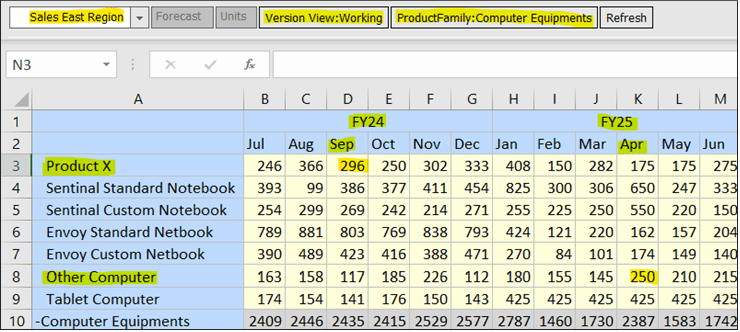
- Open the form in Oracle Smart View for Office and
copy the cell column headers and row headers into the
cellstag. This tag must contain values exactly as displayed in Smart View regardless of how they appear in the application screen.If hidden rows or columns are present in the form in Smart View, unhide them before copying the headers. Provide all the column headers and row headers, including values in hidden rows and columns, to reach the cell. In the preceding example, if the target cells are D3 and K8, the cells tag should be
cells=[FY24->Sep|Product X|296],[FY25->Apr|Other
                            Computer|250];
Note:
Cell definition is optional. If cell definition is not included, the command saves the form for the selected POV without updating any cells. - If none of the dimension or user variable is selectable in the form, a blank POV
tag (for example,
pov=[];) is required. - The
cellstag is not required if cells are not to be updated as part of Save form operation. - The
rtptag is not required in these situations:- No business rule is associated with the form
- You want to use the default runtime prompt values present in the form