Overview of Data Model
The data model in Policy Modeling consists of the entities, relationships and attributes that make up the project.
For example, a data model could have:
- entities: Global, the school, the child, the activity
- attributes for each entity:
- Global attributes: the date of assessment, the family's income
- attributes for the school: the school's type, the school's website
- attributes for the child: the child's age, the child's student ID
- attributes for the activity: the cost of the activity, the type of activity
- relationships between the entities:
- one-to-many relationship from the Global to the school entity: all instances of the school
- one-to-many relationship from the Global to the child entity: all instances of the child
- one-to-many relationship from the Global to the activity entity: all instances of the activity
- many-to-one relationship from the child entity to the school entity: the child's school
- many-to-many relationship between the child entity and the activity entity: the child's activities
- one-to-one relationship between the child entity and the child entity: the child's twin
This would be represented in a data model diagram as shown below.
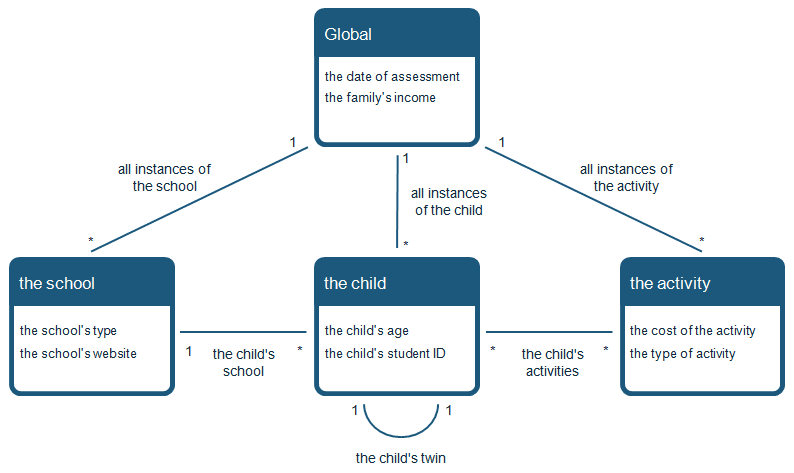
In data model diagrams:
- the boxes represent the entities,
- the lines represent the relationships between the entities
- * represents a many-relationship type