Cash Processing Agent for Receipt Processing and Cash Application
The Cash Processing Agent improves cash processing exception handling and increases cash application matching accuracy. It combines AI-assisted cash processing automation with guided insights to help users identify and resolve exceptions more efficiently.
In an earlier release, Document IO, Oracle's GenAI-powered document ingestion capability, introduced automated ingestion of bank files and remittance advices from customer emails, extracting enriched data to create receipts and match them to invoices.
In this release, the Cash Processing Agent builds on those capabilities by surfacing receipt creation and cash application exceptions in a unified conversational experience. Users can focus on the exceptions that matter most, use natural language inquiries to explore supporting details, and take guided actions with user confirmation actions to resolve issues more quickly.
The following sections describe how the agent delivers these business outcomes.
Cash Processing Agent Overview
- The Overview page provides a centralized starting point to review and take action on Receipts and Cash Application open issues using insights and natural language questions and prompts. Users can switch between the Receipts and Cash Application contexts:
- The Receipts context covers receipt exploration and receipt creation exceptions for Bank Statement and Lockbox. It also supports resolving remittance advice data after ingestion.
- The Cash Application context covers unidentified and unapplied receipt investigation, open invoices, open promise-to-pay commitments, remittance information review, and the user-confirmed Apply Receipt flow.
- Enables users to interact through Ask Oracle by selecting context-aware, predefined prompt suggestions with adjustable values or by entering natural language questions.
- Provides navigation links from receipt creation exceptions to source-specific correction paths.
- Helps users move from issue awareness to review and follow-up without manually switching between multiple payment pages and transaction views.
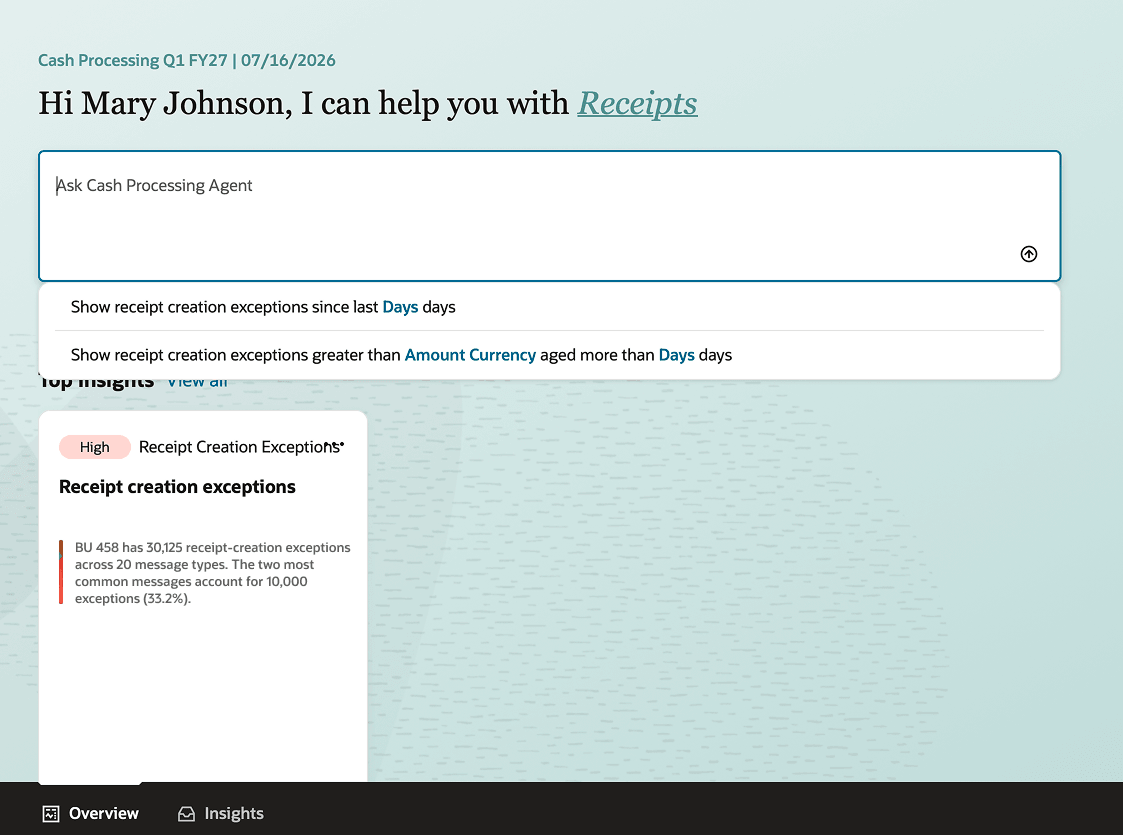
Users can choose from predefined prompts for frequent quick queries and see insights for Receipts context
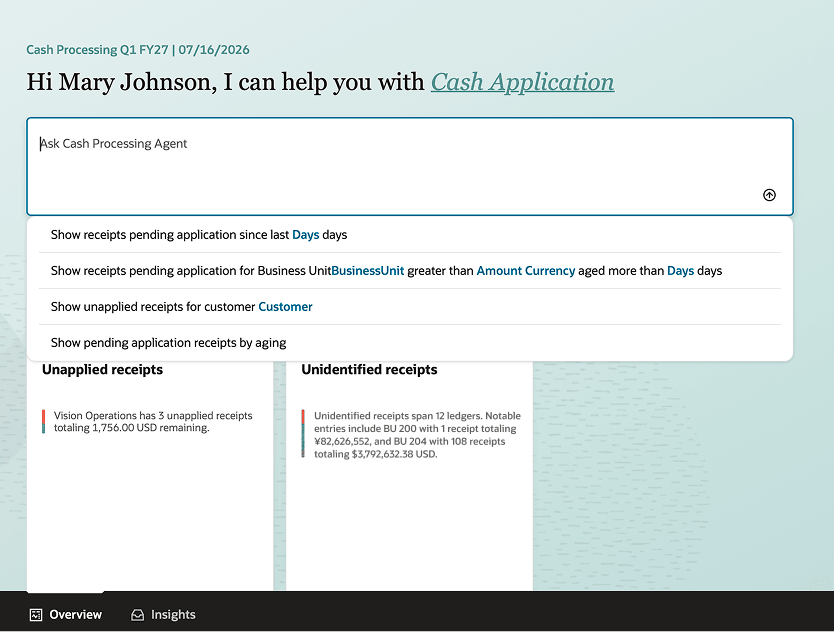
Users can choose from predefined prompts for frequent quick queries and see insights for Cash Application context
Receipts
- Quickly identify receipt creation and remittance advice exceptions from Overview page insights or by using predefined prompts and natural language questions.
- Use the conversational chat experience to explore file ingestion, receipt creation, and remittance advice exceptions. Review supporting details such as:
- Bank, source document, statement line, remittance reference, receipt method, and exception reason.
- Processing status and exception summaries at the document level.
- Maintain conversational context throughout the interaction. For example, if you ask for receipt creation exceptions associated with a specific document, the agent returns the related details, including the source file, impacted amount, and exception reason.
- Receive context-aware recommendations for the next best actions, including a direct link to the correction flow where you can review exception details and take corrective action.
- In the correction flow, search for the relevant batch using the batch number provided in the chat
- Enter the valid missing value and submit the correction job through upload from the spreadsheet.
- After the correction process is complete, recheck the receipt batch to confirm that the exception no longer appears.
Cash Application
- Quickly find unidentified and unapplied receipts from Overview page insights or through predefined or ad hoc prompts that identify receipts requiring resolution.
- In the conversational chat experience, explore supporting details to resolve cash application issues. Ask natural language questions to identify potential customers or matching invoices, and search across:
- Receipt source information, such as payment channel, bank, originator name, wire number, and related details.
- Remittances that have not been matched to receipts, filtered by amount, date, currency, or customer, to determine whether they correspond to the receipt.
- Open invoices, including whether any invoices are currently in dispute.
- Open or past promise-to-pay commitments.
- Receipt activity, including previous applications, partial applications, or unapplied receipts.
- Maintain conversational context throughout the interaction. For example, if you search for a receipt associated with a customer and then ask, "Show me all open invoices," the agent displays the open invoices for that customer.
- Receive context-aware recommendations for the next best actions to support further review and cash application.
- The agent applies the receipt to an invoice after receiving user confirmation.
Insights
- Users can review all Receipts and Cash Application insights in one place on the Insights page, making it easier to prioritize actions across contexts.
- The page surfaces receipt creation exceptions, unidentified receipts, and unapplied receipts, helping users quickly identify delayed, incomplete, or high-value items that require attention.
- Users can open any insight and continue the investigation through the conversational experience, review contextual details, and take supported actions.
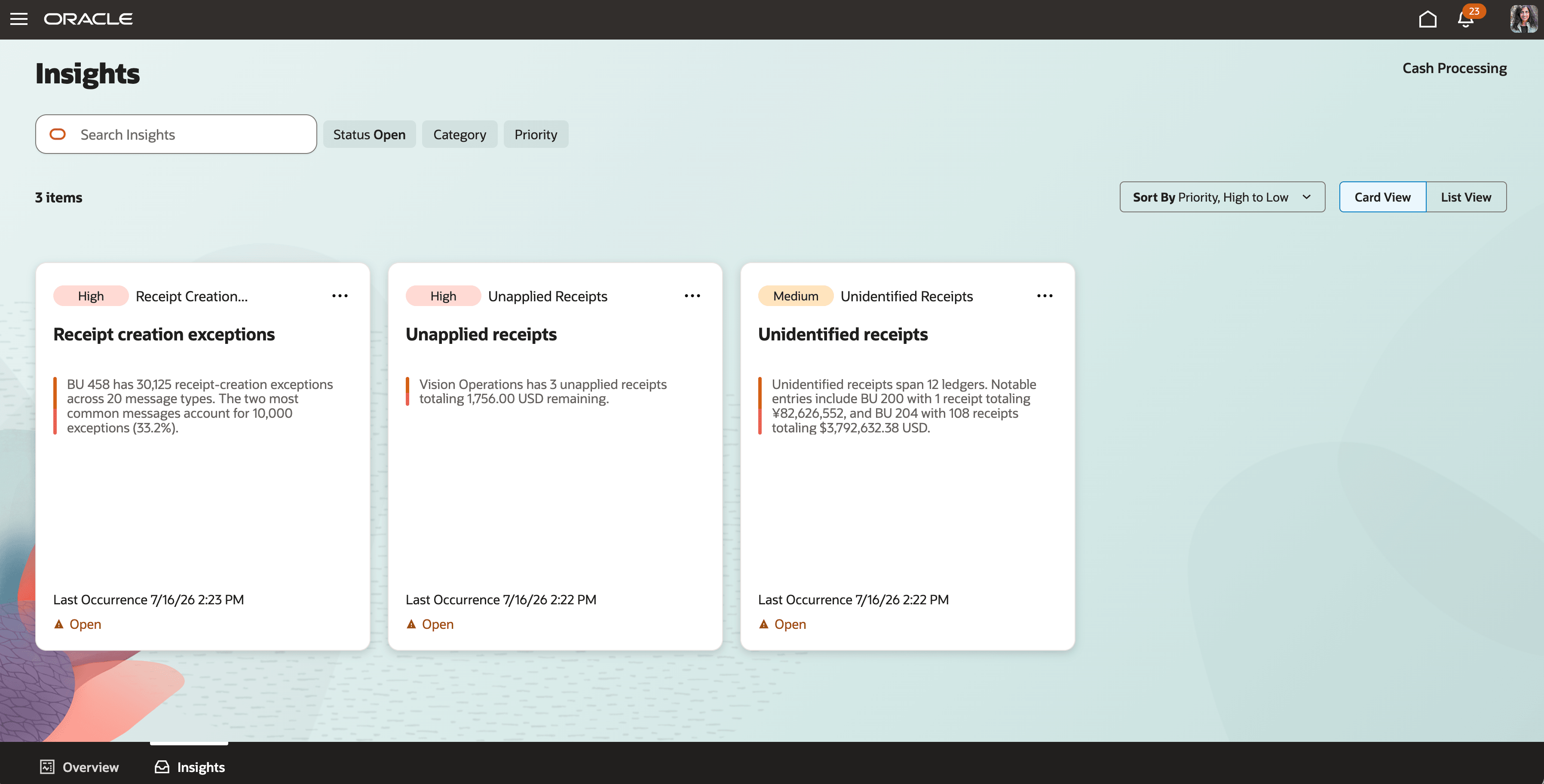
Users can review all insights in one place
Key benefits include:
- Accelerates cash application by helping users identify and resolve unapplied and unidentified receipts more quickly, reducing the time spent researching receipt and invoice information across multiple work areas.
- Improves visibility into receipt processing and cash application by surfacing processing exceptions, unapplied receipts, and application opportunities earlier. This enables teams to address issues before they affect cash application performance.
- Reduces manual effort and context switching by bringing conversational inquiry, actionable insights, guided investigations, and transaction-level follow-up actions into a unified experience.
- Maintains controlled and auditable processing by enforcing existing Receivables validations, authorizations, segregation-of-duties controls, and audit requirements for all actions performed through the agent.
Steps to enable and configure
- The Cash Processing Agent is enabled by default.
- Configure the required security access described in the Access Requirements section so users can access the Cash Processing Agent from the new navigation menu entry.
- No additional enablement is required to automate the ingestion of bank files and remittance advice from customer emails through the Document IO Agent.
- For completeness, the following steps describe how to configure the Receipt Creation from Bank Statement feature delivered in an earlier release:
Enable Receipt Creation from Bank Statements
- Go to Setup and Maintenance > Manage Bank Accounts.
- Select the bank account you want to configure.
- On the Controls tab, enable Create Receipts from Bank Statement.
- Define the Receipt Creation Start Date. You can set the date up to 30 days earlier.
- Set the Default Receipt Method. Select a specific receipt method or use ORA_Bank Statement.
Configure Receipt Methods for receipts created from bank statement lines
- Go to: Setup and Maintenance > Manage Receipt Classes and Methods.
- Verify that the receipt methods used for this feature are correctly configured and associated with the relevant bank accounts and business units.
- Select the receipt method to use for receipts created from bank statements. You can use the predefined receipt method: ORA_Bank Statement or use receipt methods that meet your business requirements.
Tips and considerations
- Existing classic ADF receipt pages remain available for detailed receipt processing, application, and review when users need capabilities outside the Cash Processing Agent.
- Remittance advice can be ingested from PDF files, email bodies, and image files. Configure email-forwarding rules to route remittance advice documents from corporate email accounts to the provisioned pod email address, reducing the need for manual forwarding. To copy the provisioned pod email address, navigate to Cash Processing Agent > Take Me to Receipt Document Processing > View Email > Copy Email.
- Schedule Apply Receipts Using AutoMatch with Include Remittance set to Yes so the extracted remittance advices can be evaluated for matching to corresponding receipts as they become available. Automated matching is supported even when the remittance advice is ingested before the receipt creation.
- For ad hoc natural language prompts, the data query uses the period specified by the user. For predefined prompts with no user-provided input, the default period is applied.
Key resources
Oracle Help Center: Cash Processing from Bank Statements and Remittance Advices
Oracle Help Center: Get Started with AI Agent Studio
Oracle Help Center: Security Reference for Financials: Receivables and cash processing duties and privileges
Oracle Help Center: REST API documentation for Receivables
Access requirements
The Cash Processing Agent is secured through assistant duty roles inherited by four Oracle-provided SAS-enabled Receivables job roles. Access to each context is controlled by the corresponding assistant duty role and, where applicable, the context intent privilege. Administrators must also enable permission groups in the Security Console.
| Predefined Job Role | Role Code |
|---|---|
|
Accounts Receivable Specialist |
ORA_AR_ACCOUNTS_RECEIVABLE_SPECIALIST_JOB |
|
Accounts Receivable Specialist Segregated Role |
ORA_AR_ACCOUNTS_RECEIVABLE_SPECIALIST_SOD_JOB |
|
Accounts Receivable Manager |
ORA_AR_ACCOUNTS_RECEIVABLE_MANAGER_JOB |
|
Accounts Receivable Manager Segregated Role |
ORA_AR_ACCOUNTS_RECEIVABLE_MANAGER_SOD_JOB |
| Assistant Duty Role | Role Code | Access Controlled |
|---|---|---|
|
Cash Receipt Generation Assistant Duty |
ORA_AR_CASH_RECEIPT_GENERATION_ASSISTANT_DUTY |
Receipt context and receipt creation exception insights (AR_RECEIPTS_INTENT_PRIV) |
|
Cash Application Assistant Duty |
ORA_AR_CASH_APPLICATION_ASSISTANT_DUTY |
Cash Application context, cash application insights, and Apply Receipt (AR_CASH_APPLICATION_INTENT_PRIV) |
|
Cash Receipts Inquiry Assistant Duty |
ORA_AR_CASH_RECEIPTS_INQUIRY_ASSISTANT_DUTY |
Supporting receipt inquiry access |
| Cash Processing Agent Insights Duty | ORA_AR_CASH_PROCESSING_INSIGHTS_DUTY | Cash Processing Agent insights |
Scenario 1 — If You Have Implemented Custom Job Roles
Use these steps for users who are not assigned one of the Oracle-provided predefined Receivables job roles listed above. To enable access, create or update a custom role with the required assistant duty role.
1. Navigate to the Security Console.
2. Search for the custom job role you want to use.
3. Click Edit Role.
4. Select Enable Permission Groups.
5. Save your changes.
6. Navigate to Role Hierarchy > Roles and Privileges.
7. Add the appropriate assistant duty role: Cash Receipt Generation Assistant Duty for the Receipt context, Cash Application Assistant Duty for the Cash Application context, and Cash Receipts Inquiry Assistant Duty for receipt inquiry access, Cash Processing Agent Insights Duty for insights, as required.
8. Navigate to Role Hierarchy > Roles and Permission Groups.
9. Add the same assistant duty role that you added in the previous step, including Cash Processing Agent Insights Duty if users need access to insights and save changes.
Scenario 2 — If You Have Used Oracle-Provided Predefined Job Roles
Use these steps for users assigned one of the Oracle-provided predefined Receivables job roles listed above. These users inherit the corresponding assistant duty roles through their predefined job role. Administrators must still enable permission groups.
1. Navigate to the Security Console.
2. Search for the applicable predefined job role, or the custom role derived from it.
3. Click Edit Role.
4. Select Enable Permission Groups.
5. Add Cash Processing Agent Insights Duty where users need access to insights and save changes.