Support for Percentage Sourced of Less Than 100%
This feature provides enhanced support for components sourced from multiple suppliers. You may have multiple sources for a component to ensure sufficient supply or to increase resilience in your supply chain when facing unexpected disruptions. Certain trade agreements allow for such scenarios to be managed accordingly.
One common approach is to calculate the proportion of each input source from the prior year and allocate that percentage to an item origin in GTM. Previously, you were required to enter a Percentage Sourced for all item origins, and the total had to sum to 100%.
With this enhancement, if you do not know the Percentage Sourced for all item origins, you may leave some values blank (null). GTM will treat unspecified item origins as non-originating.
For example:
If a component is 70% sourced from a specific supplier and the remaining 30% comes from other suppliers, you can specify only the 70% as originating. You do not need to list item origins for the remaining suppliers.
- If there are other item origins but their Percentage Sourced values are not specified, the remaining percentage will be divided equally among these item origins. In the qualification report, split components will be created for each item origin, and those components will be considered non-originating. In the example above, the remaining 30% would be split among the unspecified item origins and marked as non-originating.
- If there are no other item origins specified, the unspecified percentage is considered entirely non-originating. For example, if you specify 70% for certain item origins and do not specify the remaining 30%, the 30% will be treated as non-originating.
In this example, you are manufacturing an electric bicycle that includes brakes sourced from multiple suppliers:
- Tektro supplies 50% of the brake components from Puerto Rico.
- Spectris supplies 25% of the brake components from Mexico.
- The remaining 25% of the components come from various suppliers that are not specifically tracked.
With the enhanced GTM feature, you can specify the known percentages for Tektro and Spectris, and leave the remaining 25% unspecified. GTM will automatically treat this unspecified portion as non-originating.
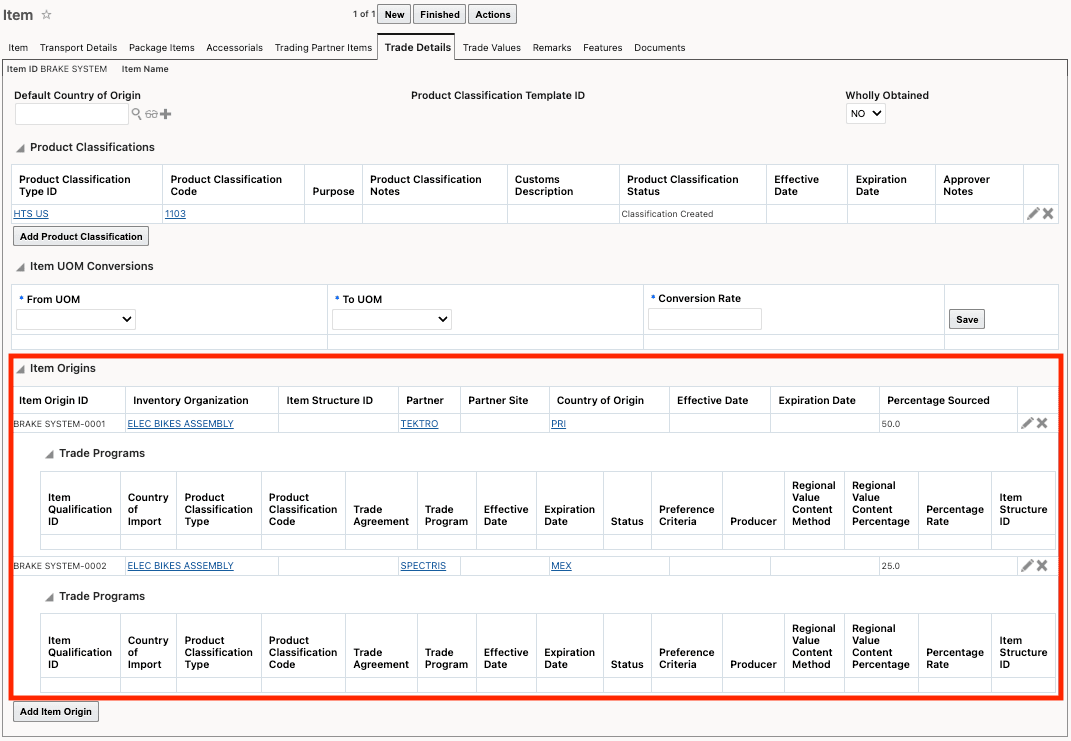
Item > Item Origins
When qualifying the finished good for a trade agreement, GTM uses the Percentage Sourced information to calculate the value of originating and non-originating materials. If the specified percentages do not total to a 100%, the remaining percentage is considered non-originating.
In this example, the qualification report for the BRAKE SYSTEM shows three rows:
- SNo 3 (SC-1): Represents 25% of the components from various untracked suppliers. This percentage is considered non-originating.
- SNo 3 (SC-2): Represents 50% of the components sourced from Puerto Rico. This percentage is considered originating.
- SNo 3 (SC-3): Represents 25% of the components sourced from Mexico. This percentage is considered originating.
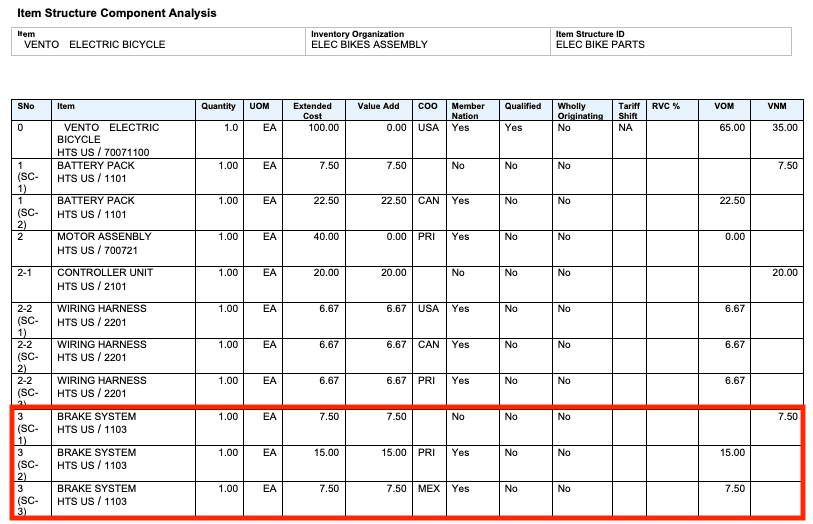
Qualification Report
Business Benefit: This feature enables you to leave the Percentage Sourced field blank on item origins. GTM will then automatically treat those unspecified portions as non-originating content. This streamlines trade compliance workflows, improves data accuracy, and allows organizations to respond more dynamically to changes or gaps in supplier data — helping them maintain compliance while managing a more resilient and responsive supply chain.
Steps to enable and configure
The following configuration is required to take advantage of this feature:
- Select the "Allow Prorate on Multi-Sourcing" checkbox on the Trade Agreement to indicate that the trade agreement supports multi-sourcing for fungible goods.
- Add the Percentage Sourced to your Item Origins (where known).
Tips and considerations
GTM does not calculate the percentage sourced from each location automatically. Instead, you must specify the percentage sourced for each supplier based on your own analysis. These specified values are then used by GTM to determine the Value of Originating Material and the Value of Non-originating Material for trade agreement calculations.