 Support Contract Manufacturing in Process Manufacturing
Process manufacturers increasingly rely on Contract Manufacturing (CM) partners - not only to leverage specialized skills and equipment, but also to gain additional capacity or cost advantages. However, this shift demands robust tools to execute, monitor, and control outsourced process manufacturing. Businesses require visibility, traceability, and quality assurance to prevent errors, ensure on-time delivery, and minimize supply chain disruptions.
Today, contract manufacturing is only supported for discrete manufacturing flows. Process industries must rely on workarounds or manual tracking to manage fully outsourced batch production, which leads to inefficiencies and poor visibility. Without native capabilities for outsourced manufacturing support with process manufacturing, organizations struggle to manage multi-output formulas, batch yields, and subcontractor collaboration effectively. This feature eliminates the need for manual coordination and enables end-to-end orchestration for fully outsourced process execution.
Some of the key features of this enhancement include:
- Enable contract manufacturing organizations for process manufacturing:
You can enable a Contract Manufacturing (CM) organization to support process manufacturing execution. This allows the CM organization to execute formula-based, multi-output batch production while participating in outsourced manufacturing flows.
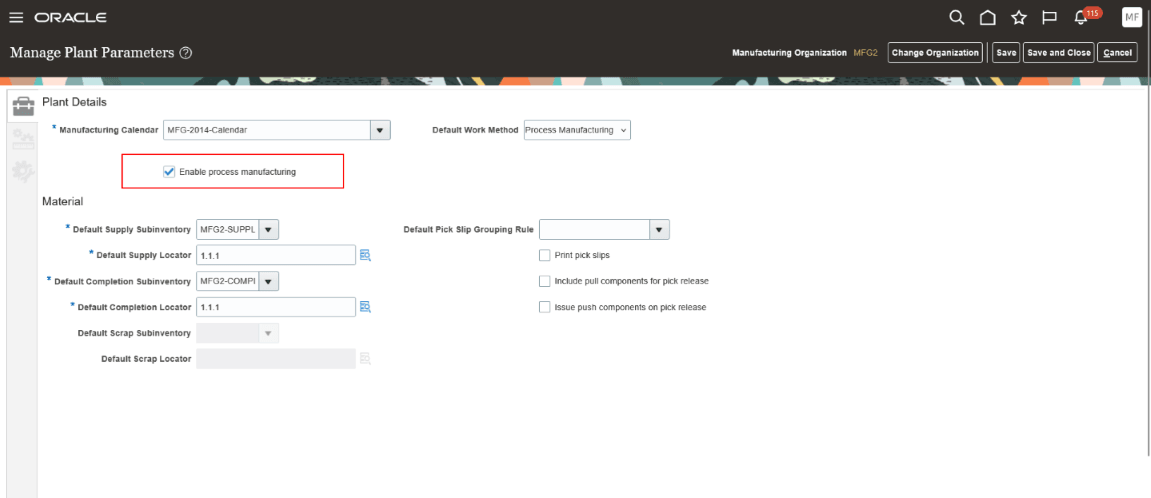
Manage Plant Parameters Page
- Define service items for contract manufacturing:
You can define service items to represent contract manufacturing services for process manufacturing. For process work methods, the service item quantity is mapped to the primary output quantity. You can specify a per-unit price on the blanket purchase agreement that represents the total contract manufacturing cost for the work order, including contract manufacturer services and ingredient handling, with appropriate consideration for co-products and by-products. - Define and share process work definitions for outsourced manufacturing:
You can define process manufacturing work definitions and share the correct formulas, operations, and outputs with the contract manufacturer. The service item quantity for process flows is mapped to the primary output quantity. You should ensure that the service item quantity and UOM are same as the primary product quantity and unit of measure to get the expected results.
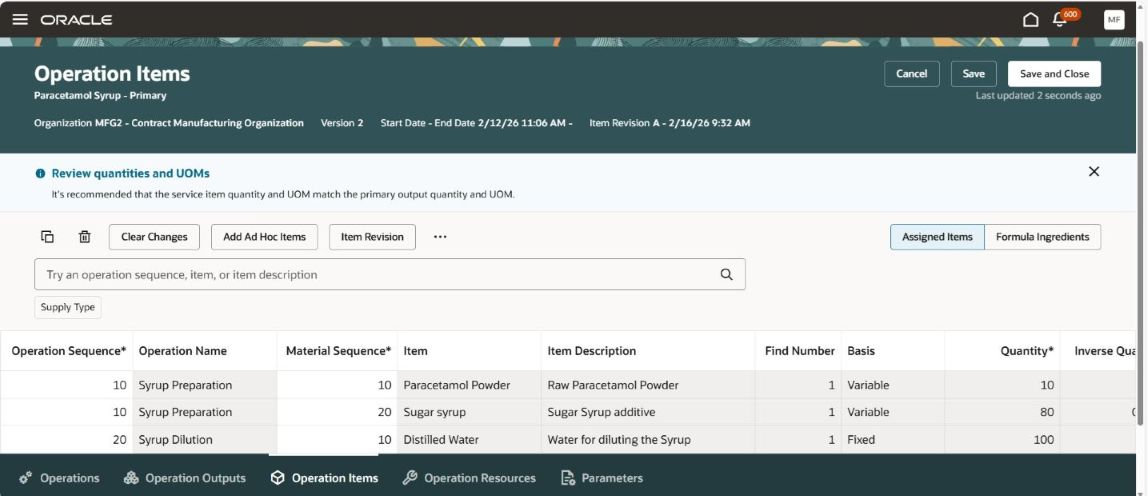
Process Manufacturing Work Definition in a Contract Manufacturing Organization
- Plan and release planned orders for primary product:
You can release planned orders for process manufacturing primary products to create service item purchase orders and contract manufacturing work orders in the contract manufacturing organization. This enables seamless orchestration of outsourced work orders while leveraging existing process work definitions and formulas. Service item purchase orders are automatically generated from the blanket purchase agreement, where the service quantity is derived from the primary product quantity.
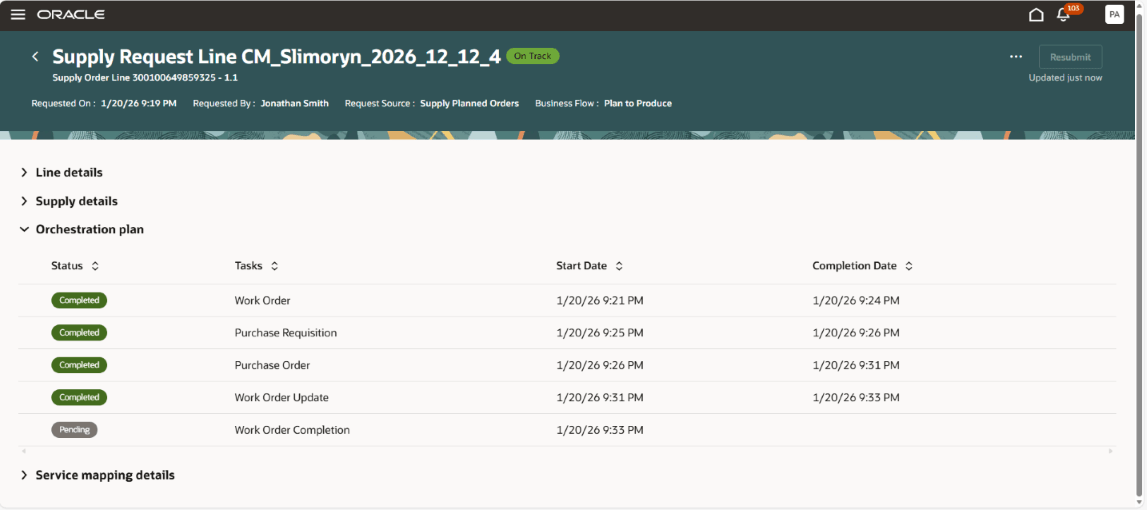
Orchestration of Purchase Order and Work Order for Process manufacturing
- Track outsourced production execution and progress:
You can now track production progress for outsourced work orders. The solution supports reporting of ingredients, co-products, and by-products across operations. The service item is automatically received and issued upon completion of the last operation of the work order. Reporting of the primary output defaults to automatic during work order creation to ensure that the service item and primary output quantities are always equal. You can adjust the batch completion quantity, co-products, by-products, and ingredients manually in proportion with the primary output completed.
Contract manufacturing in process industries provides several benefits:
- Improves visibility and control over outsourced process production
- Enables accurate costing, streamlined collaboration, and reduced manual effort in the process manufacturing
- Enhanced quality and compliance by ensuring correct process specifications are communicated to contract manufacturers
- Increased agility in fulfilling demand using external partners, enabling greater scalability and responsiveness
Here's the demo of these capabilities:
Steps to enable and configure
Create a contract manufacturing organization and make sure that the organization is enabled for contract manufacturing:
- In the Setup and Maintenance work area, search for, and select the Manage Inventory Organizations task.
- Select your organization and select Manage Organization Parameters.
- Ensure that the flag Organization represents a contract manufacturer is enabled.
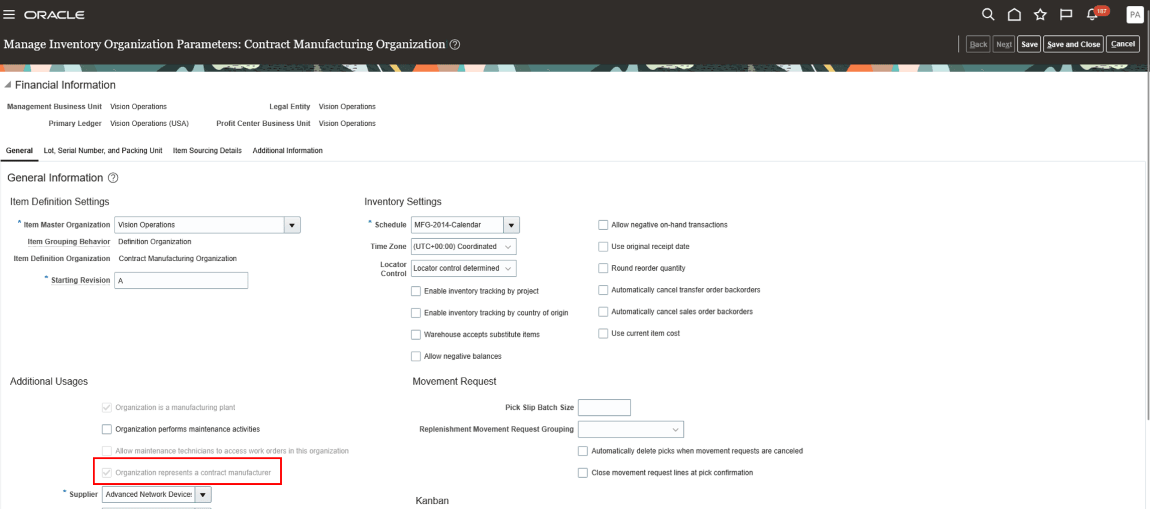
Manage Inventory Organization Parameters
Set up the plant parameters for the contract manufacturing organization to enable this feature:
- In the Setup and Maintenance work area, search for, and select the Manage Plant Parameters task.
- On the Manage Plant Parameters page, select the required inventory organization.
- In the Plant Details tab, select the Enable process manufacturing checkbox.
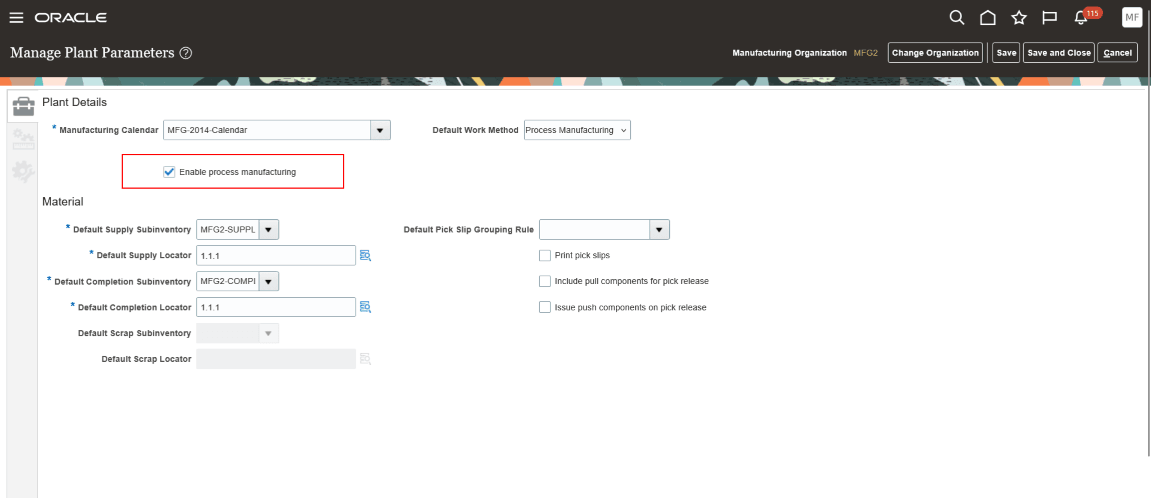
Manage Plant Parameters Page
Tips and considerations
- You can propagate quantity changes across purchase orders and work orders. The system validates changes based on production progress to ensure consistency and control throughout the outsourced manufacturing lifecycle.
- You can capture and allocate total outsourced production costs, including OEM-supplied ingredient costs and subcontracting service charges. Costs are allocated to primary products, co-products, and by-products based on defined allocation factors, ensuring accurate financial reporting.
- Contract manufacturing orchestration is supported only for primary products in process manufacturing work definitions. Co-products and by-products are supported as outputs but cannot independently drive contract manufacturing flows.
- Purchase Order for the service item is derived from the primary product quantity and unit of measure for the work order.
- Service item receipt is derived from the primary product quantity defined for the work order in proportion with the batch completed in the last operation. Service item component issue is derived from the service item quantity defined for the work order in proportion with the batch completed in the last operation. To ensure consistency, always keep the service item and primary output quantity same in the work order.
- Operation yield, parallel operations, intermediate quantity tracking, and reporting the same output in multiple operations are not supported for contract manufacturing.
- The contract manufacturing for process manufacturing is only supported for plan to produce flows. Back-to-back flows are not supported as a part of this feature.
- The contract manufacturing service item must have a supply type of Assembly Pull. It is also recommended that there should be only one service item for the work definition and consumed as such on the last count point operation of the work definition.
- The Contract Manufacturing flag in product information management must be selected for both the primary output and the service item. The item type for the primary output must be set to make.
- All other operation items on the work definition can only use the following supply types:
- Phantom, Assembly Pull, or Operation Pull for Original Equipment Manufacturer provided items.
- Supplier for Supplier provided items.
Key resources
- Oracle Fusion Cloud SCM: Implementing Manufacturing and Supply Chain Materials Management guide, available on the Oracle Help Center.
- Oracle Fusion Cloud SCM: Using Supply Chain Cost Management guide, available on the Oracle Help Center.
Access requirements
No new privileges are introduced as part of this feature. Users who are assigned a configured job role that contains privileges for process manufacturing, contract manufacturing, purchasing, inventory management, and cost accounting can access this feature.