 Delete Configuration Entities via a Batch Request
The existing Configuration Deletion portal is designed to discover the entities that should be deleted and allows for a manual selection of entities to be deleted. Neither option handles the use case where a large list of entities for deletion is known in advance (that is, does not need to be discovered nor manually selected, and the same list needs to be deleted in multiple environments).
The product now supports the ability to submit a request for deleting a pre-defined list of configuration entities in batch.
A new request type Delete Configuration Entities (F1-DeleteConfigEntitiesType) is introduced that allows the user to upload a list of entities from a CSV file onto a request record and submit the request for batch processing when ready. When processed in batch, the request deletes all the entities in the list as a single transaction.
The file with the entities to delete should be prepared with the following header columns: maintenance object, key1, key2, key3, key4, key5. You can add rows after the header row for each configuration entity to delete.
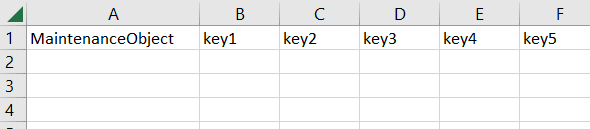
NOTES:
-
The file should be of a reasonable size to be uploaded online, which is assumed to be in the hundreds of entities. If the upload step times out, then use smaller files.
-
The deletion abides to the application's standard referential integrity rules. The same rules like deleting the entity online. This mean the order in the list should reflect data model relationship.
-
The deletion logic stops at the first error. It does not accumulate exceptions. The user needs to review the exception, correct the issue, and resubmit the request as needed.
Allowing configuration entities to be deleted in batch supports more customer business practices related to configuration data management.
Steps to enable and configure
Complete these steps to allow a user to submit a request for deleting configuration entities in batch:
- Provide access to the application service Delete Configuration Entities BO (F1CFGDEL-REQB) required for creating the deletion request.
- Provide access to the application service of the existing Request portal, if the user does not already have it.
- Provide access to the application service F1SUBRQN that secures the submission of the batch job that processes the request.