About Task States and Transitions
Learn about the task lifecycle in the Oracle APEX approval component.
The task lifecycle is the path a task takes from the time the task is created to the time that the task is complete. There are three lifecycle stages: Initial , when a task is created, Intermediate , as the task moves through various states, and Final , when a task is complete.
A state is the current location of the task in the task lifecycle. A transition refers to the movement of a task between states. Transitions can occur as part of the normal task lifecycle, or they can occur due to an exception or a user interruption.
An errored state occurs when there is a non-recoverable error during the execution of the task, including:
-
an underlying database error
-
a code bug
-
an invalid Task Definition
-
an error during execution of the action specified for the Task Definition
An errored tasks raises a task lifecycle event with the event type fail. This makes the errored transition actionable through task actions, similar to other lifecycle transitions.
A canceled state occurs when the initiator or the business administrator of the task explicitly cancels the task.
An expired state occurs when the due date for an incomplete task arrives and the task does not have a renewal policy or the maximum number of renewals has already been reached.
Task states and possible transitions are available in the following diagram, or in the Table 20-1 table.
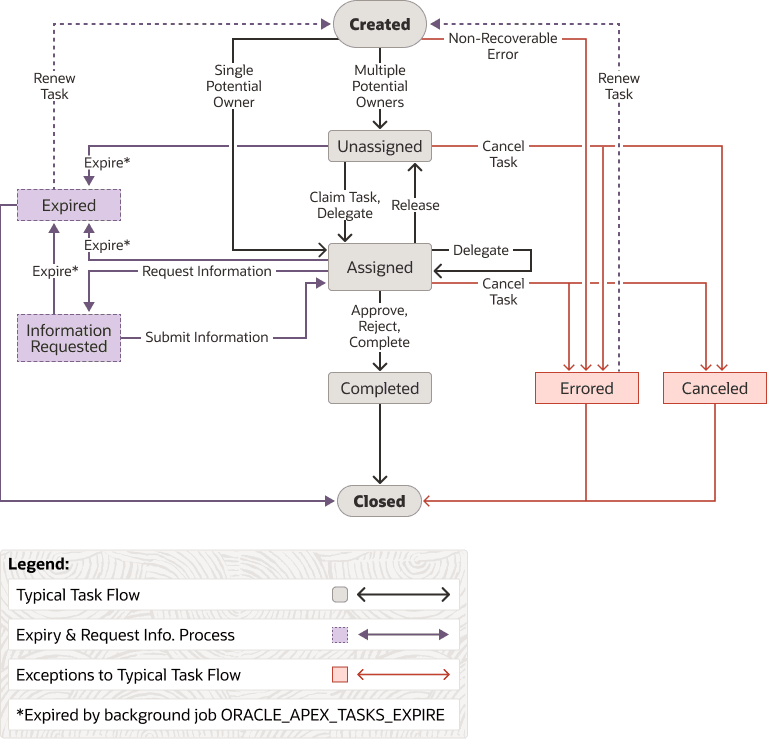
Description of the illustration approvals_state_diagram.png
Table: Task States and Transitions
| Task State |
Lifecycle Stage |
Category |
Possible Transitions |
| Created |
Initial |
Normal |
- Unassigned, when there are multiple potential owners
- Assigned, when there is one potential owner
- Errored, when there is a non-recoverable error during execution
|
| Unassigned |
Intermediate |
Normal |
- Assigned, when a user claims the task or delegates the task
- Completed, when a potential owner approves or rejects the task from the unified task list
- Errored, when there is a non-recoverable error during execution
- Canceled, when the initiator cancels the task
- Expired, when the task is not completed by the due date the expiration policy for the task definition is either:
- Expire (APEX does not create a new task)
- Renew (APEX creates a new task as long as the maximum number of renewals is not yet reached)
|
| Assigned |
Intermediate |
Normal |
- Completed, when the owner approves, rejects, or completes the task
- Unassigned, when the owner releases the task
- Info Requested, when the owner requests information from the initiator
- Assigned, when a user delegates the task to another potential owner
- Errored, when there is a non-recoverable error during execution
- Canceled, when the initiator cancels the task
- Expired, when the task is not completed by the due date the expiration policy for the task definition is either:
- Expire (APEX does not create a new task)
- Renew (APEX creates a new task as long as the maximum number of renewals is not yet reached)
|
| Info Requested |
Intermediate |
Normal |
- Assigned, when the initiator submits the requested information
- Expired, when the task is not completed by the due date the expiration policy for the task definition is either:
- Expire (APEX does not create a new task)
- Renew (APEX creates a new task as long as the maximum number of renewals is not yet reached)
|
| Completed |
Final |
Normal |
None |
| Errored |
Final |
Exception |
- Renewed, when the Business Administrator manually renews the task. APEX creates a new task based on the underlying task definition.
|
| Canceled |
Final |
User Interrupted |
None |
| Expired |
Final |
Normal |
None - If the task's Expiration Policy is set to Renew and the maximum number of renewals is not yet reached, APEX creates a new task.
- If the task's Expiration Policy is set to Expire, or if it is set to Renew but the maximum number of renewals is already reached, APEX does not create a new task. The business administrator can manually renew the task.
|