Oracle Backend for Microservices and AI
This chapter explains the Oracle Backend for Microservices and AI, a platform for building, deploying, and operating modern applications and AI-enabled microservices.
Topics:
About Oracle Backend for Microservices and AI
Oracle Backend for Microservices and AI is a comprehensive platform for building, deploying, and operating modern applications and AI-enabled microservices. It combines Oracle AI Database with integrated infrastructure for API routing, service discovery, centralized configuration, messaging, distributed transactions, data persistence, security, and observability. The platform supports both Helidon and Spring Boot and can be deployed on existing Kubernetes infrastructure or through Oracle Cloud Infrastructure (OCI) provisioned environments.
The platform provides these key capabilities:
-
The platform deploys with Kubernetes across multiple clouds and hybrid environments, supporting both existing infrastructure and OCI provisioned environments.
-
Applications can take advantage of Oracle AI Database as a converged data platform, with support for relational, document/JSON, graph data and analytics, spatial, vector, and other data models; JSON Relational Duality Views for accessing relational and JSON representations; and Transactional Event Queues (TxEventQ) for transactional messaging and event-driven processing. These capabilities support data-at-rest, data-in-motion, and AI workloads in enterprise applications.
-
Oracle AI Database provides a strong data foundation for microservices. Pluggable databases (PDBs) and schemas can be used together to isolate services by bounded context. Depending on deployment requirements, each microservice can use a dedicated PDB, or multiple microservices can share a PDB while remaining isolated through separate schemas. This supports both database-per-service and schema-level isolation patterns.
-
The platform includes an integrated observability stack powered by SigNoz and OpenTelemetry, providing centralized collection and visualization of application and infrastructure metrics, logs, and distributed traces, along with monitoring for Oracle AI Database and Kafka.
Getting Started with Oracle Backend for Microservices and AI
This section provides essential information for developers looking to get started with the Oracle Backend for Microservices and AI platform.
Deployment Options
The platform supports multiple deployment options for production, development, and testing. Production workloads can run on Oracle Cloud Infrastructure (OCI), other cloud providers, or on-premises environments. Production installations use Helm and can use an existing Kubernetes cluster, Oracle AI Database, and network infrastructure. For development and testing on OCI, the OCI Magic Button provides a quick way to provision an OKE cluster, an Autonomous Database, the required network infrastructure, and the platform.
Support
Oracle Backend for Microservices and AI is supported for customers using eligible Oracle AI Database offerings. Support eligibility, coverage, and service-request procedures depend on the applicable Oracle product and support agreement. To request assistance for the platform, sign in to My Oracle Support and submit a service request.
For details, including applicable support requirements and scope, see Knowledge Base article KB181357 in My Oracle Support
Platform Services
The following platform services support application deployment and operations. Services are deployed and managed through Helm and can be enabled or disabled individually according to deployment requirements.
-
Oracle Transaction Manager for Microservices (MicroTx):
The platform integrates services for API routing, service discovery, messaging, distributed transactions, data management, security, and observability, making it simpler to build and operate microservices with Kubernetes and Oracle AI Database.
The following figure illustrates a high-level view of the platform’s architecture.
Figure 1: Oracle Backend for Microservices and AI
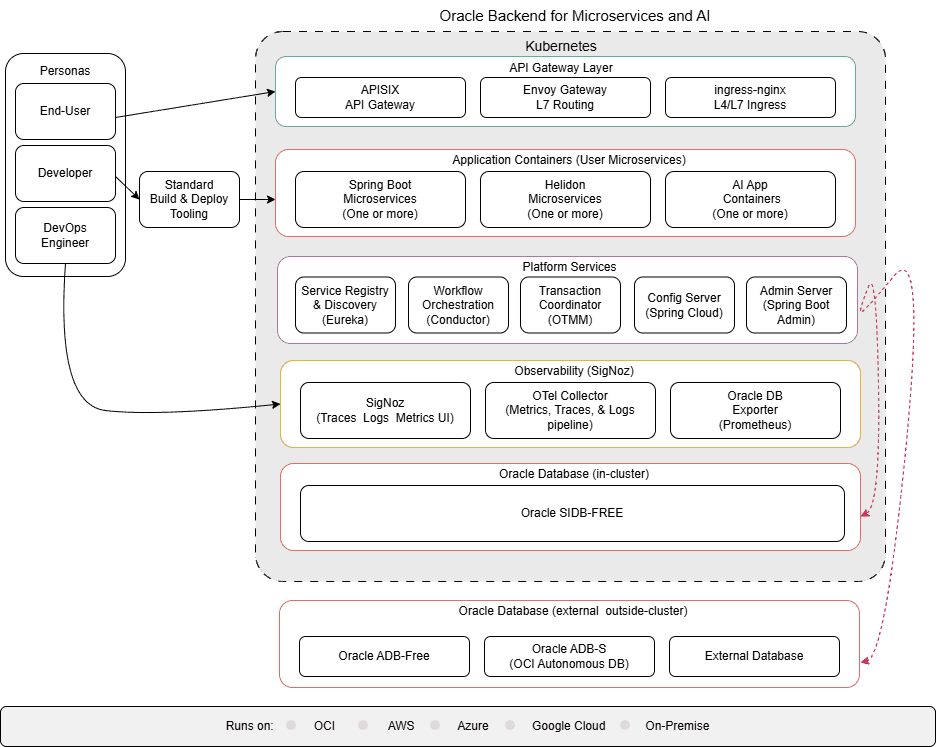
Developers can use the platform with supported application frameworks, including Spring Boot and Helidon. The platform provides tools and integrations for deploying services, managing configuration and database schemas, accessing Oracle AI Database, connecting to messaging and transaction services, and collecting application telemetry. Framework-specific libraries, drivers, and integrations are described in the relevant application-development documentation.
The platform is extensible. Applications can add Kubernetes operators, such as WebLogic, and other components when required.
For more information about deploying and using the platform, see the documentation.