Understand Hybrid Search
With hybrid search, you can search through your documents by performing a combination of full-text queries and vector-based similarity queries, using out-of-the-box or custom scoring techniques.
Here are the key points to note when using hybrid search:
-
Hybrid searches are run against hybrid vector indexes (as explained in Manage Hybrid Vector Indexes). You use the
DBMS_HYBRID_VECTOR.SEARCHPL/SQL function to query a hybrid vector index. -
After you create a hybrid vector index, you have five possibilities to use the index by querying it in multiple search modes summarized here:
-
When performing hybrid search by both keywords and vectors, the results are combined (or fused) into a single result set.
Similarity search uses the notion of
VECTOR_DISTANCEvalues to decide on the ranking of chunks, whereas the traditional Oracle Text search uses the notion of keyword score also known asCONTAINSscore. These two metrics are very different and one cannot be used directly to compare to the other. Hence, similarity search distances are converted or normalized into aCONTAINS-score equivalent that is called semantic score so its value will range between 100 (best) to 0 (worse). That way, keyword score and semantic score are comparable when running a hybrid search.After the results are combined (or fused) into a single result set, hybrid search employs any one of the following search_scorer methods to evaluate the search scores from both keyword and semantic search results. The results of a hybrid search are based on this scoring mechanism that is important to understand to be able to interpret the results.
-
RSF (Relative Score Fusion) : RSF computes a weighted sum of the normalized scores from the keyword and semantic search results. Use this method when you want a simple, weighted blend of scores directly proportional to their quality and relevance.
Formula
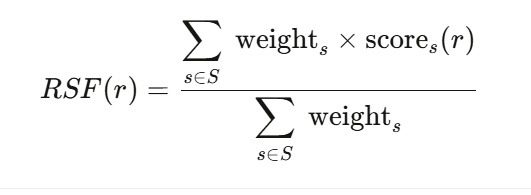
Description of the illustration rsf-formula.png
When the database calculates the RSF search scores for hybrid search results, it uses the values specified in the
text.score_weightandvector.score_weightfields provided in the JSON search request as the weights for the text and vector scores during the computation. Here is an example of how RSF is calculated for each document in a hybrid search result set.RSF Example
Document Vector Score Vector Weight Vector RS Text Score Text Weight Text RS Sum RS RSF 1 90 5 450.0000 4 1 4.0000 454.0000 75.67 2 50 5 250.0000 95 1 95.0000 345.0000 57.50 3 33 5 165.0000 80 1 80.0000 245.0000 40.83 MAX RFS 100 5 500.0000 100 1 100.0000 600.0000 100.00 -
RRF (Reciprocal Rank Fusion): RRF uses the reciprocal of the rank positions from both keyword and semantic search methods, adjusted by a penalty (rank constant), to blend relevance. Use this method when you want to emphasize highly ranked results from both search types, rather than raw score magnitude.
Formula
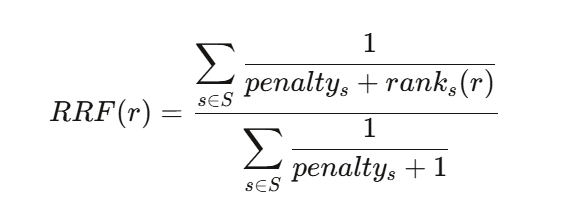
Description of the illustration rrf-formula.png
When the database calculates the RRF search scores for hybrid search results, it uses the values specified in the
text.rank_penaltyandvector.rank_penaltyfields provided in the JSON search request as the penalty values for the text and vector scores during the computation. The following table illustrates the calculation of the RRF for various documents with given rankings in the vector and text results.RRF Example
Document Vector Rank Vector Penalty Vector RR Text Rank Text Penalty Text RR Sum RR RRF 1 1 1 0.5000 4 5 0.1111 0.6111 91.67 2 5 1 0.1667 100 5 0.0095 0.1762 26.43 MAX RRF 1 1 0.5000 1 5 0.1667 0.6667 100.00 -
WRRF (Weighted Reciprocal Rank Fusion): WRRF is an extension of RRF, introducing weights to balance the relative influence of keyword and semantic results. Use this method when more granular control of the influence of each modality (keyword vs. semantic) is needed.
Formula
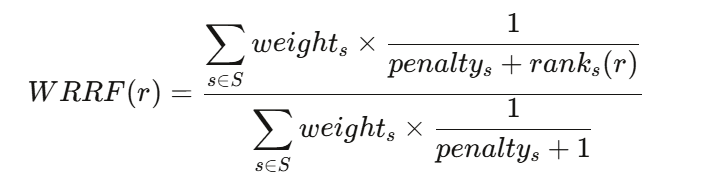
Description of the illustration wrrf-formula.png
When the database calculates the WRRF search scores for hybrid search results, it uses the values specified in the
text.score_weightandvector.score_weightfields provided in the JSON search request as the weights values for the text and vector scores during the computation. Similarly, it uses the values specified in thetext.rank_penaltyandvector.rank_penaltyfields provided in the JSON search request as the penalty values for the text and vector scores during the computation. The following table illustrates the calculation of the WRRF for various documents with given rankings in the vector and text results.WRRF Example
Document Vector Rank Vector Penalty Vector Weight Vector WRR Text Rank Text Penalty Text Weight Text WRR Sum WRR WRRF 1 1 60 5 0.0820 4 60 1 0.0156 0.0976 99.22 2 5 60 5 0.0769 100 60 1 0.0063 0.0832 84.56 MAX WRRF 1 60 5 0.0820 1 60 1 0.0164 0.0984 100.00
-
For the sake of the following explanations, we are using the same use case as seen in Understand Hybrid Vector Indexes:
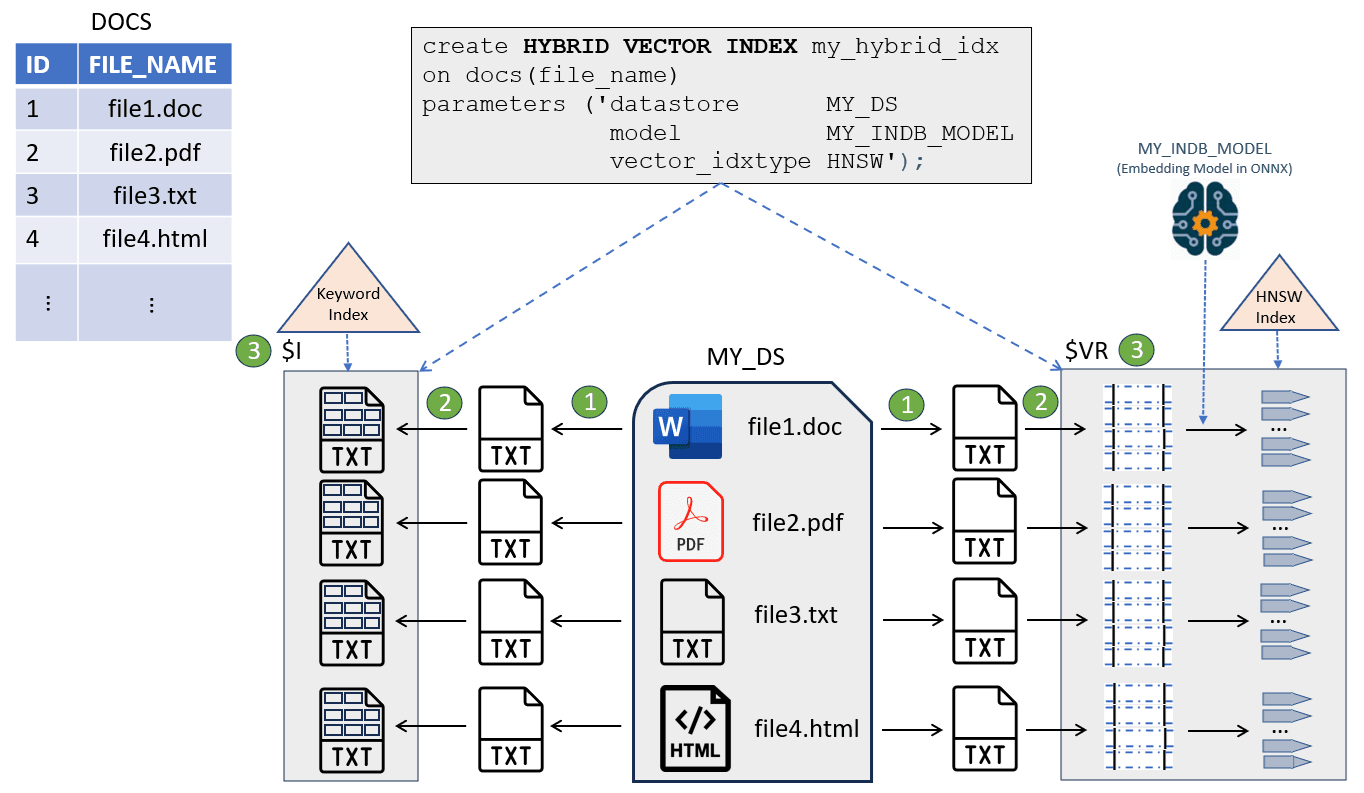
Description of the illustration overview_hybrid_vector_index.png
Pure Semantic in Document Mode
The pure semantic in document mode performs vector-only search to fetch document-level results.
The following SQL statement queries a hybrid vector index in this mode:
select json_Serialize(
  DBMS_HYBRID_VECTOR.SEARCH(
    json(
      '{ "hybrid_index_name" : "my_hybrid_idx",
         "vector":
          {
             "search_text"   : "galaxies formation and massive black holes",
             "search_mode"   : "DOCUMENT",
             "aggregator"    : "AVG"
          },
         "return":
          {
             "values"        : [ "rowid", "score", "vector_score" ],
             "topN"          : 10
          }
      }'
    )
  ) RETURNING CLOB pretty);
The result of this query may look like the following, where you see the ROWIDs of the DOCS table rows corresponding to documents as well as its vector score (vector_score). Here, the final score (score) is the same as the vector score because there is no keyword score in this case.
Here is an excerpt from the results:
[
{
    "rowid"        : "AAASBEAAEAAAUpqAAB",
    "score"        : 71.04,
    "vector_score" : 71.04
  },
  {
    "rowid"        : "AAASBEAAEAAAWBKAAE",
    "score"        : 67.82,
    "vector_score" : 67.82
  },
]
Here is how to interpret this statement:
-
The system runs a similarity search on all the vectors and extracts the top k ones at most. The value k is internally calculated. Each is given a vector score.
-
These k vectors (at most) are then grouped by document IDs and for each identified document, the semantic score of each associated vector found for that document is used to compute the average (in this example) of these scores for that particular document.
-
The top 10 documents (at most) with the highest averages are returned.
This is illustrated here:
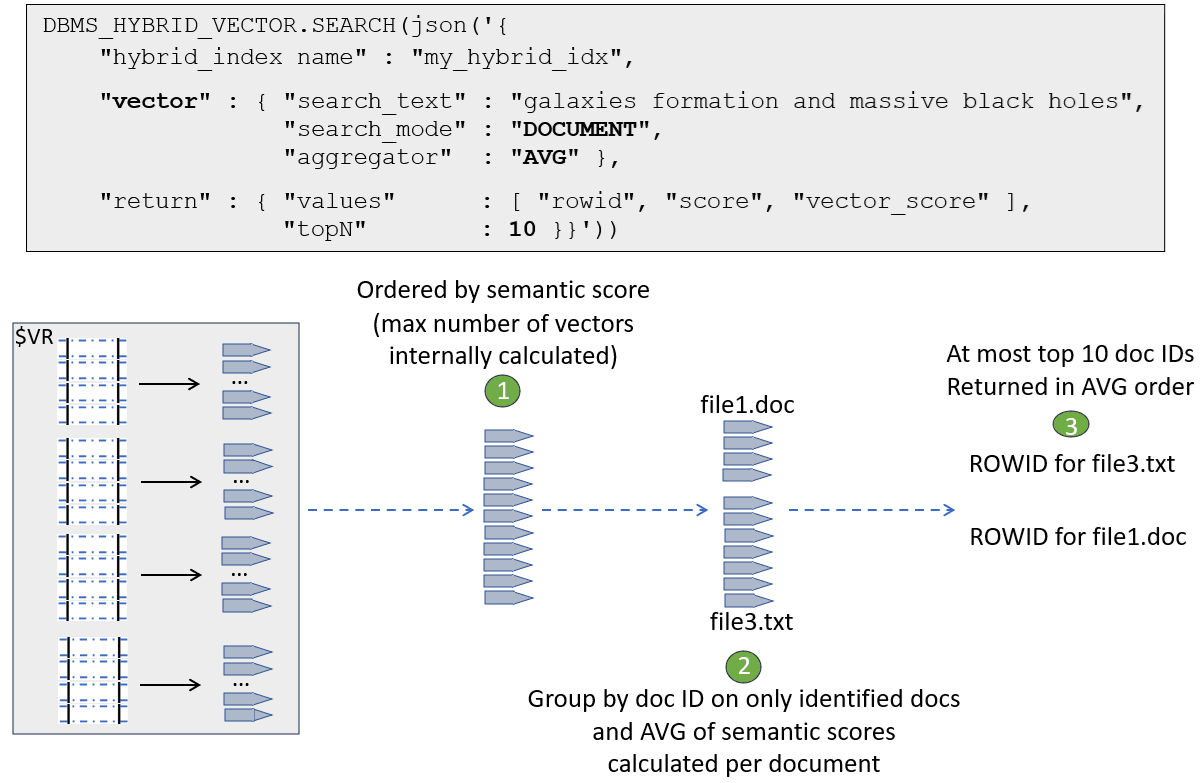
Description of the illustration pure_semantic_document_mode_query.png
Pure Semantic in Chunk Mode
The pure semantic in chunk mode is the SQL semantic search equivalent. This mode performs a vector-only search to fetch chunk results.
The following SQL statement queries a hybrid vector index in this mode:
select json_Serialize(
  dbms_hybrid_vector.search(
    json(
      '{ "hybrid_index_name" : "my_hybrid_idx",
         "vector":
          {
             "search_text"   : "galaxies formation and massive black holes",
             "search_mode"   : "CHUNK"
          },
         "return":
          {
             "values"        : [ "score", "chunk_text", "chunk_id" ],
             "topN"          : 3
          }
      }'
    )
  ) RETURNING CLOB pretty);
Here is how to interpret this statement:
-
The system runs a similarity search on all the vectors and extracts the top k ones at most. The value k is internally calculated. Each is given a vector score.
-
The top 3 chunks (at most) with the highest scores are returned.
The result of this query may look like the following, where you can see the chunks corresponding to their semantic scores:
[
  {
    "score"      : 61,
    "chunk_text" : "Galaxies form through a complex process that begins with small fluctuations in the density of matter in the early
universe. Massive black holes, typically found at the centers of galaxies, are believed to play a crucial role in their formation and evolution.",
    "chunk_id"   : "1"
  },
  {
    "score"      : 56.64,
    "chunk_text" : "The presence of massive black holes in galaxies is closely linked to their morphological characteristics and star formation rates.
Observations suggest that as galaxies evolve, their central black holes grow in tandem with their host galaxy's mass.",
    "chunk_id"   : "3"
  },
  {
    "score"      : 55.75,
    "chunk_text" : "Black holes grow by accreting gas and merging with other black holes. Their gravitational influence can regulate star
formation and drive powerful jets of energy, which can impact the surrounding galaxy.",
    "chunk_id"   : "2"
  }
]
Pure Keyword in Document Mode
The pure keyword search in document mode is equivalent to the traditional CONTAINS query using Oracle Text. This mode performs a text-only search to fetch document-level results.
The following SQL statement queries a hybrid vector index in this mode:
select json_Serialize(
  dbms_hybrid_vector.search(
    json(
      '{ "hybrid_index_name" : "my_hybrid_idx",
         "text":
          {
             "contains"      : "galaxies, black holes"
          },
         "return":
          {
             "values"        : [ "rowid", "score" ],
             "topN"          : 3
          }
      }'
    )
  ) RETURNING CLOB pretty);
Here is how to interpret this statement:
-
The system runs a
CONTAINSquery that returns a maximum number of documents. This maximum number is internally calculated. Each document is given a keyword score. -
The top 3 documents (at most) with the highest scores are returned.
The result of this query may look like the following, where you can see the ROWIDs of the DOCS table rows corresponding to documents as well as their keyword scores:
[
  {
    "rowid" : "AAAR9jAABAAAQeaAAB",
    "score" : 68
  },
  {
    "rowid" : "AAAR9jAABAAAQeaAAA",
    "score" : 35
  },
  {
    "rowid" : "AAAR9jAABAAAQeaAAD",
    "score" : 2
  }
]
Keyword and Semantic in Document Mode
Let us examine a non-pure case of hybrid search where keyword scores and semantic scores are combined.
The following SQL statement performs a keyword and semantic search to fetch document-level results:
select json_Serialize(
  DBMS_HYBRID_VECTOR.SEARCH(
    json(
      '{
         "hybrid_index_name" : "my_hybrid_idx",
         "search_scorer"     : "rsf",
         "search_fusion"     : "UNION",
         "vector":
          {
             "search_text"   : "How can I search with hybrid vector indexes?",
             "search_mode"   : "DOCUMENT",
             "aggregator"    : "MAX",
             "score_weight"  : 1,
             "rank_penalty"  : 5
          },
         "text":
          {
             "contains"      : "hybrid AND vector AND index"
             "score_weight"  : 10,
             "rank_penalty"  : 1
          },
         "return":
          {
             "values"        : [ "rowid", "score", "vector_score", "text_score" ],
             "topN"          : 10
          }
      }'
    )
  ) RETURNING CLOB pretty);
Here is how to interpret this statement:
In document mode, the result of your search is a list of ROWIDs from your base table corresponding to the list of best files identified.
To get to this list, two searches are conducted:
-
Keyword search: During this search, the system uses the
CONTAINSstring representing the Oracle TextCONTAINSsearch expression for the searched keywords. The result of this operation is a list of document identifiers satisfying yourCONTAINSexpression. The numbers of document identifiers to retrieve, at max, is internally calculated. -
Similarity search: During this search, the system performs a similarity search with the query vector (created from the
SEARCH_TEXTstring) against the vector index of all the chunks of all your documents. The maximum number of chunks to retrieve is also internally calculated. It then assigns a vector score to each chunk retrieved. Because you want to run this search inDOCUMENT SEARCH_MODE, the result of this similarity search is first grouped by document identifier. The process now aggregates the vector scores for each document, identified using theAGGREGATORfunction. The result of this similarity search is a list of document identifiers satisfying yourSEARCH_TEXTsimilarity query string.
After the searches complete, the system needs to merge the results and score them as illustrated here:
Scoring for Keyword and Semantic Search in Document Mode
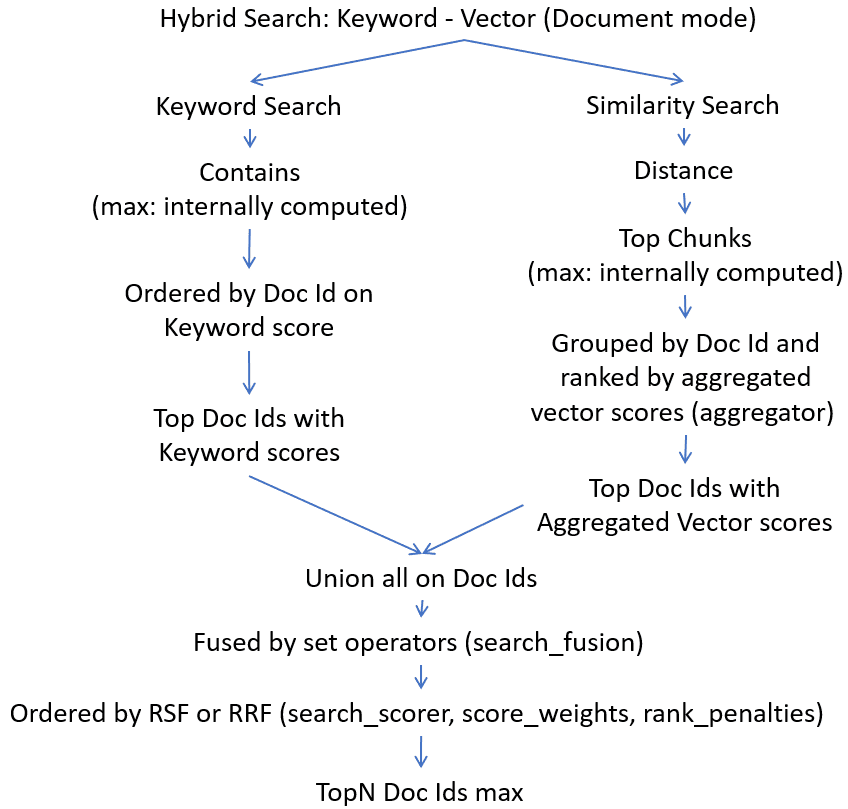
Description of the illustration keyword_semantic_document_mode_query.png
As outlined in the preceding diagram,
-
First, both search results are added using a
UNION ALLoperation. -
Before final scoring, you have the possibility to define what you want to retain from this intermediate result set by specifying the
SEARCH_FUSIONoperation. -
Then comes the time where final scoring is computed using the defined
SEARCH_SCORERalgorithm such as Reciprocal Rank Fusion (RRF) or Relative Score Fusion (RSF). The final scoring can use the specifiedSCORE_WEIGHTandRANK_PENALTYvalues for each retrieved document identifier, depending from which sort operation they are coming from. -
Finally, the defined
topNdocument identifiers are returned at most.
The possible fuse operators are illustrated here:
Fusion Operation in Document Search Mode
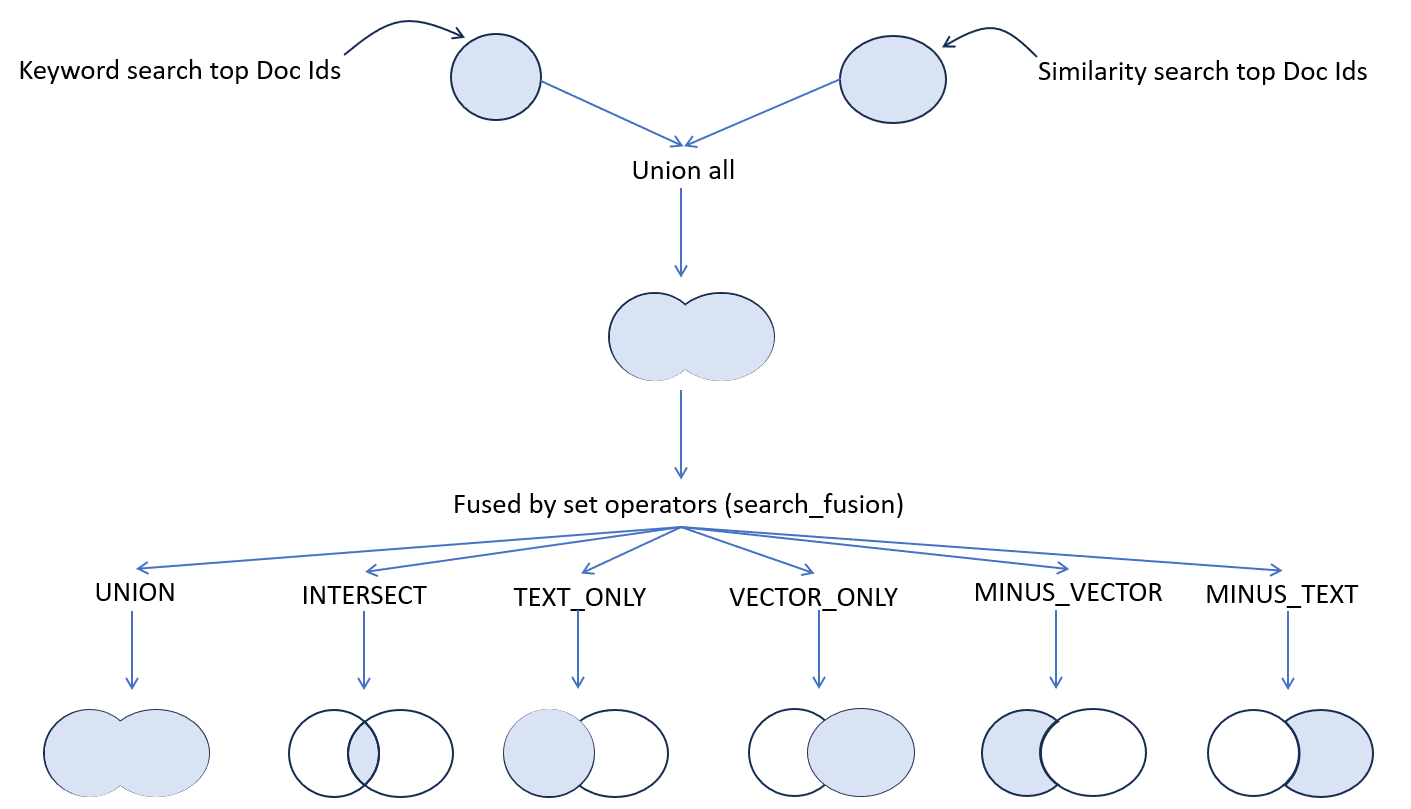
Description of the illustration fuse_operators_doc_mode.png
Keyword and Semantic in Chunk Mode
Let us examine another non-pure case of hybrid search where keyword scores and semantic scores are combined to fetch chunk results.
The following SQL statement performs a keyword and semantic search in chunk mode:
select json_Serialize(
  DBMS_HYBRID_VECTOR.SEARCH(
    json(
         '{
            "hybrid_index_name" : "my_hybrid_vector_idx",
            "search_scorer"     : "rsf",
            "search_fusion"     : "UNION",
            "vector":
                      {
                        "search_text"   : "How can I search with hybrid vector indexes?",
                        "search_mode"   : "CHUNK",
                        "score_weight"  : 1
                      },
            "text":
                      {
                       "contains"       : "hybrid AND vector AND index",
                       "score_weight"   : 1
                      },
            "return":
                      {
                        "values"        : [ "chunk_id", "score", "vector_score", "text_score" ],
                        "topN"          : 10
                      }
          }'
    )
  ) RETURNING CLOB pretty);
Here is how to interpret this statement:
In chunk mode, the result of your search is a list of best chunk identifiers from the files stored using your base table.
To get to this list, two searches are conducted:
-
Keyword search: During this search, the system uses the
CONTAINSstring representing the Oracle TextCONTAINSsearch expression for the searched keywords. The result of this operation is a list of document identifiers satisfying yourCONTAINSexpression. The numbers of document identifiers to retrieve, at max, is internally calculated. -
Similarity search: During this search, the system performs a similarity search with the query vector (created from the
SEARCH_TEXTstring) against the vector index of all the chunks of all your documents. The maximum number of chunks to retrieve is also internally calculated. It then assigns a vector score to each chunk retrieved. Because you want to do this search inCHUNK SEARCH_MODE, the result of this similarity search is ordered by chunk vector scores. The result of this similarity search is a list of chunk identifiers and associated document identifiers satisfying yourSEARCH_TEXTsimilarity query string.
After the searches complete, the system needs to merge the results and score them as illustrated here:
Scoring for Keyword and Semantic Search in Chunk Mode
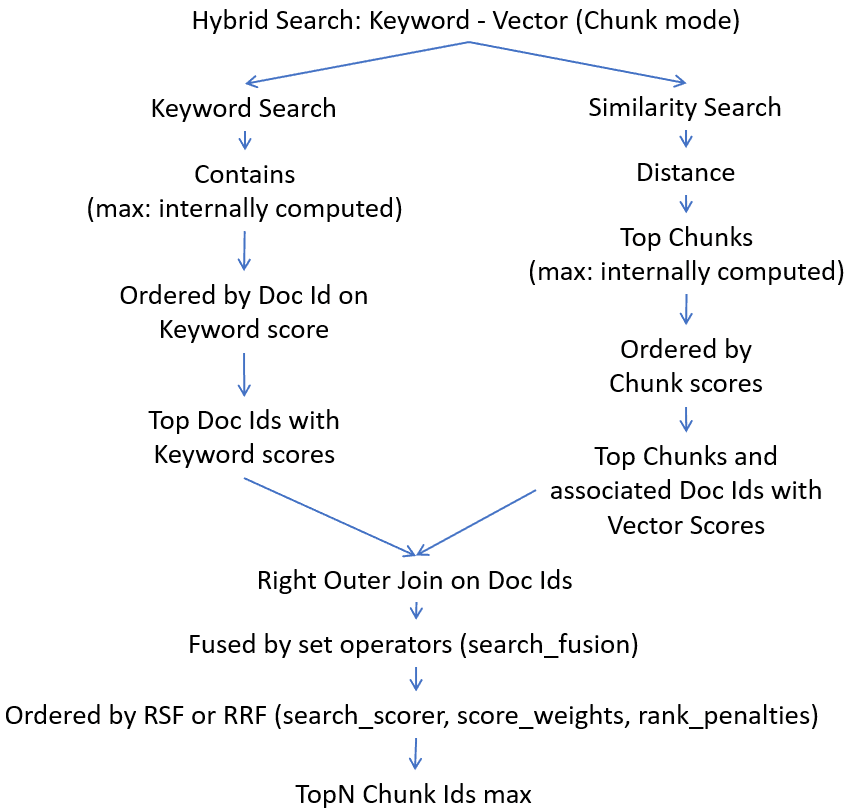
Description of the illustration keyword_semantic_chunk_mode_query.png
As outlined in the preceding diagram,
-
First, both search results are submitted to a
RIGHT OUTER JOINoperation on the document identifiers. -
Before final scoring, you have the possibility to define what you want to retain from this intermediate result set by specifying the
SEARCH_FUSIONoperation. -
Then comes the time where final scoring is computed using the defined
SEARCH_SCORERalgorithm such as Reciprocal Rank Fusion (RRF) or Relative Score Fusion (RSF). The final scoring can use the specifiedSCORE_WEIGHTandRANK_PENALTYvalues for each retrieved document identifier, depending from which sort operation they are coming from. -
Finally, the defined
topNchunk identifiers are returned at most.
The possible fuse operators are illustrated here:
Fusion Operation in Chunk Search Mode
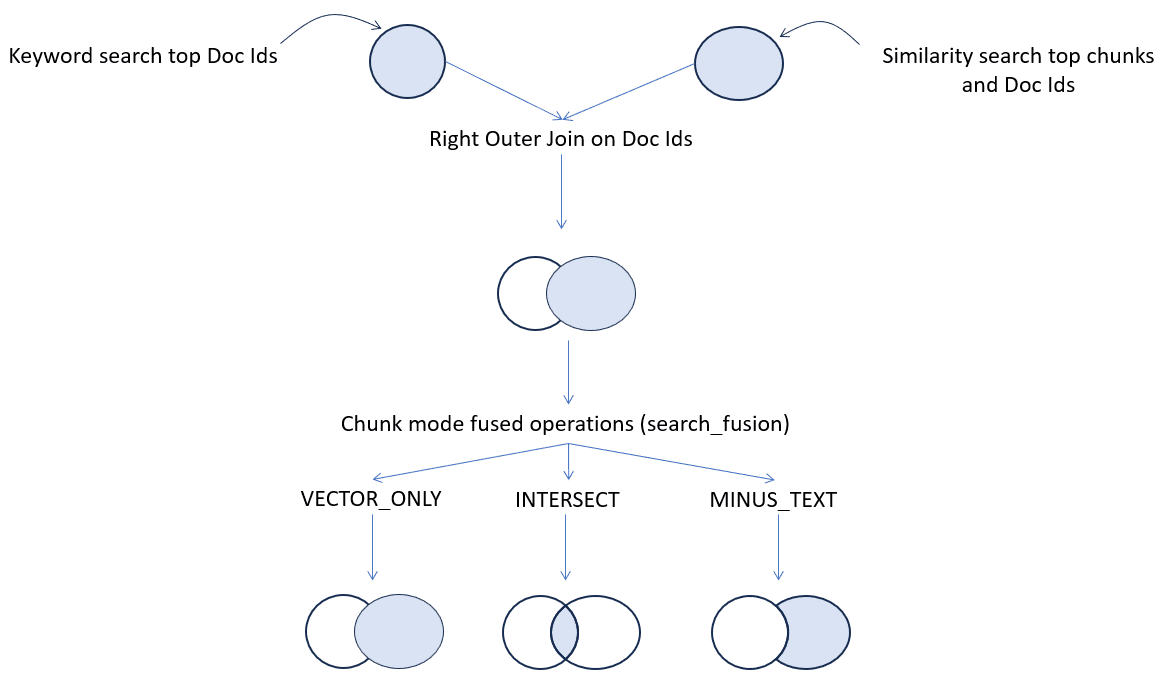
Description of the illustration fuse_operators_chunk_mode.png
MINUS_VECTOR, UNION, and TEXT_ONLY are ignored. MINUS_VECTOR would eliminate all results. TEXT_ONLY and UNION are not possible because the right outer join excludes the non-overlapping text results.
See Also: