Developing Applications with Sagas
This chapter covers Saga APIs that allow applications that are built using microservices principles to incorporate efficient transactions across microservices. Saga APIs are implemented while closely following the Long Running Action (LRA) specification from Eclipse MicroProfile.
Topics:
Implementing Sagas with Oracle Database
You can use Oracle Database as a platform to build your Saga-based, on-cloud or on-premises applications. When you implement Sagas with Oracle Database for handling distributed transactions, you can leverage the robust underlying infrastructure built into Oracle Database. The Saga infrastructure maintains the global application state for microservices, facilitating development and throughput.
The following are some key benefits of using Oracle Database for Saga implementation:
-
The Saga implementation is integrated in the database to make Sagas simpler to code, deploy, and maintain.
-
Simplified Saga annotations following the Eclipse LRA standard make it easy to enable transactions across microservices using Oracle Database.
-
Data consistency is achievable across microservices.
-
Auto-compensating logic based on lock-free, reservable columns is provided in the database to handle rollbacks on Saga rollback.
-
Advanced Queuing (AQ) and Oracle Transactional Event Queues (TxEventQ) messaging platforms are built into Oracle Database, enabling microservices to produce and consume messages and events as part of database transactions.
-
Support is provided for different languages, including PL/SQL and Java applications.
-
The Saga framework recommends a JSON type for representing the application payload.
-
There is improved availability and scalability for applications that require transactions across microservices. Such transactions are common with monolith applications that are converting to microservices, where transactions may span multiple bounded contexts. Note that a bounded context is an explicit boundary within which a business domain model exists.
Oracle Saga Framework Overview
The Oracle Saga framework provides the foundation to implement and administer Sagas for microservices applications built using Oracle Database. The framework provides administrative and client interfaces. Administrative interfaces enable Saga applications to configure and manage Saga participants and message brokers. Client interfaces enable applications to initiate, participate, and finalize Sagas. Saga participants are automatically configured with message channels and message propagation. The Saga framework is compensation-aware and provides for automatic rollback of the affected data when a Saga is rolled back. The Saga framework includes PL/SQL packages, dictionary tables, and Advanced Queuing (AQ) integration that facilitate Sagas in the database.
The Oracle Saga framework leverages two important features of Oracle Database. There is a transaction layer with reservable column support that enables recording of appropriate meta-information when reservable columns are updated. The reservable column support invokes compensating transactions automatically to revert the state of the reservable column updates when a Saga is rolled back. Reservable columns are a part of the lock-free reservation feature that Oracle provides to improve transactional concurrency.
Another important layer integrated into the database is the event queues built on the Oracle Advanced Queuing (AQ) technology. AQ provides the asynchronous messaging platform that connects various microservice participants. The Saga framework deploys a hub-and-spoke topology to connect Saga initiators, coordinators, and participants. The Saga message broker acts as the hub in this topology.
Saga Framework Features
The Saga framework provides the following features for implementing Sagas on Oracle Database:
-
PL/SQL administrative interfaces to add and manage active Sagas and Saga participants
-
PL/SQL and Java interfaces for applications to interact with the Saga framework, and participate and finalize (commit or rollback) database Sagas
-
Asynchronous message communication across multiple participants that contribute to a Saga, facilitated by microservice-specific AQ message propagation infrastructure from Oracle
-
Reservable column-based Saga finalization (compensation and completion) support to enable recording of reservable column updates, and auto-compensation of transactions to roll back changes for canceled Sagas
-
User-defined Saga finalization (compensation and completion) support to enable users to explicitly define and automatically execute Saga finalization
-
Strong messaging semantics to ensure that interservice messages are delivered exactly once and never lost or duplicated
-
Saga ID support to bind individual transactions to the Saga ID
-
A globally unique name for each participant in a Saga
-
Automatic configuration of message channels and message propagation for Saga participants that are provisioned into the system
-
Various dictionary tables to maintain the status of Sagas
-
System-defined views to report on Sagas and Saga participants in the system
-
Eclipse Microprofile LRA specification emulation
Saga Framework Concepts
Saga Participant and Initiator
A Saga participant represents a spoke (participant microservice) in the Saga topology that either initiates and orchestrates a Saga or enrolls to participate in one. A participant is associated with a message broker (that is local or remote) and optionally with a local Saga coordinator. Saga participants that initiate Sagas are described in this document as “initiators” and non-initiator participants are described as “participants”. Saga initiators must be associated with a Saga coordinator. In the initial version, the Saga framework only supports a local Saga coordinator (from the same PDB) for an initiator. Meanwhile, a Saga participant need not be associated with a coordinator and can be remote to the initiator.
Any participant can initiate a Saga. A Saga initiator is a microservice that initiates a Saga and enrolls other microservice participants by sending asynchronous messages.
In the travel agency example that follows, the participant microservices are the flight service, hotel service, and car service. A participant microservice executes one or more participant transactions on behalf of a Saga. Compensation action for a participant transaction is maintained in the local PDB. Participants are responsible for maintaining the local state of their Sagas.
Transaction Coordinator
A transaction coordinator acts as a transaction manager in the Saga topology. The Saga coordinator maintains the Saga state on behalf of the Saga initiator.
A Saga topology can have several Saga coordinators. In the initial release of the Saga framework, a Saga participant can only associate with coordinators who are local (same PDB and schema) to the participants. A coordinator can, however, associate with a local or remote message broker.
Message Broker
A message broker acts as an intermediary and represents the hub in the Saga topology. A broker provides a message delivery service for the message propagation between two or more Saga participants and their coordinator. Each Saga participant or coordinator is associated with a single broker, who can be local or remote. A broker does not maintain any Saga state.
Administrator and Client Interfaces
The Saga framework provides two PL/SQL packages: DBMS_SAGA_ADM and DBMS_SAGA.
The DBMS_SAGA_ADM package provides the administrative interface for the Saga framework. Using the administrative interface, you can manage Saga entities and ongoing Sagas.
The DBMS_SAGA package provides the developer APIs to initiate and complete Sagas, when building microservices applications.
Java developers, who want to create microservices using Sagas, should use Saga annotations, which is defined separately in this document.
Saga Annotations
Java applications initiating and participating in Sagas should use the Saga annotations for flexibility and simplicity of development. For more details, see Developing Java Applications Using Saga Annotations section of this document.
Advanced Queuing
The Saga Infrastructure leverages existing Oracle Advanced Queuing (AQ) technology, including message propagation between queues and event notification. AQ is the transaction communication mechanism for Saga participants and coordinators. AQ provides necessary plumbing and message channels to facilitate asynchronous message communication across multiple participants contributing to a Saga. AQ provides exactly-once message propagation without distributed transactions.
Reservable columns
A reservable column is a column type that has auto-compensating capabilities. Reservable columns enable individual databases to maintain reservation journals that record compensating actions for participant transactions. Compensating actions are automatically executed on the reservable column values in the event of a Saga rollback to revert local transactional changes.
Saga local transactions that the participant microservices execute can modify one or more reservable columns of database tables. Sagas leverage reservable columns to record compensating actions when transactional changes are made and automatically invoke the compensating actions when transactions fail. Compensating actions for reservable columns are recorded in reservation journals. Compensating transactions free up any resources that were locked earlier.
Dictionary Views
The Saga framework provides system-defined views to report on Sagas and Saga participants in the system. System defined views ALL_MICROSERVICES, CDB_MICROSERVICES, DBA_MICROSERVICES, and USER_MICROSERVICES provide the ability to monitor Sagas and Saga participants in the system.
The following views show all participants in the system:
-
CDB_SAGA_PARTICIPANTS -
DBA_SAGA_PARTICIPANTS -
USER_SAGA_PARTICIPANTS
The following system-defined views show the dynamic state of ongoing Sagas:
-
CDB_SAGAS -
DBA_SAGAS -
USER_SAGAS
The following system-defined views show the state of completed Sagas:
-
CDB_HIST_SAGAS -
DBA_HIST_SAGAS -
USER_HIST_SAGAS
Information for completed Sagas is retained for a period of 30 days. You can configure this duration using the saga_hist_retention database parameter.
The following system-defined views show incomplete Sagas:
-
CDB_INCOMPLETE_SAGAS -
DBA_INCOMPLETE_SAGAS -
USER_INCOMPLETE_SAGAS
The following views provide details about reservable columns for incomplete Sagas:
-
CDB_SAGA_PENDING -
DBA_SAGA_PENDING -
USER_SAGA_PENDING
The following views provide details about each Saga:
-
CDB_SAGA_DETAILS -
DBA_SAGA_DETAILS -
USER_SAGA_DETAILS
The following views show the pending finalization actions for Sagas:
-
CDB_SAGA_FINALIZATION -
DBA_SAGA_FINALIZATION -
USER_SAGA_FINALIZATION
See Also: Oracle Database Reference guide
Finalization Methods
Sagas are finalized when all participants commit (complete) or roll back (compensate) their respective participant transactions. Saga commit() or rollback() operations result in the completion of a Saga. The Saga framework enables you to also implement application-specific finalization in addition to the implicit reservable column-based finalization.
Eclipse Microprofile LRA Specification
The Saga framework emulates the Eclipse Microprofile LRA specification and provides equivalent functionality with certain limitations. The initial version of the Saga framework has the following limitations:
-
Nested Sagas are not supported.
-
Saga initiators and coordinators are co-located.
Initializing the Saga Framework
Initializing Parameters
In the database initialization parameter file, init.ora, the max_saga_duration parameter identifies the time in seconds beyond which a Saga can be considered incomplete. The default value for this parameter is 86400 seconds. Any Saga that exceeds this configurable duration is considered incomplete and is liable to termination using the dbms_saga.rollback_saga() API. The Saga initiator automatically rolls back Sagas that exceed their duration.
In the init.ora file, you can use the _use_saga_qtyp parameter to set the message queuing type to be used in the Saga infrastructure. By default, the _use_saga_qtyp parameter is set to 0, which means it uses classic AQ queues, but if you want to switch to transactional event queues (TEQ), the _use_saga_qtyp parameter must be set to
- Any change in the
_use_saga_qtypparameter must be done before creating the Saga entities: broker, coordinator, or participant. Changing the_use_saga_qtypparameter after creating the Saga entities does not change the type of the queues used in the Saga.
See Also: Oracle Database Transactional Event Queues and Advanced Queuing User’s Guide
Roles for Access Control
The Saga framework enables database administrators to provide the necessary privileges to the database users, who can administer and participate in Sagas. Users can have the following roles and privileges:
| User Role | Access |
|---|---|
SAGA_ADM_ROLE |
Provides the ability to invoke APIs from the DBMS_SAGA_ADM package. This role is required for Saga administrators for the initial setup and provides full access to the DBMS_SAGA_ADM API. In the Saga framework setup example, SAGA_ADM_ROLE privilege is granted to the mailbox user MB. |
SAGA_PARTICIPANT_ROLE |
This role is required for Saga participant services. Saga primitives can only be invoked by a user that has the SAGA_PARTICIPANT role granted to it. |
SAGA_CONNECT_ROLE |
This role is provided to the remote dblink user. |
SYS owns all the dictionary tables and user-accessible views of the data dictionary.
Setting Up a Saga Topology
The Saga framework provides administration APIs that the DBAs (with SAGA_ADM_ROLE privilege) can use to define and manage the Saga participants, coordinators, and brokers. The Saga PL/SQL package called SYS.DBMS_SAGA_ADM implements the Saga administrative interface. A participant must invoke the procedures in the SYS.DBMS_SAGA_ADM package from inside its schema and PDB.
The administrative interface provides the following APIs to provision Saga participants and brokers.
-
add_participant()to add participants and their coordinator -
add_broker()to explicitly create a broker -
add_coordinator()to explicitly create a coordinator -
drop_participant()to drop a participant -
drop_coordinator()to drop a coordinator -
drop_broker()to drop a broker
Saga participants provisioned to the system are automatically configured with message channels and message propagation. Adding a participant creates a corresponding entry in the SYS.SAGA_PARTICIPANT$ dictionary table, and creates incoming and outgoing Java topics for the participant. The inbound and outbound Java topics are provisioned with system-generated names that are derived from the participant’s name. The following sections have further details about the administrative interface processing.
See Also: DBMS_SAGA_ADM for a complete description of SYS.DBMS_SAGA_ADM package APIs
Adding a Message Broker
In the Saga framework, a message broker acts as a message delivery service that receives messages from the Saga participants and propagates them to the Saga recipients.
The Saga framework uses the dbms_saga_adm.add_broker() API to add brokers explicitly to the framework. Creating a message broker creates a single Java topic that acts as the mailbox for the Saga participants. The system-generated name of the Java topic is of the form SAGA$_<broker_name>_INOUT, where the message broker name (broker_name) is the identifier that is provided as an input to the add_broker() call.
The SAGA_ADM_ROLE (administrator) role is required to create a Saga message broker.
Adding a Coordinator
A Saga coordinator acts as a transaction manager for Sagas. A Saga coordinator maintains the state of the Saga across various participants.
The Saga framework uses the dbms_saga_adm.add_coordinator() API to add coordinators to the framework.
Note: The add_coordinator() API must be called prior to invoking the add_participant() API, because add_participant() needs a coordinator name as an argument. Example: Saga Framework Setup explains the preparatory and provisioning steps.
The add_coordinator() interface executes the following:
-
Creates system-defined AQ queues for the coordinator’s inbound and outbound message channels.
-
Establishes a bidirectional message propagation channel between the coordinator and the message broker.
Adding a Participant
A participant is a named entity that represents an application or a microservice that desires to participate in database Sagas. Adding a participant sets up a bidirectional message propagation channel between the participant and the message broker.
The Saga framework uses the dbms_saga_adm.add_participant() API to add participants to the framework.
Note: Prior to invoking add_participant(), complete the pre-requisite steps in the participant and broker databases (PDBs). Example: Saga Framework Setup explains the preparatory and provisioning steps.
The add_participant() interface executes the following:
-
Creates system-defined Java topics for the inbound and outbound message channels of the participants.
-
Establishes a bidirectional message propagation channel between the participant and the message broker.
Managing Participants and Message Brokers
You can drop participants, coordinators, and message brokers using the drop_participant(), drop_coordinator(), and drop_broker() APIs. Dropping a participant, coordinator, or message broker also removes the associated JMS topic.
Note:
You can drop a participant only if there are no ongoing Sagas and no pending messages in the participant’s incoming queue. You can drop a coordinator only if there are no participants associated with the coordinator. You can drop a message broker only if there are no registered participants and no pending messages.
See Also: DBMS_SAGA_ADM for details of administrative APIs in the SYS.DBMS_SAGA_ADM package
Message Propagation
Message propagation transfers messages between Saga entities, namely initiators, participants, and brokers. Adding a participant to the Saga framework sets up message propagation. A message propagation job connects a participant’s outbound topic to a broker’s INOUT topic and connects a broker’s INOUT topic to a participant’s inbound topic.
-
To propagate a participant’s outbound topic to a broker’s INOUT topic, the message propagation job uses the dblink from the
dblink_to_brokerparameter of theadd_participant()interface. -
To propagate a broker’s INOUT topic to a participant’s inbound topic, the message propagation job uses the dblink from the
dblink_to_participantof theadd_participant()interface.Propagation of messages to a particular participant happens only for messages destined for that participant.
About Dictionary Tables
A globally unique identifier (GUID) is used to identify every Saga transaction. The sys.saga_finalization$ dictionary table records individual steps that are required to complete the compensating actions for a Saga.
Several dictionary tables track the state (meta-data) associated with the Saga transactions at the participant database. These tables are:
-
sys.saga_message_broker$: This table stores information for Saga brokers. Rows are inserted into thesaga_message_broker$table using an explicitadd_broker()call. Brokers can be remote or local, and this information is captured using thesaga_message_broker$.remotecolumn. -
sys.saga_participant$: This table stores information for participants and coordinators of the Saga framework. Rows are inserted into thesaga_participant$table using theadd_participant()or theadd_coordinator()calls. Participants can be remote or local, and this information is captured using thesaga_participant$.remotecolumn. -
sys.Saga$: Thesys.Saga$table contains entries for Sagas, either initiated on the given PDB or joined (usingjoinSaga()). -
sys.saga_finalization$: Thesaga_finalization$table at the participant database records the sequence number and reservation journal information for each unique reservable table updated as part of the participant transaction. Thesaga_finalization$table does not maintain information for application-specific compensation. -
sys.saga_participant_set$: A Saga initiator sends AQ JMS messages to enroll Saga participants. The Saga AQ JMS messages use special JMS message properties to indicate thesaga_idand other Saga attributes to the participants. An entry insys.saga_participant_set$table tracks each participant enrolled in a Saga. These entries track the enrollment and finalization status for each participant. -
sys.saga_pending$: This table records the reservation journal compensation information for Sagas that have timed out. The Saga infrastructure uses this information to forcefully commit or rollback a Saga. -
sys.saga_errors$: This table records error messages corresponding to various Sagas.
The following two database parameters affect Sagas:
-
max_saga_duration: This database parameter defines the maximum time in seconds that a Saga is considered to be active and is not marked incomplete.max_saga_durationis the system default for Saga duration, You can override this value using thebegin()API. A Saga is marked incomplete if any of its participants are unable to finalize the Saga within the Saga duration. An incomplete Saga can be finalized using thedbms_saga.rollback_saga()interface. -
saga_hist_retention: This database parameter defines the maximum time in days for retaining information for completed Sagas. The default value forsaga_hist_retentionis 30 days.
Example: Saga Framework Setup
The following example configures a set of participant microservices and a broker.
Preparatory Steps
This example sets up and configures a broker, two participants, namely TravelAgency and Airline, and their respective coordinator. Following these preparatory and provisioning steps, a Saga topology with two participants is created.
Steps 1 through 7 are executed on brokerPDB, 8 through 11 at TravelAgency, and 12 through 15 at AirlinePDB.
-
Provision or designate a pluggable database (PDB) called
brokerPDBto host the broker. -
At
brokerPDB, create a mailbox user that owns the broker and its JMS topic. For example:MB. -
Grant the role
SAGA_ADM_ROLEto userMB. -
Create a proxy user
AirlineatMB(Role:SAGA_CONNECT_ROLE). -
Create a proxy user
TravelAgencyatMB(Role:SAGA_CONNECT_ROLE). -
Create dblink
LinkToAirlineto Airline PDB usingMBatAirlineschema. -
Create dblink
LinkToTravelAgencyto Travel PDB usingMBatTravelschema. -
Provision or designate a PDB called
TravelAgencyto host Travel Reservation service. -
At the
TravelAgencyPDB, create a userTA. -
Create a proxy user
MBatTravelAgency(Role:SAGA_CONNECT_ROLE). -
Create dblink
LinktoBrokertobrokerPDBusingTravelAgencyatMBschema. -
Provision or designate a PDB called
AirlinePDBto host the Airline. -
At
AirlinePDB, create userAirline. -
Create proxy user
MBatAirline(RoleSAGA_CONNECT_ROLE). -
Create dblink
LinktoBrokertobrokerPDBusingAirlineatMBschema.
DBA views and entries associated with the dictionary entries in this example can be found in the DBA_SAGA_PARTICIPANTS view. For more information about the [DBA_SAGA_PARTICIPANTS](/pls/topic/lookup?ctx=en/database/oracle/oracle-database/26/adfns&id=REFRN-GUID-6B76A2A3-D86C-48AF-A903-37643A9FDD88) view and the following DBA views, see the Database Reference Guide.
-
DBA_SAGAS -
DBA_HIST_SAGAS -
DBA_INCOMPLETE_SAGAS -
DBA_SAGA_DETAILS -
DBA_PARTICIPANT_SET -
DBA_SAGA_FINALIZATION -
DBA_SAGA_PENDING -
DBA_SAGA_ERRORS
Provisioning Steps
BrokerPDB:
--Add a broker
dbms_saga_adm.add_broker(name=>'TravelBroker',  schema=>'MB');
TravelAgencyPDB:
--Add the Saga coordinator(local to the initiator)
 dbms_saga_adm.add_coordinator(
 coordinator_name => 'TACoordinator',
 dblink_to_broker => 'LinktoBroker',
 mailbox_schema => 'MB',
 broker_name => 'TravelBroker',
 dblink_to_coordinator => 'LinkToTravelAgency'
);
--Add the local Saga participant TravelAgency and its coordinator as below
dbms_saga_adm.add_participant(
participant_name=> 'TravelAgency',
coordinator_name=> 'TACoordinator',
dblink_to_broker=> 'LinktoBroker',
mailbox_schema=> 'MB',
broker_name=> 'TravelBroker',
dblink_to_participant=> 'LinktoTravelAgency',
callback_package => 'dbms_ta_cbk'
);AirlinePDB:
--Add the local Saga participant Airline as below
 dbms_saga_adm.add_participant(
 participant_name=> 'Airline',
 dblink_to_broker=> 'LinktoBroker',
 mailbox_schema=> 'MB',
 broker_name=> 'TravelBroker',
 dblink_to_participant=> 'LinktoAirline'
 callback_package => 'dbms_airline_cbk'
);
--Add a table with reservable column which maintains flight information
Create table flights(id NUMBER primary key,
seats NUMBER reservable constraint flights_const check (seats > 0));Managing a Saga Using the PL/SQL Interface
Use PL/SQL to develop packaged microservice applications in the database without requiring a mid-tier.
The PL/SQL package DBMS_SAGA enables you to use PL/SQL to develop packaged microservice applications in the database without requiring a mid-tier to communicate with a database. The DBMS_SAGA package provides the PL/SQL interfaces that enable client programs to initiate and interact with database Sagas.
See Also:
DBMS_SAGA for the full description of the DBMS_SAGA package APIs Developing Java Applications Using Saga Annotations
Example: Saga PL/SQL Program
The following is a PL/SQL sample program depicting a Saga initiator (TravelAgency) and a Saga participant (Airline).
Example 31-1 Saga Initiator
declare
  saga_id RAW(16);
  request JSON;
begin
  saga_id := dbms_saga.begin_saga('TravelAgency');
  request := json('{"flight":"United"}');
  dbms_saga.send_request(saga_id, 'Airline', request);
end;
/
Example 31-2 Airline
create or replace package dbms_airline_cbk as
function request(saga_id in RAW, saga_sender IN VARCHAR2, payload IN JSON DEFAULT NULL) return JSON;
end dbms_airline_cbk;
/

create or replace package body dbms_airline_cbk as
function request(saga_id in RAW, saga_sender IN VARCHAR2, payload IN JSON DEFAULT NULL) return JSON as
response JSON;
tickets NUMBER;
BEGIN
  BEGIN
    select seats into tickets from flights where id = json_value(payload, '$.flight') for update;
    IF tickets > 0 THEN
      response := json('{"result":"success"}');
      update flights set seats = seats - 1 where id = json_value(payload, '$.flight');
    ELSE
      response := json('{"result":"failure"}');
    END IF;
  EXCEPTION
      WHEN OTHERS THEN
        response := json('{"result":"failure"}');
  END;
    return response;
end;

end dbms_airline_cbk;
/
Example 31-3 TravelAgency
create or replace package dbms_ta_cbk as
procedure response(saga_id in RAW, saga_sender IN varchar2, payload IN JSON DEFAULT NULL);
end dbms_ta_cbk;
/

create or replace package body dbms_ta_cbk as

procedure response(saga_id in RAW, saga_sender IN varchar2, payload IN JSON DEFAULT NULL) as
booking_result VARCHAR2(10);
begin
  booking_result := json_value(payload, '$.result');
  IF booking_result = 'success' THEN
    dbms_saga.commit_saga('TRAVELAGENCY', saga_id);
  ELSE
    dbms_saga.rollback_saga('TRAVELAGENCY', saga_id);
  END IF;
end;
end dbms_ta_cbk;
/
Developing Java Applications Using Saga Annotations
Java applications initiating and participating in Sagas should use the Saga annotations for flexibility and simplicity of development. In this section, you can find further details on Saga and LRA annotations that Java applications can leverage.
Note: The Saga topology must be created separately.
See Also: Setting Up a Saga Topology for more information about creating a Saga topology
The following participant types are used with Saga annotations.
Saga Initiator
A Saga initiator is a special Saga participant that is responsible for the Saga lifecycle. The initiator initiates a Saga, invites other participants to join the Saga, and finalizes the Saga. Only the initiator can send messages requesting other participants to join a Saga. A Saga initiator is associated with a Saga coordinator. Saga initiators use the standard @LRA annotation defined by the MicroProfile LRA specification that allows JAX-RS applications to initiate Sagas. The Saga framework’s support for @LRA, @Complete, and @Compensate annotations is similar to the corresponding LRA annotation in the MicroProfile LRA specification. Instead of an LRA ID, the Saga framework’s @LRA annotation initializes and returns a Saga ID to the application. The Java class for initiator must extend the SagaInitiator class provided by this framework.
See Also: The SagaInitiator class in the section titled “Saga Interfaces and Classes”
Saga Participant
A Saga participant joins a Saga at the request of a Saga initiator. A participant can directly communicate with the initiator but not with other participants. Saga participants use the @Request annotation to mark the method invoked for processing incoming Saga payloads. Such methods consume a SagaMessageContext object that contains all the required metadata and payload for the Saga. The @Request annotated method returns a JSON object that the Saga framework automatically sends to the Saga initiator in response. A participant class must extend SagaParticipant.
See Also: The SagaParticipant class and the SagaMessageContext class in the section titled “Saga Interfaces and Classes”
LRA and Saga Annotations
The Saga framework emulates the LRA framework and provides equivalent functionality. The following lists the annotations used in the Saga framework.
Table 1 LRA and Saga Annotations
| Annotation | Description |
|---|---|
@LRA |
For Sagas, the LRA annotation controls the Saga initiation behavior. Currently, Sagas are handled using only an asynchronous model. The use of The Saga JAX-RS filter initializes a new Saga on behalf of the participant (described using the The method annotated with Currently, the Saga framework only supports |
@SagaConnection |
Any method annotated with Each invocation of the method annotated with Note: When |
@Complete |
The Saga framework provides a public void airlineComplete(SagaMessageContext info). See the note at the end of this section for additional method signatures. The |
@Compensate |
The Saga framework provides a public void airlineCompensate(SagaMessageContext info) See the note at the end of this section for additional method signatures. The |
@Participant |
The Saga participant must be previously defined within the database using the Note: If |
@Request |
The Saga framework provides a |
@Response |
The Saga framework provides a |
@BeforeComplete |
The method annotated with The use of |
@BeforeCompensate |
The method annotated with The use of |
@InviteToJoin |
If the method returns true, the participant joins the Saga. Otherwise, a negative acknowledgment is returned, and The use of |
@Reject |
|
Note:
For all annotations with an associated method, three method signatures are supported. For example, consider the following method signatures for the @Request annotation.
-
ProcessPayload (SagaMessageContext info) -
ProcessPayload (URI sagaId) -
ProcessPayload (URI sagaId, URI parentId)
Since the Saga framework does not support NESTED Sagas, parentId is always null. For using these alternate signatures, a utility method: getSagaMessageContext() is provided to retrieve the SagaMessageContext object from a given Saga ID.
Note:
-
All database operations should be performed using the database connection object found in the
SagaMessageContextclass, and an explicit transaction commit or rollback is not supported. -
If there are multiple matches on the sender value, an exception is raised.
Packaging
The Saga framework comprises two libraries:
-
The Saga Client library
-
The JAX-RS filter
The JAX-RS filter is only needed if the application is a JAX-RS application and wishes to initiate Sagas using the @LRA annotation.
The following are the relevant Maven coordinates for the two libraries:
Saga Client Library
<dependency>
  <groupId>com.oracle.database.saga</groupId>
  <artifactId>saga-core</artifactId>
  <version>${SAGA_VERSION}</version>
</dependency>
JAX-RS Filter
<dependency>
  <groupId>com.oracle.database.saga</groupId>
  <artifactId>saga-filter</artifactId>
  <version>${SAGA_VERSION}</version>
</dependency>
Configuration
JAX-RS Filter Configuration
The JAX-RS filter has the following parameters that can be configured using a property file (sagafilter.properties, application.properties, or both):
| Property Name | Description |
|---|---|
osaga.filter.database.tnsAlias |
The TNS alias to use from the tnsnames.ora file |
osaga.filter.database.walletPath |
The path to the wallet that needs to be used for the filter connection |
osaga.filter.database.tnsPath |
The path to the location of the tnsnames.ora file |
osaga.filter.initiator.publisherCount |
The total number of publishers to instantiate in the publisher pool that is used to initiate Sagas Each time a new Saga needs to be initiated, an existing publisher from the pool is used. Once the Saga is initiated, the publisher is released back into the pool. |
osaga.filter.initiator.name |
The osaga.filter.initiator.name property should match the @Participant annotation value as the filter acts on behalf of the initiator. |
Note: The Saga JAX-RS filter should be the only JAX-RS LRA filter in the environment. Multiple LRA filters can cause inconsistency and unpredictable results.
Participants Configuration
Each of the participants has the following parameters that can be configured using a property file (osaga.app.properties, application.properties, or both):
| Property Name | Description |
|---|---|
osaga.<participant_name>.tnsAlias |
The TNS alias to use from the Note: This parameter is not required if |
osaga.<participant_name>.walletPath |
The path to the wallet that needs to be used for the participant connection Note: This parameter is not required if |
osaga.<participant_name>.tnsPath |
The path to the location of the Note: This parameter is not required if |
osaga.<participant_name>.numListeners |
The number of listeners assigned to this participant per queue partition. Listeners are used to process incoming messages. In practice, the number of listeners configured for a participant or an initiator depends on the number of other participants and initiators that can communicate with it. This number may have to be increased due to other factors, such as when the processing time for the payloads is higher or the number of concurrent requests increase. |
osaga.<participant_name>.numPublishers |
Publishers are needed to send the requests to participants. In practice, the number of publishers depends on the expected number of concurrent Sagas. The |
Note: numListeners and numPublishers are independent entities. numListeners refers to the number of threads responding to incoming requests. numPublishers refers to an initiator’s publisher threads. For an initiator, it is ideal to have numListeners=numPublishers for reliable throughput.
Saga Interface and Classes
The Saga interface and classes describe the functionality required to support Sagas. This section describes the interface and classes for Java applications.
Saga Interface
The Saga interface provides the means to participate in, complete, and request metadata for a database Saga. The Saga interface provides the following methods:
sendRequest(String recipient, String payload) Method
Syntax:
* @param recipient - name of the participant to be enrolled
* @param payload - saga payload
public void sendRequest(String recipient, String payload)
Description: The sendRequest(String recipient,String payload) method is invoked at the initiator level to send a message (payload) to a participant. If the participant joins the Saga, the initiator invokes the method annotated with @Response. Otherwise, the initiator invokes the method annotated with @Reject.
Note: The sendRequest(String recipient,String payload) method automatically commits the transaction by default when used outside the scope of Saga-annotated methods. Fine-grained control over the transaction boundary can be achieved using the `sendRequest(java.sql.Connection
                    connection, String recipient, String payload)` method.
                    {: .infoboxnote}
sendRequest(AQjmsSession session, TopicPublisher publisher, String recipient, String payload) Method
Note: This method is deprecated. Instead, use the `sendRequest(java.sql.Connection connection, String recipient, String
                    payload)` method.
                    {: .infoboxnote}
Syntax:
* @param session - user supplied saga session
* @param publisher - user supplied topic publisher
* @param recipient - name of the participant to be enrolled
* @param payload - saga payload
public void sendRequest(AQjmsSession session, TopicPublisher publisher, String recipient, String payload)
Description: This method is identical to sendRequest(String recipient,String payload) except for the use of AQjmsSession and TopicPublisher parameters.
Multiple sendRequest() calls can be made in a single database transaction, provided they have identical AQjmsSession session and TopicPublisher publisher parameter values. Other database operations (such as DML) can also be part of the same transaction, provided they use the database connection embedded in AQjmsSession session obtained using the getDBConnection() method of the AQjmsSession class. The transaction can be committed or rolled back using the commit() or rollback() method in AQjmsSession.
Note: A TopicPublisher (publisher) instance is obtained using the getSagaOutTopicPublisher (AQjmsSession session) method declared in the SagaInitiator class.
sendRequest(java.sql.Connection connection, String publisher, String recipient, String payload) Method
Syntax:
* @param connection - user supplied JDBC connection
* @param publisher - user supplied topic publisher
* @param recipient - name of the participant to be enrolled
* @param payload - saga payload
public void sendRequest(java.sql.Connection connection, String publisher, String recipient, String payload)
Description: This method is identical to sendRequest(String recipient,String payload) except for the use of java.sql.Connection connection and the publisher parameter.
Multiple sendRequest() calls can be made in a single database transaction, provided they use the supplied java.sql.Connection connection. Other database operations (such as DML) can also be part of the same transaction, provided they use the supplied database connection. The transaction can be committed or rolled back using the commit() or rollback() method in Connection.
getSagaId() Method
Syntax:
public String getSagaId()Description: The getSagaId() method returns the Saga identifier associated with the Saga object instantiated using beginSaga() or getSaga(String sagaId) method in the SagaInitiator class.
commitSaga() Method
Syntax:
public void commitSaga()Description: The commitSaga() method is invoked by the initiator to commit the Saga. As part of its execution, the methods annotated with @BeforeComplete and @Complete are invoked at both the initiator and participants levels. Reservable column operations, if any, are finalized between the @BeforeComplete and @Complete calls.
Note: The commitSaga() method auto commits the transaction by default, when used outside the scope of Saga-annotated methods. Fine-grained control over the transaction boundary can be achieved using the commitSaga(java.sql.Connection connection) method.
commitSaga(AQjmsSession session) Method
Note: This method is deprecated. Instead, use the commitSaga(java.sql.Connection connection) method.
Syntax:
* @param session - user supplied saga session
public void commitSaga(AQjmsSession session)
Description: This method is identical to the commitSaga() method except for the use of AQjmsSession session.
Other database operations (such as DML) can also be part of the same transaction, provided they use the database connection embedded in the AQjmsSession session obtained using the getDBConnection() method of the AQjmsSession class. The transaction can be committed or rolled back using the commit() or rollback() method in AQjmsSession.
commitSaga(java.sql.Connection connection) Method
Syntax:
* @param connection - user supplied JDBC connection
public void commitSaga(java.sql.Connection connection)
Description: This method is identical to the commitSaga() method except for the use of java.sql.Connection connection.
Other database operations (such as DML) can also be a part of the same transaction, provided they use the supplied database connection. The transaction can be committed or rolled back using the commit() or rollback() method in Connection.
commitSaga(boolean force) Method
Syntax:
* @param force - force commit flag
public void commitSaga(boolean force)
Description: This method is identical to commitSaga() except for the use of the force flag.
The force flag could be used by a Saga participant in special situations to locally commit the Saga and inform the Saga coordinator without waiting for the finalization from the Saga initiator.
commitSaga(AQjmsSession session, boolean force) Method
Note: This method is deprecated. Instead, use the commitSaga(java.sql.Connection connection, boolean force) method.
Syntax:
* @param session - user supplied saga session
* @param force - force commit flag
public void commitSaga(AQjmsSession session, boolean force)
Description: This method is identical to the commitSaga() method except for the use of the AQjmsSession session and the force flag. It combines the functionality of the commitSaga(AQjmsSession session) and commitSaga(boolean force) methods.
Note: The commitSaga(AQjmsSession session), `commitSaga(boolean
                    force)`, and `commitSaga(AQjmsSession session, boolean

                    force)` methods can only be used outside the scope of Saga-annotated methods. Saga-annotated methods begin a new transaction, by default, which is committed or rolled back after the execution of the method.
                    {: .infoboxnote}
commitSaga(java.sql.Connection connection, boolean force) Method
Syntax:
* @param connection - user supplied JDBC connection
* @param force - force commit flag
public void commitSaga(java.sql.Connection connection, boolean force)
Description: This method is identical to the commitSaga() method except for the use of the java.sql.Connection connection and the force flag. It combines the functionality of the commitSaga(java.sql.Connection connection) and commitSaga(boolean force) methods.
Note: The commitSaga(java.sql.Connection connection), commitSaga(boolean force), and commitSaga(java.sql.Connection connection, boolean force) methods can only be used outside the scope of Saga-annotated methods. Saga-annotated methods begin a new transaction, by default, which is committed or rolled back after the execution of the method.
rollbackSaga() Method
Syntax:
public void rollbackSaga()Description: The rollbackSaga() method rolls back the Saga and invokes the methods annotated with @BeforeCompensate and @Compensate annotations. Reservable column operations (if any) are finalized between the @BeforeCompensate and @Compensate calls.
Note: The rollbackSaga() method auto commits the transaction by default if used outside the scope of Saga-annotated methods. Fine-grained control over the transaction boundary can be achieved using the rollbackSaga(java.sql.Connection connection) method.
rollbackSaga(AQjmsSession session) Method
Note: This method is deprecated. Instead, use the rollbackSaga(java.sql.Connection connection) method.
Syntax:
* @param session - user supplied saga session
public void rollbackSaga(AQjmsSession session)
Description: This method is identical to the rollbackSaga() method except for the use of the AQjmsSession session.
Other database operations (such as DML) can also be part of the same transaction provided they use the database connection embedded in the AQjmsSession session obtained using the getDBConnection() method of the AQjmsSession class. The transaction can be committed or rolled back using the commit() or rollback() method in AQjmsSession.
Note: The rollbackSaga(AQjmsSession session) method can only be used outside the scope of Saga-annotated methods. Saga-annotated methods begin a new transaction by default which is committed or rolled back after execution of the method.
rollbackSaga(java.sql.Connection connection) Method
Syntax:
* @param connection - user supplied JDBC connection
public void rollbackSaga(java.sql.Connection connection)
Description: This method is identical to the rollbackSaga() method except for the use of the java.sql.Connection connection.
Other database operations (such as DML) can also be part of the same transaction provided they use the supplied database connection. The transaction can be committed or rolled back using the commit() or rollback() method in Connection.
Note: The rollbackSaga(java.sql.Connection connection) method can only be used outside the scope of Saga-annotated methods. Saga-annotated methods begin a new transaction by default which is committed or rolled back after execution of the method.
rollbackSaga(boolean force) Method
Syntax:
* @param force - force rollback flag
public void rollbackSaga(boolean force)
Description: This method is identical to the rollbackSaga() method except for the use of the force flag.
The force flag could be used by a Saga participant in special situations to locally roll back the Saga and inform the Saga coordinator without waiting for the finalization from the Saga initiator.
rollbackSaga(AQjmsSession session, boolean force) Method
Note: This method is deprecated. Instead, use the rollbackSaga(java.sql.Connection connection, boolean force) method.
Syntax:
* @param session - user supplied saga session
* @param force - force commit flag
public void rollbackSaga(AQjmsSession session, boolean force)
Description: This method is identical to the rollbackSaga() method except for the use of the AQjmsSession session and the force flag. It combines the functionality of the rollbackSaga(AQjmsSession session) and rollbackSaga(boolean force) methods.
Note: The rollbackSaga(AQjmsSession session), rollbackSaga(boolean force), and rollbackSaga(AQjmsSession session, boolean force) can only be used outside the scope of Saga-annotated methods. Saga-annotated methods begin a new transaction, by default, which is committed or rolled back after execution of the method.
rollbackSaga(java.sql.Connection connection, boolean force) Method
Syntax:
* @param connection - user supplied JDBC connection
* @param force - force commit flag
public void rollbackSaga(java.sql.Connection connection, boolean force)
Description: This method is identical to the rollbackSaga() method except for the use of the java.sql.Connection connection and the force flag. It combines the functionality of the rollbackSaga(java.sql.Connection connection) and rollbackSaga(boolean force) methods.
Note: The rollbackSaga(java.sql.Connection connection), rollbackSaga(boolean force), and rollbackSaga(java.sql.Connection connection, boolean force) can only be used outside the scope of Saga-annotated methods. Saga-annotated methods begin a new transaction, by default, which is committed or rolled back after execution of the method.
isSagaFinalized() Method
Syntax:
public boolean isSagaFinalized()Description: The isSagaFinalized() method can be invoked at an initiator or participant level and it checks whether the Saga has reached one of the finalization states. It returns false if the saga is in a JOINING, JOINED, or TIMEDOUT state, and returns true, otherwise.
beginSagaTransaction(AQjmsSession session, TopicPublisher publisher) Method
Note: This method is deprecated. Instead, use the beginSagaTransaction(java.sql.Connection connection) method.
Syntax:
* @param session - user supplied saga session
* @param publisher - user supplied topic publisher
public void beginSagaTransaction(AQjmsSession session, TopicPublisher publisher)
Description: The beginSagaTransaction(AQjmsSession session, TopicPublisher publisher) method is used outside the scope of a Saga-annotated method (for example, under the @LRA annotated method) to start a new Saga transaction. It can only be invoked at an initiator level. All operations performed inside the Saga transaction are committed or rolled back explicitly by calling the commit() or rollback() method of AQjmsSession. The beginSagaTransaction(AQjmsSession session, TopicPublisher publisher) call requires a corresponding endSagaTransaction() call to complete the Saga transaction.
Note: The `beginSagaTransaction(AQjmsSession session, TopicPublisher
                    publisher)` method is serialized with the invocation of other Saga related methods, such as `commitSaga()` or `rollbackSaga()`.
                    {: .infoboxnote}
beginSagaTransaction(java.sql.Connection connection, String publisher) Method
Syntax:
* @param connection - user supplied JDBC connection
* @param publisher - user supplied topic publisher
public void beginSagaTransaction(java.sql.Connection connection, String publisher)
Description: The beginSagaTransaction(java.sql.Connection connection) method is used outside the scope of a Saga-annotated method (for example, under the @LRA annotated method) to start a new Saga transaction. It can only be invoked at an initiator level. All operations performed inside the Saga transaction are committed or rolled back explicitly by calling the commit() or rollback() method in Connection. The beginSagaTransaction(java.sql.Connection connection) call requires a corresponding endSagaTransaction() call to complete the Saga transaction.
Note: The `beginSagaTransaction(java.sql.Connection
                    connection)` method is serialized with the invocation of other Saga related methods, such as `commitSaga()` or `rollbackSaga()`.
                    {: .infoboxnote}
endSagaTransaction() Method
Syntax:
public void endSagaTransaction()Description: The endSagaTransaction() method ends the Saga transaction started by a beginSagaTransaction() call. The endSagaTransaction() method releases the lock upon a Saga if the Saga transaction was started with the lock flag set to true.
SagaMessageContext Class
The SagaMessageContext object is passed as an argument to methods annotated with Saga annotations upon a Saga related event. The SagaMessageContext object can be used to fetch metadata associated with the Saga that triggered the Saga annotated method.
The SagaMessageContext class provides the following methods.
getSagaId() Method
Syntax: public String getSagaId()
Description:The getSagaId() method returns the identifier of the Saga.
getSender() Method
Syntax: public String getSender()
Description: The getSender() method returns the name of the sender of the message.
getPayload() Method
Syntax: public String getPayload()
Description: The getPayload() method returns the payload associated with the Saga message.
getConnection() Method
Syntax: public java.sql.Connection getConnection()
Description: The getConnection() method can be used in any Saga-annotated method to return the database connection object of the Saga message listener thread. It can be used at an initiator or participant level. The connection can be used by the application to perform database operations.
Explicit commit() or rollback() in the saga-annotated method is not supported.
getSaga() Method
Syntax: public Saga getSaga()
Description: The getSaga() method returns the Saga object associated with the Saga that triggered the Saga annotated method. The Saga object can be used to finalize that Saga or request metadata for that Saga.
SagaParticipant Class
The SagaParticipant class provides the means to create and manage a Saga participant instance. The Saga participant is created using the add_participant() PL/SQL API provided in the DBMS_SAGA_ADM package.
See Also: DBMS_SAGA_ADM for a complete description of the SYS.DBMS_SAGA_ADM package APIs.
The SagaParticipant class exposes the following methods.
addSagaMessageListener() Method
Syntax:
public void addSagaMessageListener()Description: The addSagaMessageListener() method allows a Saga participant to add an additional message listener thread. Adding more Saga message listener threads allows the application to increase concurrency when processing Saga messages.
Note: addSagaMessageListener() adds only one message listener thread. To add more than one listener thread at once, the `addSagaMessageListener(int
                numListeners)` method should be used.
                {: .infoboxnote}
addSagaMessageListener(int numListeners) Method
Syntax:
* @param numListeners - number of listeners to add
public void addSagaMessageListener(int numListeners)
Description: The addSagaMessageListener(int numListeners) method allows a Saga participant to add additional message listener threads as numListeners. Addition of more Saga message listener threads allows for processing more Saga messages concurrently.
removeSagaMessageListener() Method
Syntax:
public void removeSagaMessageListener()Description: The removeSagaMessageListener() method allows a Saga participant to remove a message listener thread. Under lower load, Saga message listener threads can be reduced to free up system resources.
Note: The removeSagaMessageListener() method removes only one message listener thread. To remove more than one listener thread at once the removeSagaMessageListener (int numListeners) method should be used.
removeSagaMessageListener(int numListeners) Method
Syntax:
* @param numListeners - number of listeners to remove
public void removeSagaMessageListener(int numListeners)
Description: The removeSagaMessageListener(int numListeners) method allows a Saga participant to remove numListeners message listener threads. Under lower load, Saga message listener threads can be reduced to free up system resources.
removeAllSagaMessageListeners() Method
Syntax:
public void removeAllSagaMessageListeners()Description: The removeAllSagaMessageListeners() method allows a Saga participant to remove all Saga message listener threads. Invoking this method prevents the execution of the methods annotated with Saga-specific annotations upon receiving a Saga message. This method can be used where the business logic of the methods annotated with Saga annotations needs to be changed. Any unprocessed Saga messages are retained in the Saga message queues and can be processed once message listeners restart.
getSagaMessageListenerCount() Method
Syntax:
public int getSagaMessageListenerCount()Description: The getSagaMessageListenerCount() method returns the total number of Saga message listener threads associated with a Saga participant.
Note: In case of an AQ queue setup, getSagaMessageListenerCount() returns the message listener threads associated with a single partition of the Saga participant. Total message listener threads are obtained by getSagaMessageListenerCount() * numPartitions, which are defined during the add_participant call. The number of partitions configured for a participant can also be queried using the DBA_SAGA_PARTITIPANTS dictionary view.
getSaga(String sagaId) Method
Syntax:
* @param sagaId - Identifier for the saga to be retrieved
public Saga getSaga(String sagaId)
Description: The getSaga(String sagaId) method returns the Saga object associated with the Saga with the specified Saga identifier.
close() Method
Syntax:
public void close()Description: The close() method removes all message listener threads and connections associated with a Saga participant. When the Saga participant is closed, methods annotated with Saga annotations are not invoked any further. The Saga participant cannot participant in, complete, and request metadata for a database Saga. The pending Saga messages for the participant are retained and can be consumed in the future.
SagaInitiator Class
The SagaInitiator class provides the means to create and manage a Saga initiator instance. The Saga initiator is created using the add_participant() PL/SQL API provided in the dbms_saga_adm package. The SagaInitiator class inherits all methods specified in the SagaParticipant class. Additionally, the SagaInititor class exposes the following methods.
beginSaga() Method
Syntax:
public Saga beginSaga()Description: The beginSaga() method starts a Saga and returns a sagaId. The sagaId can be used to enroll other participants.
Note: The beginSaga() method starts a Saga with the default timeout of 86400 seconds. Fine-grained control over the timeout can be achieved using beginSaga(int timeout).
beginSaga(int timeout) Method
Syntax:
* @param timeout - saga timeout
public Saga beginSaga(int timeout)
Description: The beginSaga(int timeout) method starts a Saga and returns a Saga identifier with a user-specified timeout. The Saga identifier can be used to enroll other participants. Note: If the Saga is not finalized before the specified timeout, the Saga automatically finalizes depending on the database initialization parameter _saga_timeout_operation_type(default=rollback).
addSagaMessagePublishers(int numPublishers) Method
Syntax:
* @param numPublisher - number of publishers to add
public void addSagaMessagePublishers(int numPublishers)
Description: The addSagaMessagePublishers(int numPublishers) method allows a Saga initiator to add additional message publisher threads as numPublisher. Addition of more Saga message publisher threads allows the initiator to create and manage more Sagas concurrently.
removeSagaMessagePublishers(int numPublishers) Method
Syntax:
* @param numPublisher - number of publishers to remove
public void removeSagaMessagePublishers(int numPublishers)
Description: The removeSagaMessagePublishers(int numPublishers) method allows a Saga initiator to remove numPublishers message publisher threads. Under lower load, Saga message publisher threads can be reduced to free up system resources.
removeAllSagaMessagePublishers() Method
Syntax:
public void removeAllSagaMessagePublishers()Description: The removeAllSagaMessagePublishers() method allows a Saga initiator to remove all Saga message publisher threads. All message publisher threads can be removed if the initiator does not want to initiate or manage any Sagas further. Removing Saga message publishers does not affect the pending messages previously published.
getSagaMessagePublisherCount() Method
Syntax:
public int getSagaMessagePublisherCount()Description: The getSagaMessagePublisherCount() method return the total number of saga message publisher threads associated with a saga initiator.
Note: In case of a AQ queue setup, the getSagaMessagePublisherCount() method returns the message publisher threads associated with a single partition of the Saga participant. Total message publisher threads are obtained by getSagaMessagePublisherCount() * numPartitions, which are defined during the add_participant() call. The number of partitions configured for a participant can also be queried using the DBA_SAGA_PARTITIPANTS dictionary view.
getSagaOutTopicPublisher(AQjmsSession session, int partition) Method
Syntax:
* @param session - user supplied saga session
* @param partition - partition for which the publisher is needed
public TopicPublisher getSagaOutTopicPublisher(AQjmsSession session, int partition)
Description: The getSagaOutTopicPublisher(AQjmsSession session, int partition) method returns the Saga topic publisher instance. The TopicPublisher instance can be supplied as a parameter to various methods that accept a user defined AQjmsSession to manage the transaction boundary manually.
Note: For AQ queue setup, the value of partition could be [1-numPartitions] specified in the add_participant call. In case of a TxEventQ queue setup, the value of partition should always be
1.
Example Program
The following example illustrates the use of a subset of the important Saga annotations through a simple Travel Agency Saga application. The Travel Agency emulates a real travel agency that performs Airline reservations for its end users. The Travel Agency is a JAX-RS application (Initiator) that uses one participant: Airline. Airline is implemented as a standard Java application (not JAX-RS).
The Travel Agency and Airline leverage appropriate Saga annotations for performing their tasks. In this example, TravelAgency is the Saga initiator that initiates a Saga to purchase airline tickets for its end users. Airline is the Saga participant. The example is a simple illustration where only one reservation is made by a participant towards a Saga. In practice, a Saga may span multiple participants.
Note: An application developer only needs to implement the annotated methods as shown in this example. The Saga framework provides the necessary communication and maintains the state of the Saga across a distributed topology.
Note: The @LRA, @Compensate, @Complete annotations are LRA annotations, whereas @participant, @Request, and @Response are Saga annotations.
Example 31-4 TravelAgency (Saga Initiator)
@Participant(name = "TravelAgency")
/* @Participant declares the participant's name to the saga framework */
public class TravelAgencyController extends SagaInitiator {
/* TravelAgencyController extends the SagaInitiator class */
 @LRA(end = false)
 /* @LRA annotates the method that begins a saga and invites participants */
 @POST("booking")
 @Consumes(MediaType.TEXT_PLAIN)
 @Produces(MediaType.APPLICATION_JSON)
  public jakarta.ws.rs.core.Response booking(
      @HeaderParam(LRA_HTTP_CONTEXT_HEADER) URI lraId,
      String bookingPayload) {
    Saga saga = this.getSaga(lraId.toString());
    /* The application can access the sagaId via the HTTP header
       and instantiate the Saga object using it */
    try {
      /* The TravelAgency sends a request to the Airline sending
         a JSON payload using the Saga.sendRequest() method */
      saga.sendRequest ("Airline", bookingPayload);
      response = Response.status(Response.Status.ACCEPTED).build();
    } catch (SagaException e) {
      response=Response.status(Response.Status.INTERNAL_SERVER_ERROR).build();
    }
  }
  @Response(sender = "Airline.*")
  /* @Response annotates the method to receive responses from a specific
     Saga participant */
  public void responseFromAirline(SagaMessageContext info) {
    if (info.getPayload().equals("success")) {
      saga.commitSaga ();
      /* The TravelAgency commits the saga if a successful response is received */
    } else {
      /* Otherwise, the TravelAgency performs a Saga rollback  */
      saga.rollbackSaga ();
    }
  }
}
Example 31-5 Airline (Saga Participant)
@Participant(name = "Airline")
/* @Participant declares the participant's name to the saga framework */
public class Airline extends SagaParticipant {
/* Airline extends the SagaParticipant class */
  @Request(sender = "TravelAgency")
  /* The @Request annotates the method that handles incoming request from a given
     sender, in this example the TravelAgency */
  public String handleTravelAgencyRequest(SagaMessageContext
      info) {

    /* Perform all DML with this connection to ensure
       everything is in a single transaction */
    FlightService fs = new
      FlightService(info.getConnection());
    fs.bookFlight(info.getPayload(), info.getSagaId());
    return response;
    /* Local commit is automatically performed by the saga framework.
       The response is returned to the initiator */
  }

  @Compensate
  /* @Compensate annotates the method automatically called to roll back a saga */
  public void compensate(SagaMessageContext info) {
    fs.deleteBooking(info.getPayload(),
        info.getSagaId());
  }
  @Complete
  /* @Complete annotates the method automatically called to commit a saga */
  public void complete(SagaMessageContext info) {
    fs.sendConfirmation(info.getSagaId());
  }
}
Note: The import directives are not included in the sample program.
Other microservices, such as Hotel and CarRental would have a structure similar to the Airline microservice.
The Travel Agency could be modified in the following ways to accommodate another participant. Consider adding a Car Rental service:
-
In TravelAgencyController’s booking method, another
sendRequest()is required to send the payload to the “Car” participant.Saga.sendRequest ("Car", bookingPayload.getCar().toString()); -
A new annotated method is required to handle responses from the Car service.
@Response(sender = "Car") -
Additional logic in the
@Responsemethods is necessary to account for the state of the reservation after messages are received from participants.@Response(sender = "Car") public void responseFromCar(SagaMessageContext info) { if (!info.getPayload().equals("success")) { /* On error, rollback right away */ Saga.rollbackSaga (); } else { /* Store the car's response */ cache.putCarResponse(info.getSagaId(), info.getPayload()); /* Check to see if Airline has responded If a response is found, commit */ if (cache.containsAirlineResponse(info.getSagaId())) { Saga.commitSaga (); } } }
The method to handle Airline’s response would be similar, except that it would replace cache.containsCarResponse(info.getSagaId()) with ` cache.containsAirlineResponse(info.getSagaId()) and cache.putCarResponse() with cache.putAirlineResponse()`.
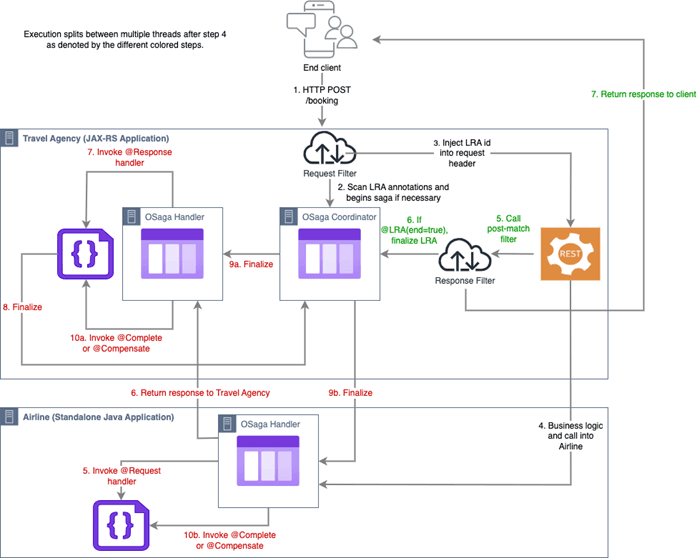
The following asynchronous flow diagram shows the process flow of a Saga application illustrated in the previous code examples. The numbers in the flow diagram correspond to the numbers shown in the code snippet.
See Also: Troubleshooting the Saga Framework for more information about the Saga lifecycle
Figure 1: Asynchronous Flow
Saga Property File
The following shows the Saga property file used by the example program.
# JAX-RS filter properties
osaga.filter.database.tnsAlias=ta
osaga.filter.database.walletPath=/Path/to/wallet
osaga.filter.database.tnsPath=/Path/to/tns
osaga.filter.initiator.publisherCount=2
osaga.filter.initiator.name=TravelAgency
osaga.travelagency.tnsAlias=ta

# Property values for the Initiator Travelagency
osaga.travelagency.walletPath=/Path/to/wallet
osaga.travelagency.tnsPath=/Path/to/tns
osaga.travelagency.numListeners=2
osaga.travelagency.numPublishers=2

# Properties pertaining to the Airline participant
osaga.airline.tnsAlias=airline1
osaga.airline.walletPath=/Path/to/wallet
osaga.airline.tnsPath=/Path/to/tns
osaga.airline.numListeners=2
osaga.airline.numPublishers=2
Finalizing a Saga Explicitly
In addition to the automatic reservable column-based finalization, the Saga framework supports finalization (complete or compensate) that is application-specific and explicit (user-defined). The framework automatically invokes application-specific finalization routines during Saga finalization.
You can designate the application-specific finalization using the PL/SQL callback routines for the PL/SQL clients.
Note: Ensure that there is no explicit COMMIT command issued from the user-defined callbacks that are implemented using the PL/SQL callback package. The Saga framework commits the changes on behalf of the application.
For Java programs, Developing Java Applications Using Saga Annotations describes the @BeforeComplete, @BeforeCompensate, and @Complete, @Compensate annotations that a Java program can use to implement application-specific compensation. In such cases, the lock-free reservations are automatically compensated between the @BeforeCompensate and @Compensate annotated methods.
PL/SQL Callbacks for a PL/SQL Client
A PL/SQL based initiator or participant needs to implement a callback package to participate in Sagas. The callback package is called internally from the notification callback for the respective participant. The callback package enables you to ignore the internal details of the Saga infrastructure and focus on your business logic.
Applications must ensure that the implementation of a callback package does not invoke any database transaction control operations (commit/rollback).
The callback package provides the following functions:
request Function
Syntax: function request(saga_id IN RAW, saga_sender IN VARCHAR2, payload IN JSON DEFAULT NULL) return JSON;
Description:The request function is invoked when receiving a Saga message with opcode REQUEST. The application is expected to implement this method. A JSON payload is returned that is sent back to the initiator as a response.
response Procedure
Syntax: procedure response(saga_id IN RAW, saga_sender IN VARCHAR2, payload IN JSON DEFAULT NULL)
Description: The response procedure is invoked when receiving a Saga message with opcode RESPONSE. The application is expected to implement this method.
before_commit Procedure
Syntax: procedure before_commit(saga_id IN RAW, saga_sender IN VARCHAR2, payload IN JSON DEFAULT NULL)
Description: The before_commit procedure is invoked before executing the Saga commit on the current participant when receiving a Saga message with opcode COMMIT for the same transaction. The before_commit() procedure is called before the lock-free reservation commits. The application is expected to implement this method and the applications that use lock-free reservations can choose whether to implement the before_commit() or after_commit() procedure.
after_commit Procedure
Syntax: procedure after_commit(saga_id IN RAW, saga_sender IN VARCHAR2, payload IN JSON DEFAULT NULL)
Description: The after_commit procedure is invoked after executing the Saga commit on the current participant when receiving a Saga message with opcode COMMIT for the same transaction. The after_commit procedure is called after the lock-free reservation commits. The application is expected to implement this method and the applications that use lock-free reservations can choose whether to implement the before_commit() or after_commit() procedure.
before_rollback Procedure
Syntax: procedure before_rollback(saga_id IN RAW, saga_sender IN VARCHAR2, payload IN JSON DEFAULT NULL)
Description: The before_rollback procedure is invoked before executing the Saga rollback on the current participant when receiving a Saga message with opcode ROLLBACK for the same transaction. The before_rollback procedure is called before the lock-free reservation rollbacks. The application is expected to implement this procedure and the applications that use lock-free reservations can choose whether to implement the before_rollback or after_rollback procedure.
after_rollback Procedure
Syntax: procedure after_rollback(saga_id IN RAW, saga_sender IN VARCHAR2, payload IN JSON DEFAULT NULL)
Description: The after_rollback procedure is invoked after executing the Saga rollback on the current participant when receiving a Saga message with opcode ROLLBACK for the same transaction. The after_rollback procedure is called after the lock-free reservation rollbacks. The application is expected to implement this procedure and the applications that use lock-free reservations can choose whether to implement the before_rollback or after_rollback procedure.
forget Procedure
Syntax: procedure forget(saga_id IN RAW, saga_sender IN VARCHAR2, payload IN JSON DEFAULT NULL)
Description: The Saga coordinator invokes the forget procedure to ask a participant to mark the Saga as forgotten. A Saga marked as forgotten cannot be finalized and requires administrative intervention. The forget procedure is triggered upon receiving a negative acknowledgment from the coordinator. A coordinator can respond with a negative acknowledgment to join requests. For example, if a Saga is set with a timeout and a participant join request is received after the timeout, a negative acknowledgment is sent to the participant. Another example of a negative acknowledgment is when a negative acknowledgment is sent on a join request made after a Saga has already been finalized by its initiator.
is_join Procedure
Syntax: procedure is_join (saga_id IN saga_id_t, saga_sender IN VARCHAR2);
Description: The Saga participants invoke the is_join procedure to disassociate themselves from the ongoing Sagas. The procedure gives the participant a choice to move ahead in this Saga or send a REJECT back to the initiator.
reject Procedure
Syntax: procedure reject (saga_id IN saga_id_t, saga_sender IN VARCHAR2);
Description: An initiator invokes the reject procedure and receives a notification if a participant rejected the invitation to join the Saga. A participant can return FALSE in their is_join method, which sends a REJECT message to the initiator.
after_saga Procedure
Syntax: procedure after_saga(saga_id in RAW, status in varchar2)
Description: For PL/SQL-based initiators, the after_saga procedure is invoked if defined in the callback package. For PL/SQL-based participants, the after_saga method is invoked if defined in the callback package and when event 10855 is set at level 512.
The argument status has the stringified values for enum(org.eclipse.microprofile.lra.annotation.LRAStatus).
Note: Along with thepayload, the implemented methods supply saga_Id and the saga_sender (sender of this message) as arguments. The clients can use the saga_Id, saga_sender, and payload parameters for book-keeping, maintaining internal states, or both.
Integration with Lock-Free Reservation
Lock-free reservation enables automatic compensation (rollback) of changes to reservable columns. The reservation journal table records an entry for every update to a reservable column in the database. These entries provide the information needed for compensating changes to the reservable columns. The reservation journal entries associated with Saga-related changes to the reservable columns are retained until the Saga is finalized.
The Saga framework uses the saga_finalization$ dictionary table to track the set of reservable tables and their corresponding journals affected by a Saga. The creation of the reservation journal entry happens during the SQL update. For example, here is a sequence of updates and the respective saga_finalization$ entries:
Update hotel_rooms set rooms = rooms - 2 where date=to_date('20201010');
Update hotel_rooms set rooms = rooms - 1 where date=to_date('20201011');
Update dinner_tables set available_tables= available_tables - 3 where date=to_date('20201010');
Table 2 saga_finalization$ table entries
| saga_id | participant | Txn_Id | User# | reservable_table | reservation_journal | status |
|---|---|---|---|---|---|---|
| ABC123 | Hotel | 1 | 124 | hotel_rooms | SYS_RESERVJRNL_81696 |
active |
| ABC123 | Hotel | 2 | 124 | dinner_tables | SYS_RESERVJRNL_81697 |
active |
The Saga framework performs compensating actions during a Saga rollback. Reservation journal entries provide the data that is required to take compensatory actions for Saga transactions. The Saga framework sequentially processes the saga_finalization$ table for a Saga branch and executes the compensatory actions using the reservation journal. Saga_finalization$ entries are marked “compensated” upon successful Saga compensation. Saga_finalization$ entries are marked “committed” upon successful Saga commit. After a saga_finalization$ entry is marked as “compensated” or “committed”, no further actions are possible.
After a Saga is finalized (successful commit or compensation), the reservation journal entries corresponding to all reservation journals associated with the Saga are deleted. The saga_finalization$ entries for the given Saga are also deleted.
See Also: Lock-Free Reservation
AfterSaga Callbacks
An AfterSaga (or AfterLRA) callback method is called after an LRA (Long Running Action, as in a Saga) has completed. An AfterLRA method is used to notify a Saga’s participants that the Saga is complete.
For a Saga in a Java-based or PL/SQL application, users can define the AfterLRA callback method. When defined, the callback method is invoked after all the participants of the Saga enter a final state; which is when all the participants involved in the Saga have successfully committed or rolled back the Saga. The Saga coordinator invokes the AfterLRA method on the initiator and all the participants, thereby triggering the @afterLRA annotated method for Java-based applications and the afterLRA() method for PL/SQL-based applications.
Note: The initiator’s AfterSaga callback is invoked by default. Participant’s AfterSaga callback is only invoked when event 10855 is set at level 512.
@afterLRA Method
For Java-based initiators and participants, the method decorated with @afterLRA is triggered. The method decorated with the @afterLRA annotation is expected to have the following signature:
@AfterLRA
public void testAfterLRA(SagaMessageContext ctx, LRAStatus status) {
}
SagaMessageContext is the Saga message context object and LRAStatus is defined by LRAStatus (as defined by Eclipse Microprofile).
after_saga Method
For PL/SQL-based initiators and participants, the following method is invoked, if defined in the callback package:
procedure after_saga(saga_id in RAW, status in varchar2)status has the stringified values for enum(org.eclipse.microprofile.lra.annotation.LRAStatus).
The Saga coordinator attempts to invoke the AfterLRA method for all completed Sagas in an interval of 5 minutes (300 seconds). You can modify this interval using the underscore parameter: _saga_afterlra_interval.
Dictionary Views
Calling the user-defined AfterLRA method changes the initiator’s status in the USER_SAGAS dictionary views to:
-
committingorrolling backafter the initiator submitscommitorrollback. -
committedorrolled backafter processing thecommitorrollbackfor a participant and after all the participants completecommitorrollbackfor the initiator.
See Also: USER_SAGAS in Database Reference Guide for views-related information