Oracle Real Application Clusters and Oracle Clusterware
Oracle RAC and Oracle Clusterware enable Oracle AI Database to run any packaged or custom application across a set of clustered servers.
This capability provides the highest levels of availability and the most flexible scalability. If a clustered server fails, then Oracle AI Database continues running on the surviving servers. When more processing power is needed, you can add another server without interrupting access to data.
Oracle RAC enables multiple instances that are linked by an interconnect to share access to an Oracle database. In an Oracle RAC environment, Oracle AI Database runs on two or more systems in a cluster while concurrently accessing a single shared database. The result is a single database system that spans multiple hardware systems, enabling Oracle RAC to provide high availability and redundancy during failures in the cluster. Oracle RAC accommodates all system types, from read-only data warehouse systems to update-intensive online transaction processing (OLTP) systems.
Oracle Clusterware is software that, when installed on servers running the same operating system, enables the servers to be bound together to operate as if they are one server, and manages the availability of user applications and Oracle databases. Oracle Clusterware also provides all of the features required for cluster management, including node membership, group services, global resource management, and high availability functions:
-
For high availability, you can place Oracle databases (single-instance or Oracle RAC databases), and user applications (Oracle and non-Oracle) under the management and protection of Oracle Clusterware so that the databases and applications restart when a process fails or so that a failover to another node occurs after a node failure.
-
For cluster management, Oracle Clusterware presents multiple independent servers as if they are a single-system image or one virtual server. This single virtual server is preserved across the cluster for all management operations, enabling administrators to perform installations, configurations, backups, upgrades, and monitoring functions. Then, Oracle Clusterware automatically distributes the processing of these management functions to the appropriate nodes in the cluster.
Oracle Clusterware is a requirement for using Oracle RAC. Oracle Clusterware is the only clusterware that you need for most platforms on which Oracle RAC operates. Although Oracle AI Database continues to support third-party clusterware products on specified platforms, using Oracle Clusterware provides these main benefits:
-
Dispenses with proprietary vendor clusterware
-
Uses an integrated software stack from Oracle that provides disk management with local or remote Oracle Automatic Storage Management (Oracle Flex ASM) to data management with Oracle AI Database and Oracle RAC
-
Can be configured in large clusters, called an Oracle Flex Cluster.
In addition, Oracle AI Database features, such as Oracle services, use the underlying Oracle Clusterware mechanisms to provide their capabilities.
Oracle Clusterware requires two clusterware components: a voting disk to record node membership information and the Oracle Cluster Registry (OCR) to record cluster configuration information. The voting disk and the OCR must reside on shared storage. Oracle Clusterware requires that each node be connected to a private network over a private interconnect.
Benefits of Using Oracle Clusterware
Oracle Clusterware provides the following benefits.
-
Tolerates and quickly recovers from computer and instance failures.
-
Simplifies management and support by means of using Oracle Clusterware together with Oracle AI Database. By using fewer vendors and an all Oracle stack you gain better integration compared to using third-party clusterware.
-
Performs rolling upgrades for system and hardware changes. For example, you can apply Oracle Clusterware upgrades, patch sets, and interim patches in a rolling fashion.
-
Automatically restarts failed Oracle processes.
-
Automatically manages the virtual IP (VIP) address. When a node fails, the node's VIP address fails over to another node on which the VIP address can accept connections.
-
Automatically restarts resources from failed nodes on surviving nodes.
-
Controls Oracle processes as follows:
-
For Oracle RAC databases, Oracle Clusterware controls all Oracle processes by default.
-
For Oracle single-instance databases, Oracle Clusterware enables you to configure the Oracle processes into a resource group that is under the control of Oracle Clusterware.
-
-
Provides an application programming interface (API) for Oracle and non-Oracle applications that enables you to control other Oracle processes with Oracle Clusterware, such as restart or react to failures and certain rules.
-
Manages node membership and prevents split-brain syndrome in which two or more instances attempt to control the database.
-
Using server weight-based node eviction allows for aligning the choice of which node gets evicted in case of certain failures in the cluster with business requirements, ensuring that the most important workload is kept alive for as long as possible, assuming an equal choice between servers.
-
Provides the ability to perform rolling release upgrades of Oracle Clusterware, with no downtime for applications.
Benefits of Using Oracle Real Application Clusters and Oracle Clusterware
Together, Oracle RAC and Oracle Clusterware provide all of the Oracle Clusterware benefits plus the following benefits.
-
Provides better integration and support of Oracle AI Database by using an all Oracle software stack compared to using third-party clusterware.
-
Relocate Oracle Service automatically. Plus, when you perform additional fast application notification (FAN) and client configuration, distribute FAN events so that applications can react immediately to achieve fast, automatic, and intelligent connection and failover.
-
Detect connection failures fast and automatically, and remove terminated connections for any Java application using Oracle Universal Connection Pool (Oracle UCP) Fast Connection Failover and FAN events.
-
Balance work requests using Oracle UCP runtime connection load balancing.
-
Use runtime connection load balancing with Oracle UCP, Oracle Call Interface (OCI), and Oracle Data Provider for .NET (ODP.NET).
-
Distribute work across all available instances using load balancing advisory.
-
You can configure a database so that Oracle Clusterware is aware of the CPU requirements and limits for the given database. Oracle Clusterware uses this information to place the database resource only on servers that have a sufficient number of CPUs, amount of memory, or both.
-
Allow the flexibility to increase processing capacity using commodity hardware without downtime or changes to the application.
-
Provide comprehensive manageability integrating database and cluster features.
-
Provide scalability across database instances.
-
Implement Fast Connection Failover for nonpooled connections.
Oracle RAC Advantages Over Traditional Cold Cluster Solutions
Oracle RAC provides many advantages over traditional cold cluster solutions, including the following.
-
Scalability across database instances
-
Flexibility to increase processing capacity using commodity hardware without downtime or changes to the application
-
Ability to tolerate and quickly recover from computer and instance failures (measured in seconds)
-
Application brownout can be zero or seconds compared to minutes and hours with cold cluster solutions
-
Optimized communication in the cluster over redundant network interfaces, without using bonding or other technologies
Oracle Grid Infrastructure and Oracle RAC make use of Redundant Interconnect Usage that distributes network traffic and ensures optimal communication in the cluster. This functionality is available starting with Oracle Database 11g Release 2 (11.2.0.2). In previous releases, technologies like bonding or trunking were used to make use of redundant networks for the interconnect.
-
Rolling upgrades for system and hardware changes
-
Rolling patch upgrades for some interim patches, security patches, CPUs, and cluster software
-
Fast, automatic, and intelligent connection and service relocation and failover
-
Comprehensive manageability integrating database and cluster features with Grid Plug and Play and policy-based cluster and capacity management
-
Load balancing advisory and run-time connection load balancing help redirect and balance work across the appropriate resources
-
Oracle Quality of Service (QoS) Management for policy-based run-time management of resource allocation to database workloads to ensure service levels are met in order of business need under dynamic conditions. This is accomplished by assigning a service to a server pool where the database is running. Resources from the pool are used to make sure the required capacity is available.
-
Oracle Enterprise Management support for Oracle Automatic Storage Management (ASM) and Oracle Advanced Cluster File System (ACFS), Grid Plug and Play, Cluster Resource Management, Oracle Clusterware and Oracle RAC Provisioning and patching.
-
SCAN (Single Client Access Name) support as a single name to the clients connecting to Oracle RAC that does not change throughout the life of the cluster, even if you add or remove nodes from the cluster.
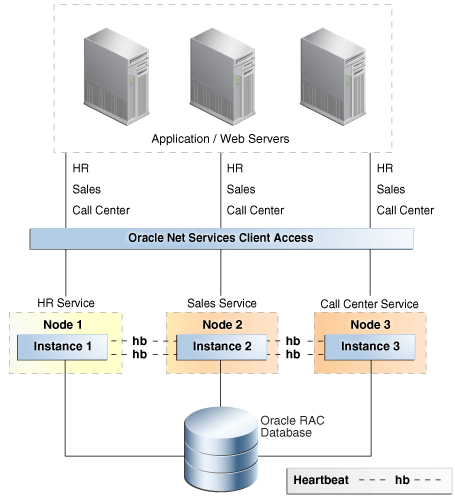
The following figure shows Oracle AI Database with Oracle RAC architecture. This figure shows Oracle AI Database with Oracle RAC architecture for a partitioned three-node database. An Oracle RAC database is connected to three instances on different nodes. Each instance is associated with a service: HR, Sales, and Call Center. The instances monitor each other by checking "heartbeats." Oracle Net Services provide client access to the Application/web server tier at the top of the figure.
Figure 3-2 Oracle AI Database with Oracle RAC Architecture
Description of "Figure 3-2 Oracle AI Database with Oracle RAC Architecture"
Note:
After Oracle release 11.2, Oracle RAC One Node or Oracle RAC is the preferred solution over Oracle Clusterware (Cold Cluster Failover) because it is a more complete and feature-rich solution.