STDDEV
Syntax
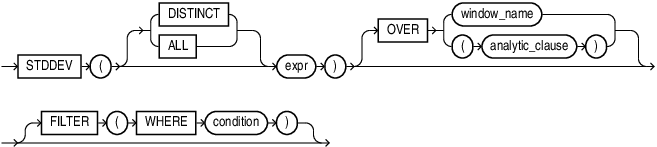
Description of the illustration stddev.gif
See Also: “Analytic Functions” for information on syntax, semantics, and restrictions
Purpose
STDDEV returns the sample standard deviation of expr, a set of numbers. You can use it as both an aggregate and analytic function. It differs from STDDEV_SAMP in that STDDEV returns zero when it has only 1 row of input data, whereas STDDEV_SAMP returns null.
Oracle Database calculates the standard deviation as the square root of the variance defined for the VARIANCE aggregate function.
This function takes as an argument any numeric data type or any nonnumeric data type that can be implicitly converted to a numeric data type. The function returns the same data type as the numeric data type of the argument.
See Also: Table 2-9 for more information on implicit conversion
If you specify DISTINCT, then you can specify only the query_partition_clause of the analytic_clause. The order_by_clause and windowing_clause are not allowed.
See Also:
-
“Aggregate Functions”, VARIANCE, and STDDEV_SAMP
-
“About SQL Expressions” for information on valid forms of expr
Aggregate Examples
The following example returns the standard deviation of the salaries in the sample hr.employees table:
SELECT STDDEV(salary) "Deviation"
   FROM employees;

 Deviation
----------
3909.36575
For the semantics of the FILTER clause, see FILTER Clause Semantics.
Analytic Examples
The query in the following example returns the cumulative standard deviation of the salaries in Department 80 in the sample table hr.employees, ordered by hire_date:
SELECT last_name, salary,
   STDDEV(salary) OVER (ORDER BY hire_date) "StdDev"
   FROM employees
   WHERE department_id = 30
   ORDER BY last_name, salary, "StdDev";

LAST_NAME                     SALARY     StdDev
------------------------- ---------- ----------
Baida                           2900 4035.26125
Colmenares                      2500 3362.58829
Himuro                          2600  3649.2465
Khoo                            3100 5586.14357
Raphaely                       11000          0
Tobias                          2800  4650.0896