Network Hierarchy
Some network applications require representations at different levels of abstraction. For example, two major processes might be represented as nodes with a link between them at the highest level of abstraction, and each major process might have several subordinate processes that are represented as nodes and links at the next level down.
A network hierarchy enables you to represent a network with multiple levels of abstraction by assigning a hierarchy level to each node. (Links are not assigned a hierarchy level, and links can be between nodes in the same hierarchy level or in different levels.) The lowest (most detailed) level in the hierarchy is level 1, and successive higher levels are numbered 2, 3, and so on.
Nodes at adjacent levels of a network hierarchy have parent-child relationships. Each node at the higher level can be the parent node for one or more nodes at the lower level. Each node at the lower level can be a child node of one node at the higher level. Sibling nodes are nodes that have the same parent node.
Links can also have parent-child relationships. However, because links are not assigned to a hierarchy level, there is not necessarily a relationship between link parent-child relationships and network hierarchy levels. Sibling links are links that have the same parent link.
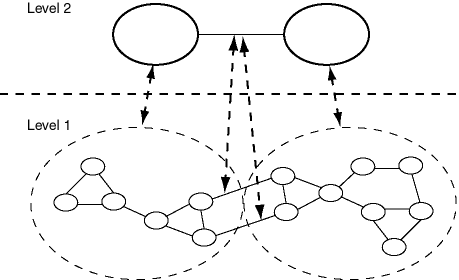
Figure: Network Hierarchy shows a simple hierarchical network, in which there are two levels.
Figure: Network Hierarchy
Description of the illustration net_hier.gif
As shown in Figure: Network Hierarchy:
-
The top level (level 2) contains two nodes. Each node is the parent node of several nodes in the bottom level. The link between the nodes in the top level is the parent link of two links between nodes in the bottom level.
-
The bottom level (level 1) shows the nodes that make up each node in the top level. It also shows the links between nodes that are child nodes of each parent node in the top level, and two links between nodes that have different parent nodes.
-
The links between nodes in the bottom level that have different parent nodes are shown with dark connecting lines. These links are child links of the single link between the nodes in the top level in the hierarchy. (However, these two links in the bottom level could also be defined as not being child links of any parent link between nodes in a higher level.)
-
The parent-child relationships between each parent node and link and its child nodes and links are shown with dashed lines with arrowheads at both ends.
Although it is not shown in Figure: Network Hierarchy, links can cross hierarchy levels. For example, a link could be defined between a node in the top level and any node in the bottom level. In this case, there would not be a parent-child relationship between the links.
Given certain grouping of nodes in a network, a parent network can be defined. The group IDs in the child network are used as node IDs in the parent network. The aggregated links between groups in the child network represent the links in the parent network, with arbitrary link IDs assigned.
A network can have multiple ways of grouping its nodes based on different criteria; therefore, it can have multiple parent networks. In addition, nodes in a parent network can be further grouped to form a higher-level parent network. For example, in a social network, members can be grouped by city, profession, income, or other criteria. Members grouped by city, for example, can be further grouped into higher-level county, state, or country networks.
The parent-child network relationship is defined through the CHILD_NETWORK and HIERARCHY_TABLE_NAME columns in the network metadata.
Note: Do not confuse a hierarchical network with a multilevel network, which is a network with multiple link levels. A multilevel network does not necessarily have parent-child relationships between nodes; that is, a multilevel network may also be a hierarchical network or may also not be a hierarchical network. In a multilevel network, a higher-level network (such as level 2) is just a subnetwork of a lower-level network (such as level 1), with link levels greater than or equal to the higher-level link.