3 Using ORDS Model Context Protocol (MCP)
This chapter describes how to use the ORDS Model Context Protocol (MCP) endpoint after it has been enabled and configured by an ORDS administrator. ORDS MCP makes selected database resources and services available to MCP-compatible tools, enabling users to securely discover and interact with ORDS capabilities through a standardized protocol.
Oracle REST Data Services (ORDS) Model Context Protocol (MCP) enables authenticated AI clients and developer tools to discover authorized ORDS MCP databases, inspect schema metadata, and execute SQL through standardized MCP tools.
ORDS MCP provides seamless integration between Oracle Database and AI applications, allowing you to query Oracle Database using natural language through AI-powered interactions.
Caution:
Granting a large language model (LLM) access to your database can expose sensitive data if the LLM is configured with excessive privileges.
To reduce this risk, follow these security best practices:
- Grant least-privilege access: Configure the database user account used by the ORDS MCP connection pool with only the privileges required to perform the intended tasks.
- Avoid direct access to production databases: Use a sanitized, read-only replica or a dedicated subset of data whenever possible.
- Monitor and audit LLM activity: Regularly review the SQL statements executed through ORDS MCP to detect unexpected or unauthorized access attempts.
- Audit LLM activity: Regularly audit the queries executed by
the LLM. This helps you detect anomalies or the attempts to access restricted
data. To support your auditing efforts, the ORDS MCP Server provides the
following built-in monitoring capabilities:
- Session tracking: It populates
VSESSION.MODULEwith the LLM name, andV$SESSION.ACTIONwith the MCP tool name. - Activity logging: Records every interaction and SQL
execution in the
DBTOOLS$MCP_LOGtable. - Query identification: All LLM-generated SQL
statements executed through ORDS MCP tools include a comment such as
/* LLM in use ... */, making them easier to identify in logs.
- Session tracking: It populates
- About ORDS MCP
This section provides an overview of the Model Context Protocol (MCP) and explains how ORDS implements it to enable authenticated AI applications to interact with Oracle Database. It also describes the ORDS MCP endpoint, authorized database targets, and how AI clients discover and access them. - About ORDS MCP Server Tools
This section describes the tools provided by the ORDS MCP Server and how they enable AI applications to discover authorized databases, inspect schema metadata, and execute SQL and PL/SQL through the standardized MCP interface. - Understanding the ORDS MCP Workflow
This section explains how the ORDS MCP Server processes requests from AI applications, from interpreting natural language prompts to executing SQL against Oracle Database and returning the results to the client. - Preparing the Environment for ORDS MCP
This following sections describe how to prepare your environment for ORDS MCP by installing the required software and configuring database connections. - MCP Authentication and Discovery
This section describes how ORDS MCP authenticates clients using OAuth 2.0 Bearer JWT access tokens and how clients discover the required authentication metadata. - MCP Protocol Requests
This section describes the ORDS MCP endpoint, required request headers, supported protocol versions, and request validation behavior. - Connecting to the ORDS MCP Server
This section explains how to configure an MCP client to connect to the ORDS MCP Server. - Discover ORDS MCP Tools
This section describes the tools available in the ORDS MCP Server. - Discover Authorized Databases
This section explains how to discover the databases that the caller is authorized to access. - Inspect Schema Metadata
This section describes how to retrieve schema metadata with configurable levels of detail. - Execute SQL
This section describes how to execute SQL or PL/SQL statements using thesql_runtool. - Understanding Authorization Failures
This section explains how ORDS MCP authorizes requests and describes the most common causes of authorization failures. - Monitoring the ORDS MCP Server
This section explains how to monitor and audit ORDS MCP Server activity using database logs, session views, and application context information. - Database Session Identity Attributes
This section explains how to retrieve the request ECID and correlate database activity with ORDS logs. - Correlating Database Activity with ORDS Logs
This section describes how to retrieve the request ECID and use it to correlate database activity with ORDS logs.
See Also:
Monitoring the ORDS MCP Server3.1 About ORDS MCP
This section provides an overview of the Model Context Protocol (MCP) and explains how ORDS implements it to enable authenticated AI applications to interact with Oracle Database. It also describes the ORDS MCP endpoint, authorized database targets, and how AI clients discover and access them.
The Model Context Protocol (MCP) is an open standard that provides a consistent method for applications to supply contextual information to AI models. MCP standardizes the connection between AI systems and external tools or data sources, such as databases and APIs. After establishing a connection, an AI client can use natural language to perform the full range of database operations. This includes executing SQL queries and invoking PL/SQL procedures.
ORDS MCP is an authenticated MCP server available at the
/mcp endpoint on the ORDS host. It enables AI applications to
interact with Oracle databases through the standardized MCP interface, providing a
structured way to discover and use authorized databases.
In MCP client responses, ORDS identifies each authorized MCP target as a database. Each database corresponds to an ORDS direct database pool configured by an administrator.
See Also:
Model Context ProtocolParent topic: Using ORDS Model Context Protocol (MCP)
3.2 About ORDS MCP Server Tools
This section describes the tools provided by the ORDS MCP Server and how they enable AI applications to discover authorized databases, inspect schema metadata, and execute SQL and PL/SQL through the standardized MCP interface.
The ORDS MCP Server provides a set of tools that enable AI applications to interact with Oracle databases.
These tools enable AI applications to perform sophisticated database tasks through natural language interactions, including executing SQL queries, invoking PL/SQL procedures, running complex analytical queries, and automating administrative tasks. By providing a standardized interface to Oracle databases, the ORDS MCP Server reduces the need for specialized database expertise and simplifies the execution of complex database operations.
The following tools are currently available through the ORDS MCP Server:
database_list:Discovers and lists all accessible MCP database targets. Each database corresponds to a single database schema. Use this tool to identify the database argument required by the other MCP tools.schema_information: Provides detailed schema information for the specified database.sql_run: Runs SQL queries and PL/SQL code blocks against the specified database.
Parent topic: Using ORDS Model Context Protocol (MCP)
3.3 Understanding the ORDS MCP Workflow
This section explains how the ORDS MCP Server processes requests from AI applications, from interpreting natural language prompts to executing SQL against Oracle Database and returning the results to the client.
The ORDS MCP Server provides a standardizes protocol between AI systems and your Oracle Database.
The following steps describe the ORDS MCP Server workflow:
- User request: The user submits a natural language request to an
MCP client (for example, Claude Desktop), such as, "
Retrieve all employees
                    hired last month from the HR schema.
" - MCP client processing: The MCP client performs the following tasks:
- Interprets the natural language request, identifies the user's intent, and determines the appropriate ORDS MCP Server tool to invoke.
- Sends the interpreted request to an AI model, which translates it into the appropriate SQL statement or PL/SQL code.
- Uses the Model Context Protocol (MCP) to issue a structured tool call to the ORDS MCP Server, including the generated SQL statement or PL/SQL code for execution.
- Database operation: The ORDS MCP Server receives the request and executes the corresponding SQL query against the Oracle Database using the selected ORDS Database Pool configuration.
- Response formatting and delivery: ORDS processes the query results, formats the response in compliance with MCP standards, and sends it back to the MCP client. The client then renders the information in clear, natural language for the user.
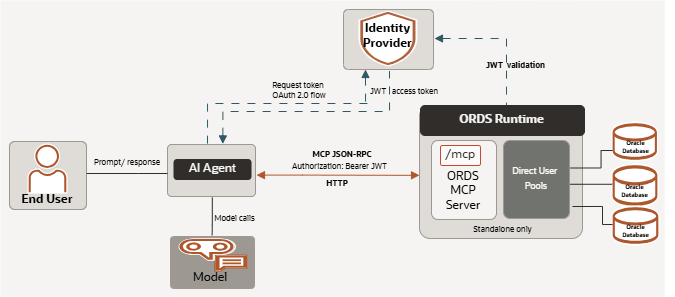
Parent topic: Using ORDS Model Context Protocol (MCP)
3.4 Preparing the Environment for ORDS MCP
This following sections describe how to prepare your environment for ORDS MCP by installing the required software and configuring database connections.
- Installing the Required Software
This section describes the software requirements for the ORDS MCP Server and the versions you must install before configuring and using ORDS MCP. - Authorization Server for ORDS MCP
This section describes how to configure an authorization server for ORDS MCP authentication. - Configuring ORDS MCP
This section describes how to enable and configure ORDS MCP, including JWT authentication and optional Role-Based Access Control (RBAC). - Creating an MCP-Compatible ORDS Database Pool
This section describes how to create and configure an MCP-compatible ORDS database pool.
Parent topic: Using ORDS Model Context Protocol (MCP)
3.4.1 Installing the Required Software
This section describes the software requirements for the ORDS MCP Server and the versions you must install before configuring and using ORDS MCP.
Install the following software before you configure and use the ORDS MCP Server:
- Oracle REST Data Services (ORDS) 26.2.0 or later
- Oracle Java Runtime Environment (JRE) 17, 21, or 25
Parent topic: Preparing the Environment for ORDS MCP
3.4.2 Authorization Server for ORDS MCP
This section describes how to configure an authorization server for ORDS MCP authentication.
Access to ORDS MCP requires a valid JWT bearer token. Configure an authorization
server that can issue JWT tokens with the
urn:oracle:dbtools:ords:mcpserver:all scope.
Parent topic: Preparing the Environment for ORDS MCP
3.4.3 Configuring ORDS MCP
This section describes how to enable and configure ORDS MCP, including JWT authentication and optional Role-Based Access Control (RBAC).
ords --config /path/to/conf config set feature.mcp trueUse the following global ORDS settings to configure how ORDS can validate the JWT Bearer token:
ords --config /path/to/conf config  set --global mcp.security.jwt.profile.issuer "https://idp.example.comm/"
ords --config /path/to/conf config  set --global mcp.security.jwt.profile.audience "https://ords.example.com/mcp"
ords --config /path/to/conf config  set --global mcp.security.jwt.profile.jwk.url "https://idp.example.com/.well-known/jwks.json"
ords --config /path/to/conf config  set --global mcp.security.jwt.profile.authorization.server.url "https://idp.example.com"
Optionally, a claim in the JWT can be used to suppport Role Based Access Control in conjunction with an MCP Database Pool configured with mcp.role setting.
ords --config /path/to/conf config set --global mcp.security.jwt.profile.role.claim.name "/roles"Parent topic: Preparing the Environment for ORDS MCP
3.4.4 Creating an MCP-Compatible ORDS Database Pool
This section describes how to create and configure an MCP-compatible ORDS database pool.
The ORDS MCP Server relies on preconfigured database pools that are dedicated to MCP use.
Note:
For an ORDS database pool to be accessible to an MCP client, it must:- Connect directly to the target database user (for example,
HR). It must not connect through an ORDS runtime user such asORDS_PUBLIC_USER. - Specify either
mcp.scopeormcp.role, depending on your preferred security model.
To create an MCP-compatible database pool, run a command similar to the following example:
ords --config /path/to/conf config --db-pool mcp-hr set db.connectionType basic
ords --config /path/to/conf config --db-pool mcp-hr set db.hostname databaseserver
ords --config /path/to/conf config --db-pool mcp-hr set db.port 2600
ords --config /path/to/conf config --db-pool mcp-hr set db.servicename orcl
ords --config /path/to/conf config --db-pool mcp-hr set db.username HR
ords --config /path/to/conf config --db-pool mcp-hr set db.description "Human Resources MCP Acccess"
ords --config /path/to/conf config --db-pool mcp-hr set mcp.scope "urn:oracle:dbtools:ords:mcpserver:all"
ords --config /path/to/conf config --db-pool mcp-hr secret db.password
Note:
In this example, mcp.scope is set to the global scope,
urn:oracle:dbtools:ords:mcpserver:all, which is required to
access the MCP service. Alternatively, you can configure a custom scope for each
database pool to control access individually.
Parent topic: Preparing the Environment for ORDS MCP
3.5 MCP Authentication and Discovery
This section describes how ORDS MCP authenticates clients using OAuth 2.0 Bearer JWT access tokens and how clients discover the required authentication metadata.
/mcp returns a bearer challenge
that identifies the protected-resource metadata location. MCP clients can
use the following protected-resource metadata endpoint during OAuth
discovery:/.well-known/oauth-protected-resource/mcpWhen the ORDS administrator provides an authorization server URL, the client uses
the associated metadata to discover the authorization server, obtain a JWT
access token for the /mcp resource, and invoke the
/mcp endpoint with an Authorization: Bearer
<access_token> header.
An ORDS administrator may choose not to configure an authorization server URL. In
this case, ORDS omits the authorization_servers field from
the protected-resource metadata to keep the authorization server private.
The MCP client must therefore be configured with the authorization server
details outside of ORDS discovery.
The token must contain the global ORDS MCP access scope:
urn:oracle:dbtools:ords:mcpserver:allDepending on the server configuration, the token might also require a pool-specific scope or role to access a specific MCP database.
Parent topic: Using ORDS Model Context Protocol (MCP)
3.6 MCP Protocol Requests
This section describes the ORDS MCP endpoint, required request headers, supported protocol versions, and request validation behavior.
The ORDS MCP endpoint accepts JSON-RPC requests over HTTP POST at the
/mcp endpoint.
Authorization: Bearer access-token
Content-Type: application/json
Accept: application/json, text/event-stream
MCP-Protocol-Version: 2025-06-18
ORDS MCP supports the following MCP protocol versions:
- 2025-06-18
- 2025-11-25
ORDS rejects unsupported MCP-Protocol-Version header values, invalid
origins, and JSON-RPC batch requests. If an initialize request body contains an
unsupported protocol version, ORDS negotiates to the latest supported protocol
version.
Parent topic: Using ORDS Model Context Protocol (MCP)
3.7 Connecting to the ORDS MCP Server
This section explains how to configure an MCP client to connect to the ORDS MCP Server.
The ORDS MCP Server supports any MCP client that implements the Streamable HTTP transport and OAuth 2.0 authentication. If your MCP client supports only the local stdio transport, then use a proxy such as mcp-remote to provide OAuth authentication and remote HTTP connectivity.
To use the ORDS MCP Server, configure your preferred MCP client, such as Claude Desktop or Cline, by specifying the server endpoint and the required authentication details. Once configured, the client automatically manages the connection and enables natural language interactions with Oracle Database through the ORDS MCP Server.
- Configuring Claude Desktop
This section describes the ORDS MCP endpoint, required request headers, and supported protocol versions.
Parent topic: Using ORDS Model Context Protocol (MCP)
3.7.1 Configuring Claude Desktop
This section describes the ORDS MCP endpoint, required request headers, and supported protocol versions.
Perform the following steps to configure Claude Desktop for ORDS MCP Server. After configuration, Claude Desktop automatically uses the ORDS MCP Server, enabling you to perform Oracle Database operations through your conversations with Claude.
Claude Desktop uses mcp-remote to handle OAuth authentication and
remote HTTP communication with the ORDS MCP Server.
- Use the following command to install
mcp-remote:npm install -g mcp-remote - Install Claude Desktop.
Note:
Installing Claude for Desktop. - Download the configuration file.
- From the Claude Desktop menu, select File and then Settings
- In the Settings window, select the Developer tab
- Click Edit Config to download the
claude_desktop_config.jsonconfiguration file
- Edit the
claude_desktop_config.jsonfile in a text editor. Add the following JSON configuration snippet, replacing"https://ords.example.com/mcp"with the absolute path of your ORDS server, and save the configuration file.{ "mcpServers": { "ords-mcp": { "command": "npx", "args": [ "mcp-remote@latest", "https://ords.example.com/mcp", "--allow-http" ] } } } - Verify the configuration
Click Search and tools in the prompt box. Verify that the ORDS MCP
Server tools are listed and enabled. If necessary, restart Claude Desktop for the
changes to take effect.
Parent topic: Connecting to the ORDS MCP Server
3.8 Discover ORDS MCP Tools
This section describes the tools available in the ORDS MCP Server.
Connect your LLM to the ords-mcp MCP server to discover the
available tools and interact with your Oracle Database using natural language. Use the
tools/list method to retrieve the tools exposed by ORDS MCP.
ORDS MCP provides the following tools:
database_list: Lists the MCP database connections that the caller is authorized to accessschema_information: Returns schema metadata for an authorized MCP databasesql_run: Executes SQL or PL/SQL for an authorized MCP database
Parent topic: Using ORDS Model Context Protocol (MCP)
3.9 Discover Authorized Databases
This section explains how to discover the databases that the caller is authorized to access.
Use the database_list tool to discover the MCP databases that the
caller is authorized to access.
You can optionally specify the name argument to filter the
results by database name. The filter is case-insensitive.
When show_details is set to true, ORDS
includes configured database descriptions, if available. If a database is not returned,
either the caller is not authorized to access it or the corresponding connection pool is
not configured for MCP.
Parent topic: Using ORDS Model Context Protocol (MCP)
3.10 Inspect Schema Metadata
This section describes how to retrieve schema metadata with configurable levels of detail.
Use the schema_information tool to inspect the schema metadata of an
authorized database.The level, objects_list, filter,
and model parameters are optional. Specify BRIEF to
retrieve a concise summary or DETAILED to include comprehensive
metadata.
Parent topic: Using ORDS Model Context Protocol (MCP)
3.11 Execute SQL
This section describes how to execute SQL or PL/SQL statements using the
sql_run tool.
To run SQL or PL/SQL statements against an authorized database, use
sql_run tool. SQL statements run with the privileges of the
underlying ORDS database connection pool. The sql_run tool can run
statements that modify database state. Client applications should present this
capability with caution and should not treat it as a read-only operation.
ORDS records MCP SQL execution details for auditing purposes. The optional
model value can be used to attribute the operation to the AI model
or client workflow that requested it.
sql_run is intended for interactive tool use. It is not a bulk export or
pagination API.
Parent topic: Using ORDS Model Context Protocol (MCP)
3.12 Understanding Authorization Failures
This section explains how ORDS MCP authorizes requests and describes the most common causes of authorization failures.
ORDS MCP authorizes access in two stages. First, the bearer token must satisfy the
global MCP JWT profile and include the global MCP access scope
(urn:oracle:dbtools:ords:mcpserver:all). Second, the token must be
authorized to access the target database. Depending on how the ORDS administrator
configured MCP, authorization is based on either a scope or a role. The target database
can be configured with either a custom mcp.scope value (which is not
discoverable by clients) or the global MCP access scope (which is discoverable).
If database_list does not include a database, the caller cannot infer
whether the corresponding connection pool exists. If a tool call targets a database that
the caller is not authorized to access, ORDS denies the operation.
Common causes of authorization failure include:
- Missing bearer token
- Token issuer, audience, or signature does not match the ORDS MCP JWT profile
- Token does not contain the global MCP access scope
- Token does not contain the pool-specific scope or role required for the requested database
- Requested database is not configured as an MCP pool
Parent topic: Using ORDS Model Context Protocol (MCP)
3.13 Monitoring the ORDS MCP Server
This section explains how to monitor and audit ORDS MCP Server activity using database logs, session views, and application context information.
ORDS MCP Server provides database-side monitoring and auditing capabilities that allow administrators to observe MCP activity, identify the authenticated caller, and correlate database operations with ORDS request processing.
DBTOOLS$MCP_LOGtable- Database session views such as
V$SESSION CLIENTCONTEXTapplication context namespace
- Monitoring MCP Activity
This section explains how to review persisted MCP audit entries and maintain the audit log. - Monitoring Live Sessions
This section explains how to view active MCP-backed database sessions and correlate them with MCP requests.
Parent topic: Using ORDS Model Context Protocol (MCP)
3.13.1 Monitoring MCP Activity
This section explains how to review persisted MCP audit entries and maintain the audit log.
ORDS MCP records database-connected MCP tool activity in the
DBTOOLS$MCP_LOG table. You can query this table to review persisted
MCP audit entries.
For example, the sql_run tool records the executed SQL statement after
ORDS injects a sanitized model comment, while the schema_information
tool records a summary such as get schema metadata for <schema>. To
protect the integrity of the audit trail, ORDS rejects non-SELECT statements that target
DBTOOLS$MCP_LOG.To maintain database performance, regularly prune
the DBTOOLS$MCP_LOG table. For example, retain only the most recent
entries or schedule a periodic cleanup job to prevent unbounded growth.
To view persisted audit entries, run a query similar to the following:
SELECT
    id,
    mcp_client,
    model,
    end_point_type,
    end_point_name,
    log_message
FROM dbtools$mcp_log
ORDER BY id DESC
Parent topic: Monitoring the ORDS MCP Server
3.13.2 Monitoring Live Sessions
This section explains how to view active MCP-backed database sessions and correlate them with MCP requests.
If you have database administrator (DBA) privileges, you can monitor active MCP-backed
database sessions in real time by querying the V$SESSION view.
To display active MCP-backed database sessions, run a query similar to the following:
SELECT
    sid,
    serial#,
    username,
    module,
    action,
    client_identifier,
    status
FROM v$session
WHERE module IS NOT NULL
ORDER BY sid;
You can then correlate the active database session with the MCP request by reading the
CLIENTCONTEXT values.
Parent topic: Monitoring the ORDS MCP Server
3.14 Database Session Identity Attributes
This section explains how to retrieve the request ECID and correlate database activity with ORDS logs.
When you run a database-connected MCP tool, such as sql_run or
schema_information, through ORDS MCP Server, ORDS propagates the
authenticated end-user identity to the database session. These identity attributes are
stored in the CLIENTCONTEXT application context namespace.You can
capture these attributes using Oracle Database Unified Auditing and correlate them with
ORDS logs to provide end-to-end traceability for MCP requests.
The following table describes the identity attributes available in the
CLIENTCONTEXT namespace:
Table 3-1 Database Session Identity Attributes
| Attribute | Description |
|---|---|
OAUTH_PRINCIPAL |
Specifies the identity of the authenticated caller. |
OAUTH_SUB |
Specifies the OAuth subject value. |
OAUTH_ISSUER |
Specifies the OAuth token issuer. |
OAUTH_MODE |
Specifies the authorization mode used for the request, such as
scope or role.
|
REQUEST_ECID |
Specifies the ORDS request ECID used to correlate with ORDS logs. |
OAUTH_APP_ROLES |
Specifies the application roles assigned to the authenticated subject. |
OAUTH_APP_SCOPES |
Specifies the application scopes assigned to the authenticated subject. |
SYS_CONTEXT
function:SELECTSYS_CONTEXT('CLIENTCONTEXT','<PARAMETER_NAME>')FROMdual;Parent topic: Using ORDS Model Context Protocol (MCP)
3.15 Correlating Database Activity with ORDS Logs
This section describes how to retrieve the request ECID and use it to correlate database activity with ORDS logs.
ORDS MCP stores the ORDS Execution Context Identifier (ECID) in the REQUEST_ECID application context attribute. Administrators can use the ECID to correlate database activity with ORDS logs and request processing records.
SELECT
    SYS_CONTEXT('CLIENTCONTEXT', 'REQUEST_ECID') AS request_ecid
FROM dual;
To view the corresponding MCP audit entries in the ORDS logs, enable
FINE logging for ORDS.
You can then use the retrieved ECID to locate the matching request in the ORDS logs, providing end-to-end traceability between the ORDS and database tiers.
Parent topic: Using ORDS Model Context Protocol (MCP)