TimesTen-Specific Features
In addition to the TimesTen general features, the following features are supported within TimesTen:
High Availability
TimesTen has several features that provide performance and high availability.
-
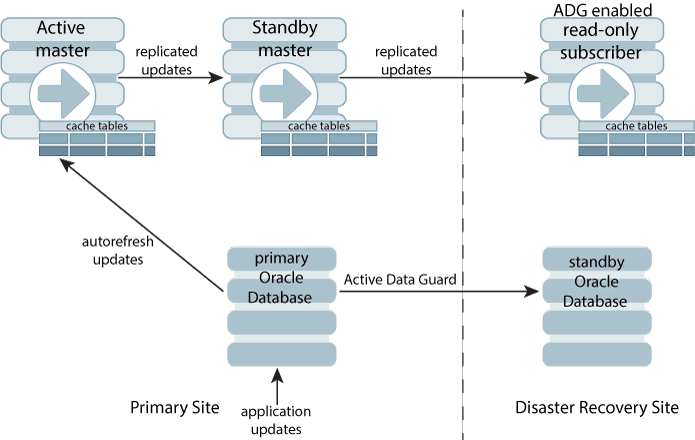
Replication enables you to achieve near-continuous availability or workload distribution by sending updates between two or more hosts. An active standby pair replication scheme includes an active database, a standby database, and optional read-only subscriber databases. In Figure 1-2, the active and standby databases can be located at a primary site, while a read-only subscriber is located at a disaster recovery site.
-
Cache operations enable you to cache portions of an Oracle database in a TimesTen database in tables within a cache group. In Figure 1-2, tables cached on the Oracle database can be cached as read-only copies in TimesTen. TimesTen can automatically propagate changes from the Oracle tables to the cache group in the TimesTen database.
In Figure 1-2, there are two Oracle databases set up within an Active Data Guard (ADG) configuration: one at the primary site and the other at the disaster recovery site. ADG propagates any data changes made on the primary Oracle database to the standby Oracle database. When used in conjunction with cache operations, the integration of ADG within TimesTen ensures that only changes that have been propagated to the standby Oracle database are refreshed to appropriate cache groups. In the event of a failure of the primary Oracle database, we switch over to the standby Oracle database. After which, cache operations also switch over and continue with automatic refresh while remaining consistent with the Oracle database.
There are other recovery methods for if the standby Oracle database fails or if the entire primary site fails. See Recovery After failure when using asynchronous Active Data Guard in the Oracle TimesTen In-Memory Database Cache Guide.
Figure 1-2 Performance and High Availability Configuration
Description of "Figure 1-2 Performance and High Availability Configuration"
See Cached Data and Replication.
Data Replication Between Servers
TimesTen Classic provides replication schemes that enable data replication between servers for high availability and load sharing.
Data replication configurations can be active-standby or active-active, using asynchronous or synchronous transmission, with conflict detection and resolution and automatic resynchronization after a failed server is restored. See Data Replication Within TimesTen.
Transaction Log API (XLA)
TimesTen Classic provides an API that enables applications to monitor update activities in order to generate actions outside the database. This capability is provided by the Transaction Log API (XLA), which enables applications to monitor update records as they are committed and take various actions based on the detected updates.
For example, an XLA application can apply the detected updates to another database, which could be TimesTen or a file system-based RDBMS. Another type of XLA application can notify subscribers that an update of interest has taken place. This API is supported for C, Java (JMS/XLA) and C++ (TTClasses).
TimesTen Classic provides materialized views that can be used with XLA to enable notification of events described by SQL queries. The primary purpose of XLA is to be a high performance, asynchronous alternative to triggers.
See Detect Transaction Modifications With the Transaction Log API and Oracle TimesTen In-Memory Database C Developer's Guide.
Automatic Data Aging
Data aging removes data that is no longer needed. TimesTen offers automatic data aging for TimesTen database tables and cache tables.
The two types of automatic data aging capability for TimesTen database tables and cache tables are:
-
Time-based data aging based on timestamp values: Removing old data based on a time value. For example, you can remove yesterday's price list or remove detailed records that are more than two days old
-
Usage-based data aging based on the least recently used (LRU) algorithm: Removing old data that has been least recently used. For example, you can remove profiles and preferences of users who have logged out from the system.
See Implementing an Aging Policy in Your Tables in Oracle TimesTen In-Memory Database Operations Guide and Implementing Aging in a Cache Group in TimesTen in Oracle TimesTen In-Memory Database Cache Guide.