5 Implementing Georedundancy with Multisite CGF Deployments
Learn about the georedundancy capability of Oracle Communications Elastic Charging Engine (ECE) composable services through multi-site deployments of the Charging Gateway Function (CGF) composable service.
Topics in this document:
About Multisite CGF Support
Multisite CGF support enables the CGF composable service to participate in an ECE cloud native Active-Active deployment. In this configuration, two or more active production sites are deployed in different geographical locations, and CGF instances at each site process charging events as part of the existing ECE cloud native georedundant architecture. If one production site fails, other production sites can take over the traffic from the failed site. This minimizes operational impact on downstream billing, mediation, and analytics systems in the case of infrastructure failure.
The feature enables CGF to continue processing rated and unrated charging events even when a site, network connection, or CGF component becomes unavailable. There is replication of CGF Call Detail Record (CDR) data and metadata between sites, allowing either site to assume processing responsibilities when failures occur.
CGF multisite support also offers priority-based Kafka consumption of unrated events generated by the Charging Manager (CHF) and rated events generated by the Elastic Charging Server (ECS). This ensures that CDR generation can continue without interruption when the CGF composable service at a site is unable to process its local unrated and/or rated events.
You can use CGF multisite support together with your ECE cloud native Active-Active operational procedures for failure handling, fallback, recovery, and synchronization across sites.
Architecture Overview
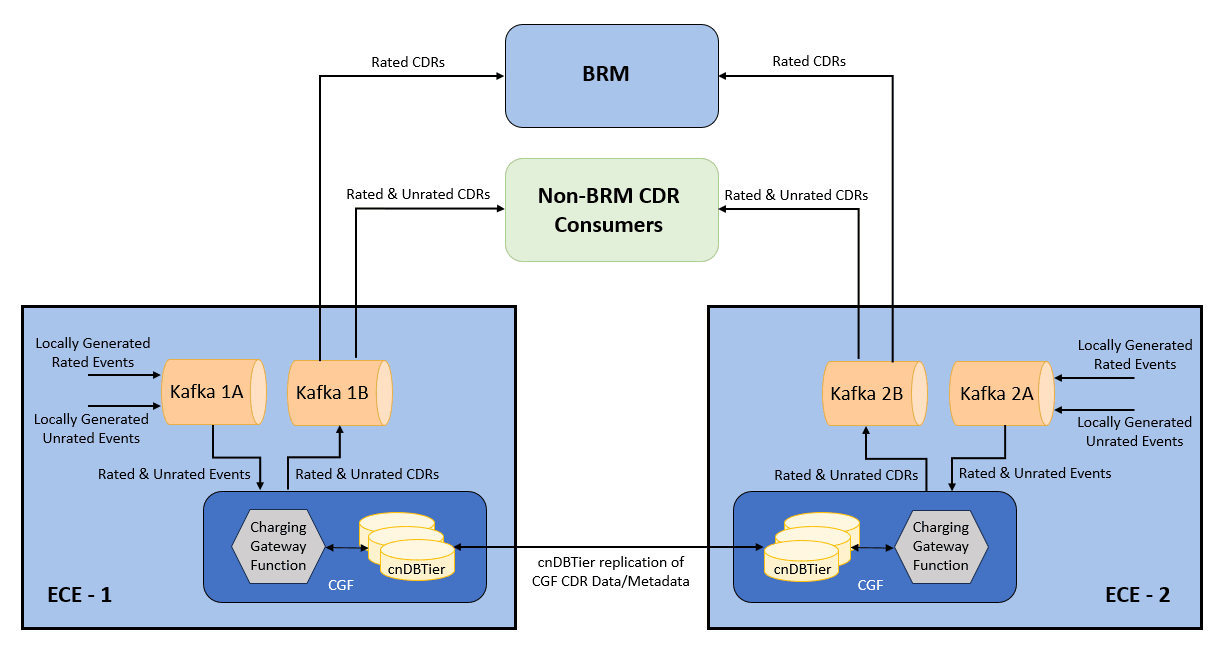
Figure 5-1 shows the architecture for multisite CGF support in ECE composable services deployments during normal operation.
Figure 5-1 Architecture for CGF Active-Active Normal Operation
Note:
In this architecture, Kafka A and Kafka B at each ECE site may be combined into a single Kafka deployment, or Kafka B may operate as a separate Kafka deployment.
In Figure 5-1, you see how the CGF supports CDR generation in a two-site Active-Active deployment.
-
Each site contains an independent ECE deployment, Kafka messaging layer, Charging Gateway Function (CGF), and DB-Tier persistence layer. Both sites can generate rated and unrated events locally and publish them to their respective Kafka environments.
-
The Kafka layer receives locally generated rated and unrated events and delivers them to the CGF, which transforms them into structured CDRs.
The CGF also interacts with the persistence layer to store rated CDR metadata for deduplication.
-
The DB-Tier persistence layers in both sites replicate CGF CDR data and metadata between each other.
This replication enables either site to continue processing charging records if the alternate site becomes unavailable and supports graceful failover and fallback operations.
-
Once processing is complete, the CGF publishes rated and unrated CDRs back to Kafka, making them available to BRM and other downstream consumer systems.
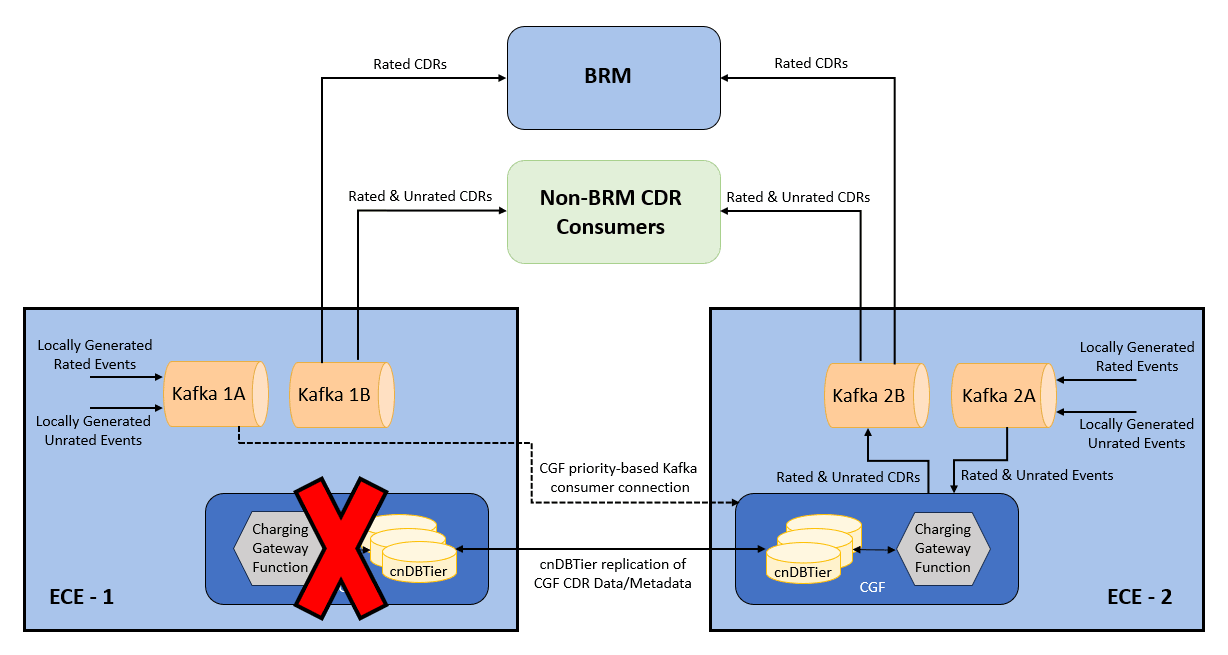
If the CGF at an ECE site fails or is unable to process the unrated and/or rated events from Kafka 1 at its local ECE site, one or more CGFs at other ECE sites are able to take over processing of the unrated and/or rated events at the site using CGF's priority-based Kafka consumption capability. It helps by supporting geo-redundant event processing across ECE sites.
Figure 5-2 shows the architecture for multisite CGF support in ECE composable services deployments when one site is down.
Figure 5-2 Architecture for CGF Active-Active with a Site Down