5 Implementing Georedundancy with Multisite CGF Deployments
Learn about the georedundancy capability of Oracle Communications Elastic Charging Engine (ECE) composable services through multi-site deployments of the Charging Gateway Function (CGF) composable service.
About Multisite CGF Support
Multisite CGF support helps with georedundancy by providing continuity in service for your customers and guarding against data loss if a system fails. This capability involves supporting Active-Active deployment, configuring two or more active production sites at different geographical locations. If one production site fails, other production sites can take over the traffic from the failed site. This minimizes operational impact on downstream billing, mediation, and analytics systems in the case of infrastructure failure.
The feature enables CGF to continue processing rated and unrated charging events even when a site, network connection, or CGF component becomes unavailable. There is replication of CGF Call Detail Record (CDR) data and metadata between sites, allowing either site to assume processing responsibilities when failures occur.
CGF multisite support also offers priority-based Kafka consumption of unrated events generated by the Charging Manager (CHF) and rated events generated by the Elastic Charging Server (ECS). This ensures that CDR generation can continue without interruption when the CGF composable service at a site is unable to process its local unrated and/or rated events.
Additionally, you can apply business logic and operational procedures that govern failure, fallback, recovery, and synchronization scenarios in a multisite environment.
Architecture Overview
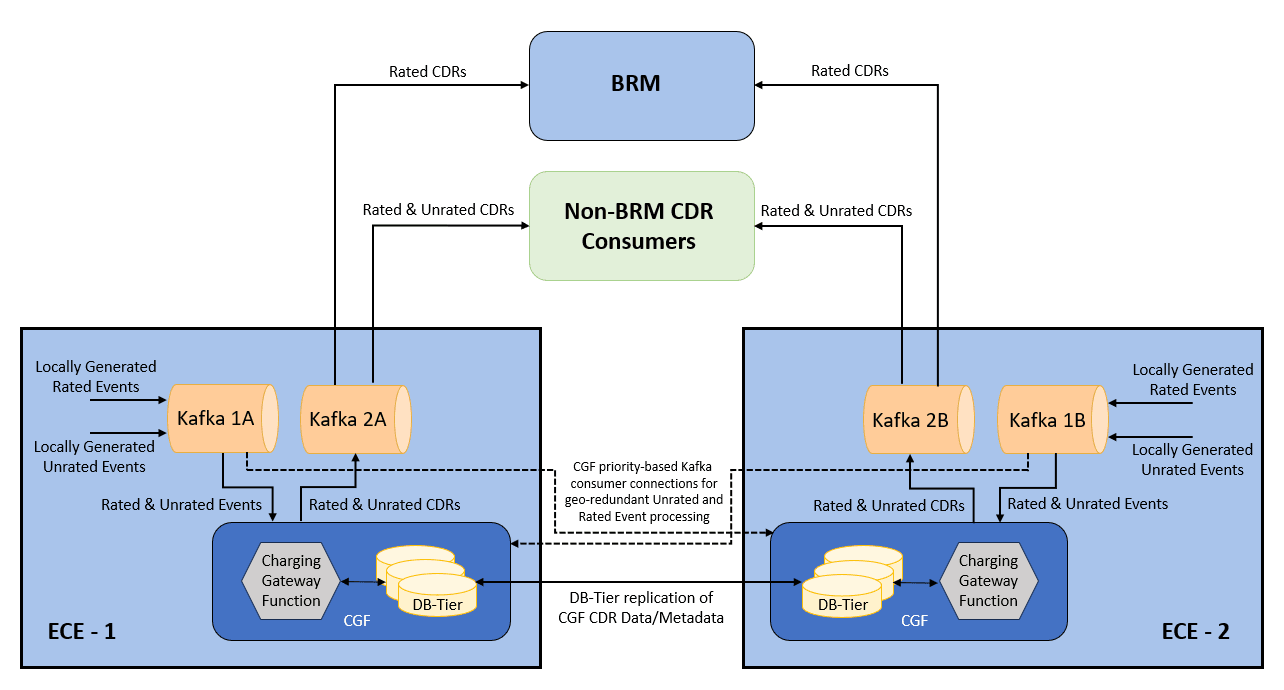
Figure 5-1 shows the architecture for multisite CGF support in ECE composable services deployments.
Figure 5-1 Architecture for Multisite CGF Support
Note:
In this architecture, Kafka 1 and Kafka 2 at each ECE site may be combined into a single Kafka deployment, or Kafka 2 may operate as an independent external component.
In Figure 5-1, you see how the CGF supports CDR generation in a two-site Active-Active deployment.
-
Each site contains an independent ECE deployment, Kafka messaging layer, Charging Gateway Function (CGF), and DB-Tier persistence layer. Both sites can generate rated and unrated events locally and publish them to their respective Kafka environments.
-
The Kafka layer receives locally generated rated and unrated events and delivers them to the CGF, which transforms them into structured CDRs.
The CGF also interacts with the persistence layer to store rated CDR metadata for deduplication.
-
The DB-Tier persistence layers in both sites replicate CGF CDR data and metadata between each other.
This replication enables either site to continue processing charging records if the alternate site becomes unavailable and supports graceful failover and fallback operations.
-
Once processing is complete, the CGF publishes rated and unrated CDRs back to Kafka, making them available to BRM and other downstream consumer systems.
-
If the CGF at an ECE fails or is unable to process the unrated and/or rated events from Kafka 1 at its local ECE site, one or more CGFs at other ECE sites are able to take over processing of the unrated and/or rated events at the site using CGF's priority-based Kafka consumption capability.