3 AI Reference Implementations
Learn about the features you can implement using machine learning (ML) workflows and models created with the artificial intelligence (AI) microservices available in Oracle Communications Cloud Scale Monetization.
Topics in this document:
About the AI Reference Implementation
Cloud Scale Monetization provides extensible microservices that let you build ML workflows to implement AI-powered features and functionalities. You use inference services to generate valuable insights, make accurate predictions, and deliver personalized suggestions to your customers.
You can use these microservices to create models tailored to your business needs. The models integrate with Oracle Monetization Suite products and you can train them using your own data and adapt them to your specific requirements using the training services.
You can configure, add, or remove the model’s features. For example, an offer recommendation model can use customer features such as country, state, currency, and usage pattern. A time-series anomaly detection model can use operational metrics collected over time.
Note:
This release offers only one AI-based feature because the AI-based microservices and associated features are still in an experimental phase.
Next Best Offer Recommendation
Cloud Scale Monetization uses AI to recommend the best customized offers, allowing you to present top recommendations for products, bundles, or services relevant to each customer.
The recommendation engine analyzes a combination of customer profile attributes, engagement history, product catalog information, and past purchase behavior to suggest the most appropriate offers for each customer. You can use these recommendations to target customers with highly relevant offers and support personalized marketing and upselling strategies.
For example, the system can propose offers or products based on a customer’s usage trends when a contract is about to expire or if the customer indicates interest in changing plans. You can also use the feature to identify top-performing offers or products within specific customer segments.
Figure 3-1 shows a sample end-to-end workflow of the AI- and ML-based model within Convergent Charging Controller.
Figure 3-1 Sample Workflow for AI-ML Model Within Convergent Charging Controller
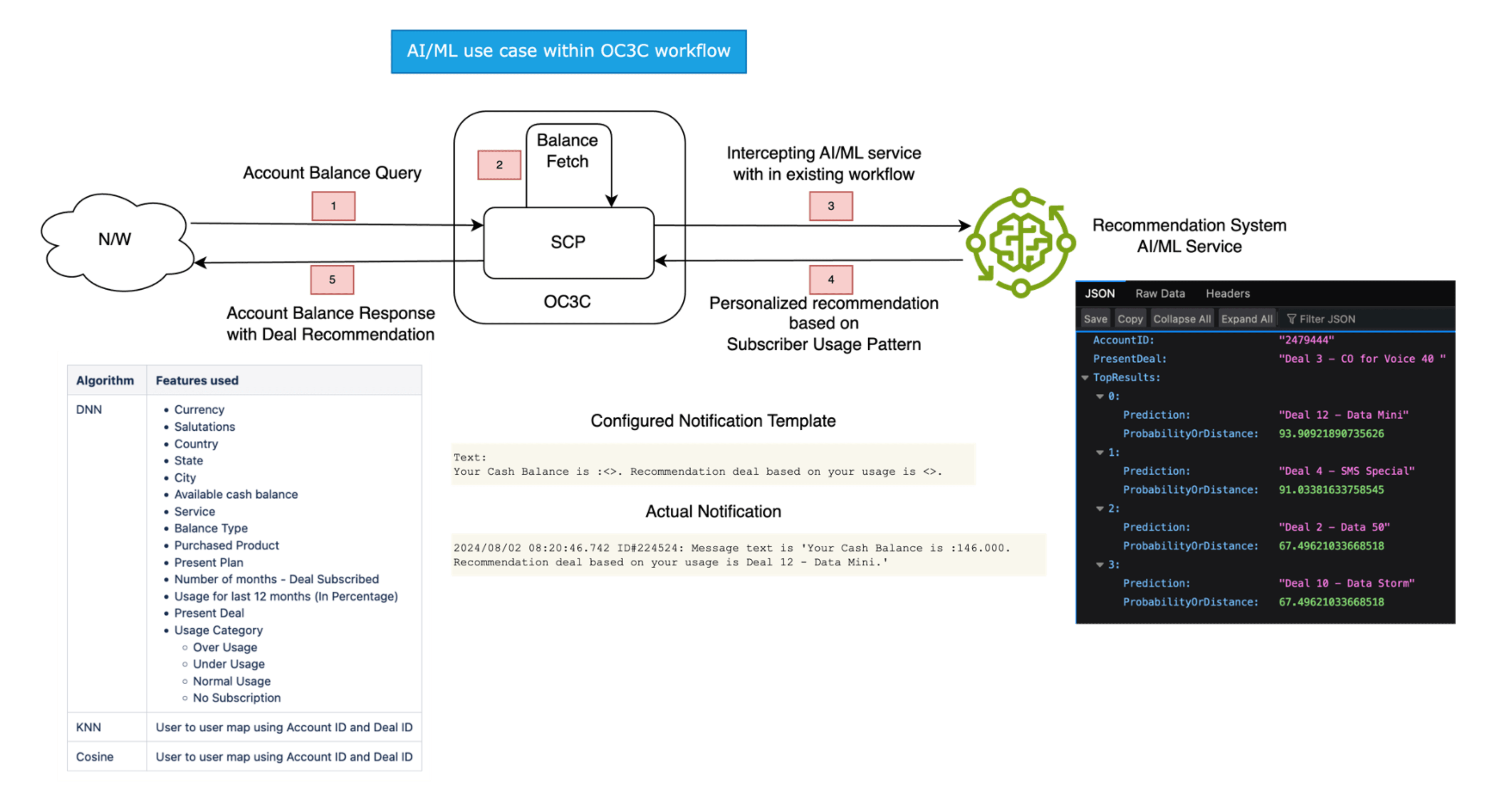
In Figure 3-1, the workflow starts when the system receives a network event or request, such as a customer action or usage update. The Service Control Point (SCP) collects and formats the required customer information and forwards it to the prediction engine.
The prediction engine uses trained models, such as a deep neural network (DNN), k-nearest neighbors (KNN), or cosine similarity, along with configured features like country, usage, and product, to generate personalized offer recommendations. The prediction service returns the top recommended offers, ranked with a probability or score.
Note:
Figure 3-1 is only an example using Convergent Charging Controller as the product. You can configure AI to integrate with other Oracle Monetization products in the Cloud Scale Monetization as needed.
Integrating Next Best Offer Recommendation with BRM and Siebel
You can integrate the next best offer recommendation feature with BRM and Siebel by using the AI Services Framework.
In this integration, the data service collects the required customer and usage data from BRM and Siebel. The training service uses the prepared data to train a multi-head DNN offer recommendation model. The model can generate multiple related recommendation outputs, such as a charge or product offer and a discount offer.
At run time, a Siebel client or other client application sends a recommendation request through the REST API, while an AI agent uses the configured Model Context Protocol (MCP) interface The MCP server validates the request and calls the Prediction Service. The prediction service retrieves the required cached customer data, loads the approved model, and generates the recommendation results.
The MCP server returns the results to Siebel as a structured response. Siebel can use the results to display recommendations to users or to support configured next best offer workflows.
Time-Series Anomaly Detection
You can use the time-series anomaly detection feature to identify unusual behavior in operational metrics by using the AI Services Framework.
The workflow begins with the data service collecting historical metrics from Prometheus. The training service uses the prepared metric data to train a time-series anomaly detection model and identify any change in regular behavior. For example, the supplied sample uses an XGBoost model that specifies 0 to represent normal metrics and 1 to represent potential outage detection.
At run time, a client application sends an anomaly detection request through the REST API, while an AI agent uses the configured MCP interface. The MCP server validates the request and calls the prediction service. The prediction service retrieves the required current metrics from Prometheus, loads the deployed model, and generates a classification for the latest timestamp in the requested time window.
The MCP server returns the classification result as a structured response. A client application can use the result to identify anomalous operational behavior and support configured monitoring workflows.
You can train the model with additional labels when your use case requires different anomaly types. The meaning of each label is defined by the training data used for the model.
Billing Care AI Agent for Bill Explanation
The Billing Care AI Agent enables you to ask supported questions about billing information in natural language. The helps you understand billing information that is available in Billing Care and BRM.
For example, you can ask the agent to explain a bill, show a previous bill, compare bills, show bill charges, or identify supported payment and accounts receivable actions.
The Billing Care AI Agent includes the following components:
-
Billing Care Chat: It provides the user interface for sending a billing question to the agent.
-
Billing Care AI Agent: It validates the request, invokes the AI model in OCI, calls approved MCP tools, and returns a response.
-
AI Model in OCI (LLM): It interprets the request and assists with selecting an approved tool.
-
Billing Care MCP Server: It validates a tool request and calls approved Billing Care REST APIs.
-
Billing Care and BRM: They provide the billing information to be returned to the agent.
The workflow begins when Billing Care sends the requested question and available account context to the agent. The agent uses OCI LLM to interpret the request and select an approved Billing Care MCP tool. The MCP server validates the request and calls the applicable Billing Care REST API to retrieve the required billing information.
The MCP server returns the billing information as a structured response. The agent uses the retrieved information to generate a summarized answer and returns the answer to the Billing Care chat interface.