4 Benchmarking SCP Model D
This section describes Model D test topologies and test scenarios for benchmarking SCP.
4.1 Model D Call Flow
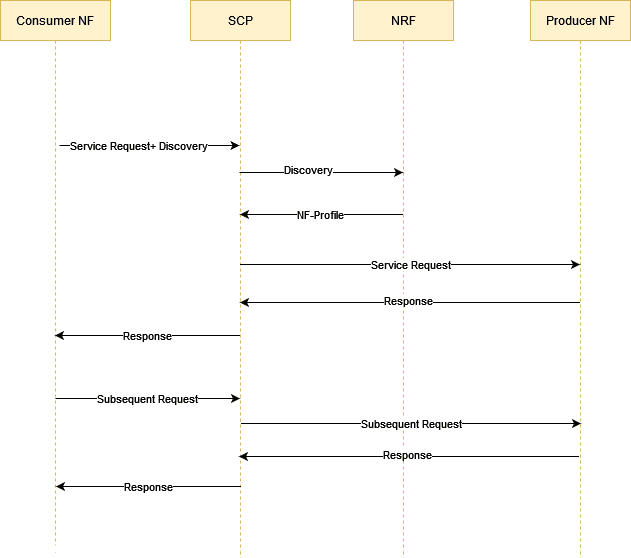
The following call flow represents how a service request is processed by SCP.
- Consumer NF sends the service request to SCP with discovery parameters.
- SCP sends the discovery request to NRF with the received discovery parameters.
- NRF responds with the NF profile list that contains information about the preferred producer NFs.
- SCP sends the request to the producer NF based on the NF profile list received from NRF.
- Producer NF sends the response to SCP for the service request.
- SCP routes the response received from the producer NF to the consumer NF.
Figure 4-1 Model D Call Flow
4.2 Test Topology 1 for SCP Model D Benchmarking
The following image represents the test topology consisting of the following components:
-
SCP
- Consumer NF test simulator
- Producer NF test simulator
- NRF simulator
Figure 4-2 SCP Model D Topology
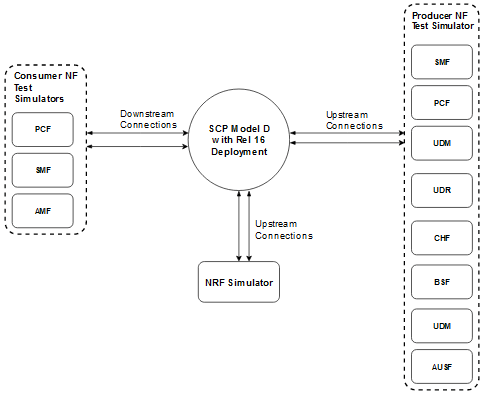
The aforementioned image represents the Model D test topology. In Release 16 Model D indirect 5G SBI communication with delegated discovery mode, the consumer NF delegates the producer NF discovery procedure to SCP by adding discovery parameters to the service requests. SCP performs NF discovery with NRF using the received discovery parameters and sends the request to the producer NF based on the NF profile list received from NRF.
4.2.1 Topology 1 Traffic Distribution
The following table describes the percentage of messages processed by SCP using N11, N7, N10, N36, N28, and so on interfaces:
Table 4-1 Topology 1 Traffic Distribution
| NF-C | NF-P | Interface Reference | NF Service | Percentage (%) of Messages |
|---|---|---|---|---|
| AMF | SMF | N11 | nsmf-pdusession | 50.00 |
| SMF | PCF | N7 |
npcf-smpolicycontrol |
30.00 |
| SMF | UDM | N10 |
|
10.90 |
| PCF | UDR | N36 |
nudr-dr |
0.40 |
| PCF | CHF | N28 | nchf-spendinglimitcontrol | 0.40 |
| PCF | BSF | Nbsf | nbsf-management | 0.30 |
| AMF | UDM | N8 |
|
2.50 |
| AMF | AUSF | N12 | nausf-auth | 2.50 |
| AMF | PCF | N15 |
|
3.00 |
Topology 1 Routing Configuration
The following table describes the routing configurations for the NF services:
Table 4-2 Routing Configuration
| NF | Service | Initial Message | Subsequent Message | reverseProxySupport | Deployment | ResponseTimeout | ||
|---|---|---|---|---|---|---|---|---|
| routePolicy | reroutePolicy | routePolicy | routePolicy | |||||
| SMF | Nsmf_PDUSession | Load_Balance | RerouteWithinRegion | Load_Balance | RerouteWithinRegion | False | REGIONAL | 1s |
| PCF | Npcf_SMPolicyControl | Load_Balance | RerouteWithinRegion | Load_Balance | RerouteWithinRegion | False | REGIONAL | 1s |
| UDR | Nudr_dm | Load_Balance | RerouteWithinSite | Load_Balance | RerouteWithinSite | False | SITE_WIDE | 1s |
| CHF | Nchf_SpendingLimitControl | Load_Balance | RerouteWithinSite | Load_Balance | RerouteWithinSite | False | SITE_WIDE | 1s |
| UDM | Nudm_sdm | Load_Balance | RerouteWithinSite | Load_Balance | RerouteWithinSite | False | SITE_WIDE | 1s |
| UDM | Nudm_uecm | Load_Balance | RerouteWithinSite | Load_Balance | RerouteWithinSite | False | SITE_WIDE | 1s |
| PCF | Npcf_AMPolicyControl | Load_Balance | RerouteWithinSite | Load_Balance | RerouteWithinSite | False | SITE_WIDE | 1s |
| PCF | Npcf_UEPolicyControl | Load_Balance | RerouteWithinSite | Load_Balance | RerouteWithinSite | False | SITE_WIDE | 1s |
| AUSF | Nausf_UEAuthentication | Load_Balance | RerouteWithinSite | Load_Balance | RerouteWithinSite | False | SITE_WIDE | 1s |
| BSF | Nbsf_management | Load_Balance | RerouteWithinSite | Load_Balance | RerouteWithinSite | False | SITE_WIDE | 1s |
| UDR | Nudr_udrService | Load_Balance | RerouteWithinSite | Load_Balance | RerouteWithinSite | False | SITE_WIDE | 1s |
Topology 1 NF Profiles
The following table describes NF profile configuration, traffic, and message call flows for 176 NF profiles registered on SCP:
Table 4-3 NF Profiles
| NF-C | NF-P | Interfaces | Supported Services | Service-related traffic | Profiles Registered | NF Range | Message Call flows | Discover parameters (Delegated Discovery) |
|---|---|---|---|---|---|---|---|---|
| AMF | SMF | N11 |
|
nsmf-pdusession | 80 | SMF1 to SMF80 |
|
|
| AMF | PCF | N15 |
|
|
12 | PCF1 to PCF12 |
Npcf_AMPolicyControl
Npcf_UEPolicyControl
|
|
| SMF | PCF | N7 |
|
npcf-smpolicycontrol | 38 | PCF13 to PCF50 |
|
|
| SMF | UDM | N10 |
|
|
3 | UDM1 to UDM3 |
Nudm_sdm
Nudm_uecm
|
|
| AMF | UDM | N8 |
|
|
3 | UDM4 to UDM6 |
Nudm_sdm
Nudm_uecm
|
|
| PCF | UDR | N36 |
|
nudr-dr | 10 | UDR1 to UDR10 |
|
|
| PCF | CHF | N28 |
|
nchf-spendinglimitcontrol | 10 | CHF1 to CHF10 |
|
|
| AMF | AUSF | N12 |
|
nausf-auth | 10 | AUSF1 to AUSF10 | Authenticate UE |
|
| PCF | BSF | Nbsf | nbsf-management | nbsf-management | 10 | BSF1 to BSF10 |
|
|
Access Token Request Parameters
Table 4-4 Data Set
| Data Set 1: NFtype level access token | Data Set 2: NFtype level access token |
|---|---|
| nfInstanceId, nfType, targetNfType, scope, requesterSnssaiList, targetSnssaiList | nfInstanceId, scope, requesterSnssaiList, targetSnssaiList, targetNfInstanceId, targetNfServiceSetId |
OAuth Parameters
Table 4-5 OAuth Parameters
| Parameter | Data Set 1 | Data Set 2 | Data Set 3 |
|---|---|---|---|
| Average size of access token (in bytes) | 500 | 1000 | 1500 |
| Average size of AccessTokenReq message sent to NRF (in bytes) | 500 | 1000 | 1500 |
| Average value of Access Token Expiry time (in hr) | 1 | 24 |
|
| Will the access token expiration time be the same for all access tokens or different? What are the criteria? | All access tokens expire at same time | All access tokens expire at same time | Half of tokens expire at same time |
| Non-Roaming partners | |||
| Maximum number of consumer NFs using oAuth | 200 | 100 | 200 |
| Maximum number of producer NFs for which OAuth enabled | 200 | 200 | 200 |
| Average number of producer NF Types to whom each consumer NFs communicates | 5 | 5 | 5 |
| Number of NF-Sets per NF Type (Number of NF instances in a GR deployment per NF Type) |
|
|
|
| Max. number of slices for which token is to be granted | 3 | 3 | 3 |
| Max. number of PLMNs in local network for which token is to be granted | 5 | 5 | 10 |
| Access Token Cache Size (# of records) - Derived from (6-11) | 45000 | 22500 | 99000 |
| Roaming partners | |||
| Max. Number of roaming PLMNs | 200 | 100 | 500 |
| Call mix | |||
| Access Token Type mix |
|
|
|
Topology 1 Notification NRF
The following table describes NF profile configuration, traffic, and message call flows for NF profiles registered on SCP:
- Priority of NF services has changed
- Capacity of NF services has changed
- Priority and Capacity of NF services have changed
- Load of NF has changed
- Addition of SUPI range to NF
- Addition of GPSI range to NF
- Service instances are removed from the NF profile
- Service instances are added from the NF profile
4.3 Test Topology 2 for SCP Model D Benchmarking
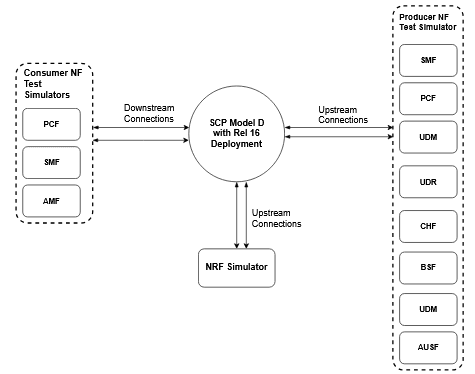
The following image represents the test topology consisting of the following components:
-
SCP
- Consumer NF test simulator
- Producer NF test simulator
- NRF simulator
Figure 4-3 SCP Model D Topology 2
4.3.1 Topology 2 Traffic Distribution
The following table describes the percentage of messages processed by SCP using N11, N7, N10, N36, N28, and other interfaces:
Table 4-6 Topology 2 Traffic Distribution
| NF-C | NF-P | Interface Reference | Percentage (%) of Messages |
|---|---|---|---|
| SMF | PCF | N7 | 60 |
| SMF | UDM | N10 | 5 |
| PCF | UDR | N36 | 1 |
| PCF | CHF | N28 | 1 |
| SMF | CHF | N40 | 10 |
| NRF | SLF | - | 3 |
| PCF | BSF | Nbsf | 2 |
| AMF | UDM | N8 | 7.5 |
| AMF | AUSF | N12 | 7.5 |
| AMF | PCF | N15 | 3 |
| NRF | SCP | Notifications |
Type of Notifications (Notification call model):
Frequency of Notifications:
|
Table 4-7 Number of NF
| NF Name | NF Count |
|---|---|
| AMF | 150 |
| SMF | 150 |
| PCF | 50 |
| UDM | 40 |
| AUSF | 40 |
| UDR | 10 |
| BSF | 10 |
| CHF | 20 |
| SLF | 10 |
| NRF | 3 Stubs |
| SCP | 2 SCP triplets in one region (1 real SCP and rest all Stubs) |
| Total | 480 (excluding NRF and SCP) |
Topology 2 Routing Configuration
The following table describes the routing configurations for the NF services:
Table 4-8 Routing Configuration
| NF | Service | Deployment | Response Timeout |
|---|---|---|---|
| PCF | Npcf_SMPolicyControl | SITE_WIDE | 3s |
| UDR | Nudr_dm | SITE_WIDE | 3s |
| CHF | Nchf_SpendingLimitControl | SITE_WIDE | 3s |
| UDM | Nudm_sdm | SITE_WIDE | 3s |
| UDM | Nudm_uecm | SITE_WIDE | 3s |
| PCF | Npcf_AMPolicyControl | SITE_WIDE | 3s |
| PCF | Npcf_UEPolicyControl | SITE_WIDE | 3s |
| AUSF | Nausf_UEAuthentication | SITE_WIDE | 3s |
| BSF | Nbsf_management | SITE_WIDE | 3s |
| UDR | Nudr_udrService | SITE_WIDE | 3s |
Topology 2 NF Profiles
The following table describes NF profile configuration, traffic, and message call flows for 176 NF profiles registered on SCP:
Table 4-9 NF Profiles
| NF-C | NF-P | Reference | Producer NF Service | Discovery Parameter |
|---|---|---|---|---|
| SMF | PCF | N7 | Npcf_SMPolicyControl |
|
| SMF | UDM | N10 |
Nudm_sdm, Nudm_uecm |
Note: SMF receives UDM Group Id from AMF, SMF will not receive UDM Group ID from MME. |
| PCF | UDR | N36 | Nudr_dm |
|
| PCF | CHF | N28 | Nchf_SpendingLimitControl |
|
| SMF | CHF | N40 | -- |
Note: NRF will perform SLF lookup for SUPI to CHF Group Id translation |
| PCF | BSF | Nbsf | Nbsf_management |
|
| AMF | UDM | N8 |
Nudm_sdm, Nudm_uecm |
Common discovery parameters:
|
| AMF | AUSF | N12 | Nausf_UEAuthentication |
Common discovery parameters:
|
| AMF | PCF | N15 |
Npcf_AMPolicyControl, Npcf_UEPolicyControl |
Scenario 1 AMF will include the following discovery headers to SCP for PCF discovery at AM Policy Association establishment time:
Scenario 2 AMF will include the following discovery headers to SCP for PCF discovery at UE Policy Association establishment time:
|
4.4 Test Topology 3 for SCP Model D Benchmarking
The following image represents the test topology consisting of the following components:
- SCP
- Consumer NF test simulator
- Producer NF test simulator
- NRF simulator
- Data Director
Figure 4-4 SCP Model D Topology 3
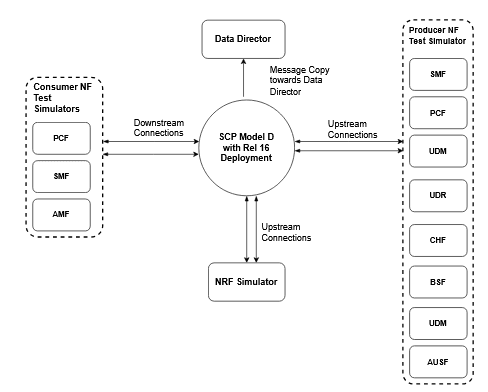
The aforementioned image represents the Model D test topology. In Release 16 Model D indirect 5G SBI communication with delegated discovery mode, the consumer NF delegates the producer NF discovery procedure to SCP by adding discovery parameters to the service requests. SCP performs NF discovery with NRF using the received discovery parameters and sends the request to the producer NF based on the NF profile list received from NRF.
4.4.1 Topology 3 Traffic Distribution
The following table describes the percentage of messages processed by SCP using N11, N7, N10, N36, N28, and other interfaces:
Table 4-10 Topology 3 Traffic Distribution
| NF-C | NF-P | Interface Reference | Percentage (%) of Messages |
|---|---|---|---|
| SMF | PCF | N7 | 60 |
| SMF | UDM | N10 | 5 |
| PCF | UDR | N36 | 1 |
| PCF | CHF | N28 | 1 |
| SMF | CHF | N40 | 10 |
| NRF | SLF | - | 3 |
| PCF | BSF | Nbsf | 2 |
| AMF | UDM | N8 | 7.5 |
| AMF | AUSF | N12 | 7.5 |
| AMF | PCF | N15 | 3 |
| NRF | SCP | Notifications |
Type of Notifications (Notification call model):
Frequency of Notifications:
|
Table 4-11 Number of NF
| NF Name | NF Count |
|---|---|
| AMF | 150 |
| SMF | 150 |
| PCF | 50 |
| UDM | 40 |
| AUSF | 40 |
| UDR | 10 |
| BSF | 10 |
| CHF | 20 |
| SLF | 10 |
| NRF | 3 Stubs |
| SCP | 2 SCP triplets in one region (1 real SCP and rest all Stubs) |
| Total | 480 (excluding NRF and SCP) |
Topology 3 Routing Configuration
The following table describes the routing configurations for the NF services:
Table 4-12 Routing Configuration
| NF | Service | Deployment | Response Timeout |
|---|---|---|---|
| PCF | Npcf_SMPolicyControl | SITE_WIDE | 3s |
| UDR | Nudr_dm | SITE_WIDE | 3s |
| CHF | Nchf_SpendingLimitControl | SITE_WIDE | 3s |
| UDM | Nudm_sdm | SITE_WIDE | 3s |
| UDM | Nudm_uecm | SITE_WIDE | 3s |
| PCF | Npcf_AMPolicyControl | SITE_WIDE | 3s |
| PCF | Npcf_UEPolicyControl | SITE_WIDE | 3s |
| AUSF | Nausf_UEAuthentication | SITE_WIDE | 3s |
| BSF | Nbsf_management | SITE_WIDE | 3s |
| UDR | Nudr_udrService | SITE_WIDE | 3s |
Topology 3 NF Profiles
The following table describes NF profile configuration, traffic, and message call flows for 176 NF profiles registered on SCP:
Table 4-13 NF Profiles
| NF-C | NF-P | Reference | Producer NF Service | Discovery Parameter |
|---|---|---|---|---|
| SMF | PCF | N7 | Npcf_SMPolicyControl |
|
| SMF | UDM | N10 |
Nudm_sdm, Nudm_uecm |
Note: SMF receives UDM Group Id from AMF, SMF will not receive UDM Group ID from MME. |
| PCF | UDR | N36 | Nudr_dm |
|
| PCF | CHF | N28 | Nchf_SpendingLimitControl |
|
| SMF | CHF | N40 | -- |
Note: NRF will perform SLF lookup for SUPI to CHF Group Id translation |
| PCF | BSF | Nbsf | Nbsf_management |
|
| AMF | UDM | N8 |
Nudm_sdm, Nudm_uecm |
Common discovery parameters:
|
| AMF | AUSF | N12 | Nausf_UEAuthentication |
Common discovery parameters:
|
| AMF | PCF | N15 |
Npcf_AMPolicyControl, Npcf_UEPolicyControl |
Scenario 1 AMF will include the following discovery headers to SCP for PCF discovery at AM Policy Association establishment time:
Scenario 2 AMF will include the following discovery headers to SCP for PCF discovery at UE Policy Association establishment time:
|
4.5 Model D Test Cases
This section provides information about the SCP Model D test cases.
This test scenario describes the performance and capacity of SCP with Model D and provides the benchmarking results with latency in a network.
4.5.1 Model D Test Case Summary
The following table provides a summary of the benchmark tests:
Table 4-14 Benchmark Test Case Summary
| Benchmark Test Case Number | Description |
|---|---|
| Model D - Test Case Scenario 1 | The Model D test is based on a network latency of 150 milliseconds at a rate of 186K MPS with Oauth2.0 and Cache enabled. |
| Model D - Test Case Scenario 2 | The Model D test is based on the network latency of 50 milliseconds at the rate of 400K MPS without features enabled in the TLS enabled BareMetal CNE setup. |
| Model D - Test Case Scenario 3 | The Model D test is based on the network latency of 150 milliseconds at the rate of 400K MPS with the features enabled in the TLS enabled vCNE setup. |
| Model D Test Scenario 4 | The Model D test is based on the network latency of 150 milliseconds at the rate of 650K MPS with Mediation enabled on vCNE. |
| Model D Test Scenario 5 | The Model D test is based on the network latency of 150 milliseconds at the rate of 650K MPS with Mediation enabled on BareMetal. |
| Model D Test Scenario 6 | The Model D test is based on the network latency of 150 milliseconds at the rate of 650K MPS with Mediation on BareMetal with 20% Static Discovery in case the discovery mode is set to "NRF Followed BY SCP". |
| Model D Test Scenario 7 | The Model D test is based on the network latency of 150 milliseconds at the rate of 650K MPS with Mediation on BareMetal with 20% Static Discovery in case the discovery mode is set to "SCP Followed BY NRF". |
| Model D Test Scenario 8 | The Model D test is based on the network latency of 150 milliseconds at the rate of 650K MPS with Mediation with 2 ingress Cloud Native Load Balancer (CNLB) and without egress configuration enabled. |
| Model D Test Scenario 9 | The Model D test is based on the network latency of 150 milliseconds at the rate of 450K MPS with Cloud Native Load Balancer (CNLB) and egress bypass. |
| Model D Test Scenario 10 | The Model D test with Mediation on BareMetal and OCNADD enabled with four trigger points, 650K MPS towards OCNADD. |
4.5.2 Model D - Test Case Scenario 1
This is a Model D test based on the network latency of 150 milliseconds with no rate limit applied.
Objective
- OAuth parameters and OAuth2.0 feature enabled
- OAuth Cache enabled
- Model D Cache disabled
- enforceReqSpecificSvcDiscovery parameter enabled
Table 4-15 Input Parameter Details
| Input Parameter Details | Configuration Values |
|---|---|
| Duration of Test | 12 Hours |
| SCP Version Tag | 23.4.0 |
| Cluster | Test Bed 1 - CNE on BareMetal. For more information, see Cluster Details |
| Topology | Topology 1. For information about topology, see Test Topology 1 for SCP Model D Benchmarking |
Test Case Parameters
The following table describes the test case parameters and their values:
Table 4-16 Test Case Parameters
| Input Parameter Details | Configuration Values |
|---|---|
|
Maximum SCP system wide traffic rate (in MPS) |
186K MPS |
| Network deployment diagram | Topology 1. For information about topology, see Test Topology 1 for SCP Model D Benchmarking |
| Mode of Network deployment (Model-C or Model-D) | Model C (80%) and Model D (20%) |
| Number of NFs deployed in the network that SCP is supposed to learn (number of NF profiles) |
|
| NF Status Information |
|
| NF Profile - Priority, Capacity, Load value same in all services of same kind? (Yes, No) | No |
| LAN latency in intra-SCP services and 5G NF communication (between SCP data and control plane services, SCP and other NFs) in milliseconds | 150 milliseconds |
| WAN latency in SCP services and 5G NF communication (SCP to NFs in other regions) in milliseconds | 150 milliseconds |
| Number of SCP ingress IPs configured | 1 |
| How many connections per published IP/FQDN producers can handle? | 200 |
| Per Egress connection max traffic in MPS | 400 |
| How many connections consumer can initiate towards per SCP IP? |
|
| Per Ingress connection, max traffic in MPS | 1000 |
| Percentage of alternate routed requests to NF due to any reason (2% to 5%) | 2% |
| Configured audit interval and audit mode |
|
| Number of NRFs and NRF sets deployed in the network |
|
| Response time (latency) from NRF (NRF processing time) | 150 milliseconds |
| Delegated Discovery Traffic Information |
|
| NF Discovery response size and Info |
|
| Egress and Ingress Configurations | NA |
| Mediation Configurations | NA |
| Mediation Trigger point configuration | NA |
| Secured HTTPs connection - % of message on HTTPs? | NA |
| DNS SRV configuration and response time | NA |
| Roaming traffic details | NA |
| Pods deployed |
|
| SCP Worker Pod Profile | 8 vCPU and 12 Gi Memory |
| Oracle Communications Network Analytics Data Director Configurations | NA |
| LCI Configurations | NA |
| Processing latency(processing time) per producer NF | Upstream Network Latency: 150 milliseconds |
| Number of entries expected in CCA certificate | NA |
| OAuth Traffic Rate | 40K MPS |
| OCI Configurations | NA |
Result and Observation
The following table provides observation data for the performance test that can be used for testing to increase the traffic rate:
Table 4-17 Result and Observation
| Parameter | Values |
|---|---|
| Test Duration | 12 Hours |
| MPS Achieved | 186K MPS |
| Average per scp-worker pod MPS | 3730 MPS |
| Success rate | ~100% |
| Average SCP processing time (Request and Response) | Less than 25 milliseconds for both Request and Response processing |
SCP Microservices and their Utilization
The following table describes SCP microservices and their utilization:
Table 4-18 SCP Microservices and their Utilization
| SCP Microservices | CPU | Memory | ||
|---|---|---|---|---|
| Max | Avg | Max | Avg | |
| scp-worker | 4.72 | 4.36 | 4.69 GB | 4.51 GB |
| scp-nrfproxy | 2.01 | 1.58 | 2.63 GB | 2.61 GB |
| scpc-notification | 0.640 | 0.621 | 1.87 GB | 1.85 GB |
| scpc-audit | 0.0106 | 0.00521 | 586 MB | 584 MB |
| scpc-configuration | 0.0632 | 0.0471 | 785 MB | 778 MB |
| scpc-subscription | 0.0304 | 0.0254 | 481 MB | 478 MB |
| scp-cache | 0.0199 | 0.0144 | 2.98 GB | 2.92 GB |
| scp-nrfproxyoauth | 2.26 | 1.97 | 3.08 GB | 3.06 GB |
| scp-mediation | 0.000644 | 0.000583 | 374 MB | 374 MB |
| scp-loadmanager | 0.0422 | 0.0309 | 844 MB | 837 MB |
Observed Values of cnDBTier Services
The following table provides information about the observed values of cnDBTier services:
Table 4-19 Observed Values of cnDBTier Services
| cnDBTier Services | Value |
|---|---|
| Memory usage of data nodes | 0.58% |
| CPU usage of data nodes | 0.87% |
| Write operations per second | 2K |
| Read operations per second | 100 |
| Transaction rates on data nodes | 2.50 |
4.5.3 Model D - Test Case Scenario 2
The Model D test is based on the network latency of 50 milliseconds at the rate of 400K MPS without features enabled in the TLS enabled BareMetal CNE setup.
Objective
- Mediation Trigger point configuration
- Model D Cache enabled
Table 4-20 Input Parameter Details
| Input Parameter Details | Configuration Values |
|---|---|
| Duration of Test | 72 Hours |
| SCP Version Tag | 25.1.200 |
| Cluster | Test Bed 1 - CNE on BareMetal. For more information, see Cluster Details |
| Topology | Topology 1. For information about topology, see Test Topology 1 for SCP Model D Benchmarking |
Test Case Parameters
The following table describes the test case parameters and their values:
Table 4-21 Test Case Parameters
| Input Parameter Details | Configuration Values |
|---|---|
|
Maximum SCP system wide traffic rate (in MPS) |
400K MPS |
| Network deployment diagram | Topology 1. For information about topology, see Test Topology 1 for SCP Model D Benchmarking |
| Mode of Network deployment (Model-C or Model-D) | Model D |
| Number of NFs deployed in the network which SCP is supposed to learn (number of NF Profiles) |
|
| NF Status Information |
|
| NF Profile - Priority, Capacity, Load value same in all services of same kind? (Yes, No) | No |
| LAN latency in intra-SCP services and 5G NF communication (between SCP data and control plane services, SCP and other NFs ) in millisecond | 150 milliseconds |
| WAN latency in SCP services and 5G NF communication (SCP to NFs in other regions) in millisecond | 300 milliseconds |
| Number of SCP ingress IPs configured | 2 |
| How many connections per published IP/FQDN producers can handle? | 485 |
| Per Egress connection max traffic in MPS | 1000 |
| Per Ingress connection max traffic in MPS | 1000 |
| Average Request and Response message size |
|
| How many consumers can initiate towards per SCP IP? |
|
| Percentage of alternate routed requests to NF due to any reason (2% to 5%) | 2% |
| Configured audit interval and audit mode |
|
| Number of NRFs and NRF Sets deployed in the network |
|
| Response time (latency) from NRF (NRF processing time) | 150 milliseconds |
| Delegated Discovery Traffic Information |
|
| NF Discovery response size and Info | Largest number of NF services in each NF profile in discovery response: 4 |
| Egress and Ingress Configurations | NA |
| Mediation Configurations | NA |
| Mediation Trigger point configuration | Number of Mediation Trigger Points: 367 |
| Secured HTTPs connection - % of message on HTTPs? | 100 |
| DNS SRV configuration and response time | NA |
| Roaming traffic details | NA |
| Pods deployed |
|
| SCP Worker Pod Profile | 12 vCPU and 24 GB Memory |
| Oracle Communications Network Analytics Data Director Configurations | NA |
| LCI Configurations | NA |
| Processing latency(processing time) per producer NF | Upstream Network Latency: 150 milliseconds |
| Number of entries expected in CCA certificate | NA |
| OAuth Traffic Rate | NA |
| OCI Configurations | NA |
Result and Observation
The following table provides observation data for the performance test that can be used for testing to increase the traffic rate:
Table 4-22 Result and Observation
| Parameter | Values |
|---|---|
| Test Duration | 72 Hours |
| MPS Achieved | 400K MPS |
| Average per scp-worker pod MPS | 7K MPS |
| Success rate | ~100% |
| Average SCP processing time (Request and Response) | Less than 25 milliseconds for both Request and Response processing |
SCP Microservices and their Utilization
The following table describes SCP microservices and their utilization:
Table 4-23 SCP Microservices and their Utilization
| SCP Microservices | CPU | Memory | ||
|---|---|---|---|---|
| Max | Avg | Max | Avg | |
| scp-worker | 7.374 | 7.136 | 7.23 GB | 7.22 GB |
| scpc-notification | 1.187 | 1.142 | 1.68 GB | 1.68 GB |
| scpc-audit | 0.018 | 0.012 | 541 MB | 541 MB |
| scpc-configuration | 0.024 | 0.018 | 861 MB | 857 MB |
| scpc-subscription | 0.008 | 0.006 | 515 MB | 515 MB |
| scp-cache | 0.01 | 0.01 | 552 MB | 551 MB |
| scp-nrfproxy | 3.998 | 3.911 | 2.80 GB | 2.80 GB |
| scp-nrfproxyoauth | 0.008 | 0.007 | 453 MB | 452 MB |
| scp-mediation | 0.029 | 0.031 | 1.57 GB | 1.57 GB |
| scp-loadmanager | 0.023 | 0.021 | 969 MB | 969 MB |
Observed Values of cnDBTier Services
The following table provides information about the observed values of cnDBTier services:
Table 4-24 Observed Values of cnDBTier Services
| cnDBTier Services | Value |
|---|---|
| Memory usage of data nodes | 3.9% |
| CPU usage of data nodes | 0.5% |
| Write operations per second | 13.1 |
| Read operations per second | 520 |
| Transaction rates on data nodes | 30.2 |
4.5.4 Model D - Test Case Scenario 3
The Model D test is based on the network latency of 150 milliseconds at the rate of 400K MPS with the features enabled in the TLS enabled vCNE setup.
Objective
This test case scenario describes the performance and capacity of SCP with 400K MPS Model D deployment model and the following features enabled:
- LCI
- OCI
- Mediation Trigger Points
- Support for HTTPS
- Outlier Detection
- Circuit Breaking
- Alternate Routing based on NFSets
- Pod Overload Control
- Enhanced 5G SBI Message Failure Handling
- Egress Congestion Control Support at SCP
- Message Priority Assignment and Override
- Enhanced NF Status Processing (Mode 1)
Table 4-25 Input Parameter Details
| Input Parameter Details | Configuration Values |
|---|---|
| Duration of Test | 12 Hrs |
| SCP Version Tag | 25.1.200 |
| Cluster | Test Bed 2 - CNE on Bare Metal. For more information, see Cluster Details |
| Topology | Topology 2. For information about topology, see Test Topology 2 for SCP Model D Benchmarking |
Test Case Parameters
The following table describes the test case parameters and their values:
Table 4-26 Test Case Parameters
| Input Parameter Details | Configuration Values |
|---|---|
|
Maximum SCP system wide traffic rate (in MPS) |
400K MPS |
| Network deployment diagram | Topology 2. For information about topology, see Test Topology 2 for SCP Model D Benchmarking |
| Mode of Network deployment (Model-C or Model-D) | Model D |
| Number of NFs deployed in the network which SCP is supposed to learn (number of NF Profiles) |
|
| NF Status Information |
|
| NF Profile - Priority, Capacity, Load value same in all services of same kind? (Yes, No) | No |
| LAN latency in intra-SCP services and 5G NF communication (between SCP data and control plane services, SCP and other NFs ) in millisecond | 150 milliseconds |
| WAN latency in SCP services and 5G NF communication (SCP to NFs in other regions) in millisecond | 300 milliseconds |
| Number of SCP ingress IPs configured | 1 |
| How many connections per published IP/FQDN producers can handle? | 490 |
| Per Egress connection max traffic in MPS | 1000 |
| Per Ingress connection max traffic in MPS | 1000 |
| Average Request and Response message size |
|
| How many consumers can initiate towards per SCP IP? |
|
| Percentage of alternate routed requests to NF due to any reason (2% to 5%) | 2% |
| Configured audit interval and audit mode |
|
| Number of NRFs and NRF Sets deployed in the network |
|
| Response time (latency) from NRF (NRF processing time) | 150 milliseconds |
| Delegated Discovery Traffic Information |
|
| NF Discovery response size and Info | Largest number of NF services in each NF profile in discovery response: 6 |
| Egress and Ingress Rate Limit Configurations | NA |
| Mediation Configurations |
|
| Mediation Trigger point configuration | Number of Mediation Trigger Points: 367 |
| Secured HTTPs connection - % of message on HTTPs? | 100 |
| DNS SRV configuration and response time | NA |
| Roaming traffic details | NA |
| Pods deployed |
|
| SCP Worker Pod Profile | 12 vCPU and 24 GB Memory |
| Oracle Communications Network Analytics Data Director Configurations | NA |
| LCI Configurations |
|
| Processing latency(processing time) per producer NF | Upstream Network Latency: 150 milliseconds |
| Number of entries expected in CCA certificate | NA |
| OAuth Traffic Rate | NA |
| OCI Configurations |
|
Result and Observation
The following table provides observation data for the performance test that can be used for benchmark testing to increase the traffic rate:
Table 4-27 Result and Observation
| Parameter | Values |
|---|---|
| Test Duration | 12 Hours |
| MPS Achieved | 400K MPS |
| Average per scp-worker pod MPS | 7K MPS |
| Success rate | ~100% |
| Average SCP processing time (Request and Response) | Less than 25 milliseconds for both Request and Response processing |
SCP Microservices and their Utilization
The following table describes SCP microservices and their utilization:
Table 4-28 SCP Microservices and their Utilization
| SCP Microservices | CPU | Memory | ||
|---|---|---|---|---|
| Max | Avg | Max | Avg | |
| scp-worker | 7.801 | 7.501 | 7.37 GB | 7.31 GB |
| scpc-notification | 0.958 | 0.939 | 1.66 GB | 1.65 GB |
| scpc-audit | 0.013 | 0.011 | 530 MB | 530 MB |
| scpc-configuration | 0.024 | 0.024 | 743 MB | 743 MB |
| scpc-subscription | 0.029 | 0.027 | 606 MB | 605 MB |
| scp-cache | 0.017 | 0.016 | 498 MB | 498 MB |
| scp-nrfproxy | 2.391 | 2.275 | 2.25 GB | 2.25 GB |
| scp-mediation | 3.624 | 3.286 | 1.24 GB | 1.24 GB |
| scp-loadmanager | 0.184 | 0.172 | 1.33 GB | 1.33 GB |
| scp-alternate-resolution | 0.010 | 0.009 | 550 MB | 460 MB |
Observed Values of cnDBTier Services
The following table provides information about observed values of cnDBTier services:
Table 4-29 Observed Values of cnDBTier Services
| cnDBTier Services | Value |
|---|---|
| Memory usage of data nodes | 5.2% |
| CPU usage of data nodes | 0.7% |
| Write operations per second | 13.1 |
| Read operations per second | 520 |
| Transaction rates on data nodes | 35.6 |
4.5.5 Model D Test Scenario 4
The Model D test is based on the network latency of 150 milliseconds at the rate of 650K MPS with Mediation enabled on vCNE.
Objective
This test case scenario describes the performance and capacity of SCP with 650K MPS Model D deployment model and the following features enabled:
- LCI
- OCI
- Mediation Trigger Points
- Support for HTTPS
- Outlier Detection
- Circuit Breaking
- Alternate Routing based on NFSets
- Pod Overload Control
- Enhanced 5G SBI Message Failure Handling
- Egress Congestion Control Support at SCP
- Message Priority Assignment and Override
- Enhanced NF Status Processing (Mode 1)
Table 4-30 Input Parameter Details
| Input Parameter Details | Configuration Values |
|---|---|
| Duration of Test | 48 Hrs |
| SCP Version Tag | 25.2.201 |
| Cluster | Test Bed 3 - vCNE on OpenStack. For more information, see Cluster Details |
| Topology | Topology 2. For information about topology, see Test Topology 2 for SCP Model D Benchmarking |
Test Case Parameters
The following table describes the test case parameters and their values:
Table 4-31 Test Case Parameters
| Input Parameter Details | Configuration Values |
|---|---|
|
Maximum SCP system wide traffic rate (in MPS) |
650K MPS |
| Network deployment diagram | Topology 2. For information about topology, see Test Topology 2 for SCP Model D Benchmarking |
| Mode of Network deployment (Model-C or Model-D) | Model D |
| Number of NFs deployed in the network which SCP is supposed to learn (number of NF Profiles) |
|
| NF Status Information |
|
| NF Profile - Priority, Capacity, Load value same in all services of same kind? (Yes, No) | No |
| LAN latency in intra-SCP services and 5G NF communication (between SCP data and control plane services, SCP and other NFs ) in millisecond | 150 milliseconds |
| WAN latency in SCP services and 5G NF communication (SCP to NFs in other regions) in millisecond | NA |
| Number of SCP ingress IPs configured | 1 |
| How many connections per published IP/FQDN producers can handle? | 512 |
| Per Egress connection max traffic in MPS | 1000 |
| Per Ingress connection max traffic in MPS | 1000 |
| Average Request and Response message size |
|
| How many consumers can initiate towards per SCP IP? |
|
| Percentage of alternate routed requests to NF due to any reason (2% to 5%) | 2% |
| Configured audit interval and audit mode |
|
| Number of NRFs and NRF Sets deployed in the network |
|
| Response time (latency) from NRF (NRF processing time) | 150 milliseconds |
| Delegated Discovery Traffic Information |
|
| NF Discovery response size and Info | Largest number of NF services in each NF profile in discovery response: 6 |
| Egress and Ingress Rate Limit Configurations | NA |
| Mediation Configurations |
|
| Mediation Trigger point configuration | Number of Mediation Trigger Points: 3 |
| Secured HTTPs connection - % of message on HTTPs? | 100 |
| DNS SRV configuration and response time | NA |
| Roaming traffic details | NA |
| Pods deployed |
|
| SCP Worker Pod Profile | 12 vCPU and 24 GB Memory |
| Oracle Communications Network Analytics Data Director Configurations | NA |
| LCI Configurations |
|
| Processing latency(processing time) per producer NF | Upstream Network Latency: 150 milliseconds |
| Number of entries expected in CCA certificate | NA |
| OAuth Traffic Rate | NA |
| OCI Configurations |
|
Result and Observation
The following table provides observation data for the performance test that can be used for benchmark testing to increase the traffic rate:
Table 4-32 Result and Observation
| Parameter | Values |
|---|---|
| Test Duration | 48 Hours |
| MPS Achieved | 650K MPS |
| Average per scp-worker pod MPS | 10K MPS |
| Success rate | ~ 99.90% |
| Average SCP processing time (Request and Response) | Less than 25 milliseconds for both Request and Response processing |
SCP Microservices and their Utilization
The following table describes SCP microservices and their utilization:
Table 4-33 SCP Microservices and their Utilization
| SCP Microservices | CPU | Memory | ||
|---|---|---|---|---|
| Max | Avg | Max | Avg | |
| scp-worker | 8.7 | 6.0 | 4.78 GB | 4.77 GB |
| scpc-notification | 1.4 | 1.1 | 3.05 GB | 3.00 GB |
| scpc-audit | 0.01 | 0.01 | 494 MB | 494 MB |
| scpc-configuration | 0.05 | 0.02 | 751 MB | 712 MB |
| scpc-subscription | 0.03 | 0.02 | 502 MB | 484 MB |
| scp-cache | 0.02 | 0.01 | 580 MB | 577 MB |
| scp-nrfproxy | 1.6 | 1.3 | 832 MB | 764 MB |
| scp-nrfproxy-oauth | 0.03 | 0.02 | 576 MB | 574 MB |
| scp-mediation | 3.1 | 2.6 | 688 MB | 675 MB |
| scp-loadmanager | 0.4 | 0.3 | 911 MB | 904 MB |
| scp-alternate-resolution | NA | NA | NA | NA |
Observed Values of cnDBTier Services
The following table provides information about observed values of cnDBTier services:
Table 4-34 Observed Values of cnDBTier Services
| cnDBTier Services | Value |
|---|---|
| Memory usage of data nodes | 3.2% |
| CPU usage of data nodes | 0.8% |
| Write operations per second | 17.3 |
| Read operations per second | 528 |
| Transaction rates on data nodes | 9.3 |
4.5.6 Model D Test Scenario 5
The Model D test is based on the network latency of 150 milliseconds at the rate of 650K MPS with Mediation enabled on BareMetal.
Objective
This test case scenario describes the performance and capacity of SCP with 650K MPS Model D deployment model and the following features enabled:
- LCI
- OCI
- Mediation Trigger Points
- Support for HTTPS
- Outlier Detection
- Circuit Breaking
- Alternate Routing based on NFSets
- Pod Overload Control
- Enhanced 5G SBI Message Failure Handling
- Egress Congestion Control Support at SCP
- Message Priority Assignment and Override
- Enhanced NF Status Processing (Mode 1)
Table 4-35 Input Parameter Details
| Input Parameter Details | Configuration Values |
|---|---|
| Duration of Test | 22 Hrs |
| SCP Version Tag | 25.2.201 |
| Cluster | Test Bed 4 - CNE on BareMetal. For more information, see Cluster Details |
| Topology | Topology 2. For information about topology, see Test Topology 2 for SCP Model D Benchmarking |
Test Case Parameters
The following table describes the test case parameters and their values:
Table 4-36 Test Case Parameters
| Input Parameter Details | Configuration Values |
|---|---|
|
Maximum SCP system wide traffic rate (in MPS) |
650K MPS |
| Network deployment diagram | Topology 2. For information about topology, see Test Topology 2 for SCP Model D Benchmarking |
| Mode of Network deployment (Model-C or Model-D) | Model D |
| Number of NFs deployed in the network which SCP is supposed to learn (number of NF Profiles) |
|
| NF Status Information |
|
| NF Profile - Priority, Capacity, Load value same in all services of same kind? (Yes, No) | No |
| LAN latency in intra-SCP services and 5G NF communication (between SCP data and control plane services, SCP and other NFs ) in millisecond | 150 milliseconds |
| WAN latency in SCP services and 5G NF communication (SCP to NFs in other regions) in millisecond | NA |
| Number of SCP ingress IPs configured | 1 |
| How many connections per published IP/FQDN producers can handle? | 512 |
| Per Egress connection max traffic in MPS | 1000 |
| Per Ingress connection max traffic in MPS | 1000 |
| Average Request and Response message size |
|
| How many consumers can initiate towards per SCP IP? |
|
| Percentage of alternate routed requests to NF due to any reason (2% to 5%) | 2% |
| Configured audit interval and audit mode |
|
| Number of NRFs and NRF Sets deployed in the network |
|
| Response time (latency) from NRF (NRF processing time) | 150 milliseconds |
| Delegated Discovery Traffic Information |
|
| NF Discovery response size and Info | Largest number of NF services in each NF profile in discovery response: 6 |
| Egress and Ingress Rate Limit Configurations | NA |
| Mediation Configurations |
|
| Mediation Trigger point configuration | Number of Mediation Trigger Points: 3 |
| Secured HTTPs connection - % of message on HTTPs? | 100 |
| DNS SRV configuration and response time | NA |
| Roaming traffic details | NA |
| Pods deployed |
|
| SCP Worker Pod Profile | 12 vCPU and 24 GB Memory |
| Oracle Communications Network Analytics Data Director Configurations | NA |
| LCI Configurations |
|
| Processing latency(processing time) per producer NF | Upstream Network Latency: 150 milliseconds |
| Number of entries expected in CCA certificate | NA |
| OAuth Traffic Rate | NA |
| OCI Configurations |
|
Result and Observation
The following table provides observation data for the performance test that can be used for benchmark testing to increase the traffic rate:
Table 4-37 Result and Observation
| Parameter | Values |
|---|---|
| Test Duration | 22 Hours |
| MPS Achieved | 650K MPS |
| Average per scp-worker pod MPS | 10K MPS |
| Success rate | ~ 100% |
| Average SCP processing time (Request and Response) | Less than 25 milliseconds for both Request and Response processing |
SCP Microservices and their Utilization
The following table describes SCP microservices and their utilization:
Table 4-38 SCP Microservices and their Utilization
| SCP Microservices | CPU | Memory | ||
|---|---|---|---|---|
| Max | Avg | Max | Avg | |
| scp-worker | 5.9 | 5.7 | 4.54 GB | 4.41 GB |
| scpc-notification | 0.98 | 0.94 | 2.79 GB | 2.78 GB |
| scpc-audit | 0.01 | 0.009 | 499 MB | 498 MB |
| scpc-configuration | 0.03 | 0.01 | 880 MB | 838 MB |
| scpc-subscription | 0.02 | 0.01 | 492 MB | 489 MB |
| scp-cache | 0.02 | 0.01 | 611 MB | 610 MB |
| scp-nrfproxy | 2.1 | 2.1 | 1.96 GB | 1.96 GB |
| scp-mediation | 2.4 | 2.1 | 597 MB | 553 MB |
| scp-loadmanager | 0.12 | 0.09 | 800 MB | 796 MB |
| scp-alternate-resolution | NA | NA | NA | NA |
Observed Values of cnDBTier Services
The following table provides information about observed values of cnDBTier services:
Table 4-39 Observed Values of cnDBTier Services
| cnDBTier Services | Value |
|---|---|
| Memory usage of data nodes | 4.8% |
| CPU usage of data nodes | 0.9% |
| Write operations per second | 18.5 |
| Read operations per second | 765 |
| Transaction rates on data nodes | 6.5 |
4.5.7 Model D Test Scenario 6
The Model D test is based on the network latency of 150 milliseconds at the rate of 650K MPS with Mediation on BareMetal with 20% Static Discovery in case the discovery mode is set to "NRF Followed BY SCP".
Objective
This test case scenario describes the performance and capacity of SCP with 650K MPS Model D deployment model and the following features enabled:
- LCI
- OCI
- Mediation Trigger Points
- Support for HTTPS
- Outlier Detection
- Circuit Breaking
- Alternate Routing based on NFSets
- Pod Overload Control
- Enhanced 5G SBI Message Failure Handling
- Egress Congestion Control Support at SCP
- Message Priority Assignment and Override
- Enhanced NF Status Processing (Mode 1)
Table 4-40 Input Parameter Details
| Input Parameter Details | Configuration Values |
|---|---|
| Duration of Test | 12 Hrs |
| SCP Version Tag | 25.2.201 |
| Cluster | Test Bed 4 - CNE on BareMetal. For more information, see Cluster Details |
| Topology | Topology 2. For information about topology, see Test Topology 2 for SCP Model D Benchmarking |
Test Case Parameters
The following table describes the test case parameters and their values:
Table 4-41 Test Case Parameters
| Input Parameter Details | Configuration Values |
|---|---|
|
Maximum SCP system wide traffic rate (in MPS) |
650K MPS |
| Network deployment diagram | Topology 2. For information about topology, see Test Topology 2 for SCP Model D Benchmarking |
| Mode of Network deployment (Model-C or Model-D) | Model D |
| Number of NFs deployed in the network which SCP is supposed to learn (number of NF Profiles) |
|
| NF Status Information |
|
| NF Profile - Priority, Capacity, Load value same in all services of same kind? (Yes, No) | No |
| LAN latency in intra-SCP services and 5G NF communication (between SCP data and control plane services, SCP and other NFs ) in millisecond | 150 milliseconds |
| WAN latency in SCP services and 5G NF communication (SCP to NFs in other regions) in millisecond | NA |
| Number of SCP ingress IPs configured | 1 |
| How many connections per published IP/FQDN producers can handle? | 512 |
| Per Egress connection max traffic in MPS | 1000 |
| Per Ingress connection max traffic in MPS | 1000 |
| Average Request and Response message size |
|
| How many consumers can initiate towards per SCP IP? |
|
| Percentage of alternate routed requests to NF due to any reason (2% to 5%) | 2% |
| Configured audit interval and audit mode |
|
| Number of NRFs and NRF Sets deployed in the network |
|
| Response time (latency) from NRF (NRF processing time) | 150 milliseconds |
| Delegated Discovery Traffic Information |
|
| NF Discovery response size and Info | Largest number of NF services in each NF profile in discovery response: 6 |
| Egress and Ingress Rate Limit Configurations | NA |
| Mediation Configurations |
|
| Mediation Trigger point configuration | Number of Mediation Trigger Points: 367 |
| Secured HTTPs connection - % of message on HTTPs? | 100 |
| DNS SRV configuration and response time | NA |
| Roaming traffic details | NA |
| Pods deployed |
|
| SCP Worker Pod Profile | 12 vCPU and 24 GB Memory |
| Oracle Communications Network Analytics Data Director Configurations | NA |
| LCI Configurations |
|
| Processing latency(processing time) per producer NF | Upstream Network Latency: 150 milliseconds |
| Number of entries expected in CCA certificate | NA |
| OAuth Traffic Rate | NA |
| OCI Configurations |
|
Result and Observation
The following table provides observation data for the performance test that can be used for benchmark testing to increase the traffic rate:
Table 4-42 Result and Observation
| Parameter | Values |
|---|---|
| Test Duration | 12 Hours |
| MPS Achieved | 650K MPS |
| Average per scp-worker pod MPS | 10K MPS |
| Success rate | ~ 100% |
| Average SCP processing time (Request and Response) | Less than 25 milliseconds for both Request and Response processing |
SCP Microservices and their Utilization
The following table describes SCP microservices and their utilization:
Table 4-43 SCP Microservices and their Utilization
| SCP Microservices | CPU | Memory | ||
|---|---|---|---|---|
| Max | Avg | Max | Avg | |
| scpc-subscription | 0.022 | 0.019 | 490 MB | 489 MB |
| scpc-notification | 1.003 | 0.961 | 2.79 GB | 2.79 GB |
| scpc-audit | 0.014 | 0.009 | 499 MB | 498 MB |
| scpc-configuration | 0.025 | 0.014 | 836 MB | 835 MB |
| scp-cache | 0.01 | 0.01 | 611 MB | 611 MB |
| scp-worker | 7.445 | 7.063 | 5.74 GB | 5.72 GB |
| scp-loadmanager | 0.112 | 0.098 | 798 MB | 796 MB |
| scp-nrfproxy | 2.077 | 2.017 | 1.69 GB | 1.44 GB |
| scp-mediation | 1.932 | 1.879 | 571 MB | 570 MB |
| scp-alternate-resolution | N.A | N.A | N.A | N.A |
Observed Values of cnDBTier Services
The following table provides information about observed values of cnDBTier services:
Table 4-44 Observed Values of cnDBTier Services
| cnDBTier Services | Value |
|---|---|
| Memory usage of data nodes | 2.1% |
| CPU usage of data nodes | 3.8% |
| Write operations per second | 0.23 |
| Read operations per second | 556 |
| Transaction rates on data nodes | 6.61 |
4.5.8 Model D Test Scenario 7
The Model D test is based on the network latency of 150 milliseconds at the rate of 650K MPS with Mediation on BareMetal with 20% Static Discovery in case the discovery mode is set to "SCP Followed BY NRF".
Objective
This test case scenario describes the performance and capacity of SCP with 650K MPS Model D deployment model and the following features enabled:
- LCI
- OCI
- Mediation Trigger Points
- Support for HTTPS
- Outlier Detection
- Circuit Breaking
- Alternate Routing based on NFSets
- Pod Overload Control
- Enhanced 5G SBI Message Failure Handling
- Egress Congestion Control Support at SCP
- Message Priority Assignment and Override
- Enhanced NF Status Processing (Mode 1)
Table 4-45 Input Parameter Details
| Input Parameter Details | Configuration Values |
|---|---|
| Duration of Test | 12 Hrs |
| SCP Version Tag | 25.2.201 |
| Cluster | Test Bed 4 - CNE on BareMetal. For more information, see Cluster Details |
| Topology | Topology 2. For information about topology, see Test Topology 2 for SCP Model D Benchmarking |
Test Case Parameters
The following table describes the test case parameters and their values:
Table 4-46 Test Case Parameters
| Input Parameter Details | Configuration Values |
|---|---|
|
Maximum SCP system wide traffic rate (in MPS) |
650K MPS |
| Network deployment diagram | Topology 2. For information about topology, see Test Topology 2 for SCP Model D Benchmarking |
| Mode of Network deployment (Model-C or Model-D) | Model D |
| Number of NFs deployed in the network which SCP is supposed to learn (number of NF Profiles) |
|
| NF Status Information |
|
| NF Profile - Priority, Capacity, Load value same in all services of same kind? (Yes, No) | No |
| LAN latency in intra-SCP services and 5G NF communication (between SCP data and control plane services, SCP and other NFs ) in millisecond | 150 milliseconds |
| WAN latency in SCP services and 5G NF communication (SCP to NFs in other regions) in millisecond | NA |
| Number of SCP ingress IPs configured | 1 |
| How many connections per published IP/FQDN producers can handle? | 512 |
| Per Egress connection max traffic in MPS | 1000 |
| Per Ingress connection max traffic in MPS | 1000 |
| Average Request and Response message size |
|
| How many consumers can initiate towards per SCP IP? |
|
| Percentage of alternate routed requests to NF due to any reason (2% to 5%) | 2% |
| Configured audit interval and audit mode |
|
| Number of NRFs and NRF Sets deployed in the network |
|
| Response time (latency) from NRF (NRF processing time) | 150 milliseconds |
| Delegated Discovery Traffic Information |
|
| NF Discovery response size and Info | Largest number of NF services in each NF profile in discovery response: 6 |
| Egress and Ingress Rate Limit Configurations | NA |
| Mediation Configurations |
|
| Mediation Trigger point configuration | Number of Mediation Trigger Points: 367 |
| Secured HTTPs connection - % of message on HTTPs? | 100 |
| DNS SRV configuration and response time | NA |
| Roaming traffic details | NA |
| Pods deployed |
|
| SCP Worker Pod Profile | 12 vCPU and 24 GB Memory |
| Oracle Communications Network Analytics Data Director Configurations | NA |
| LCI Configurations |
|
| Processing latency(processing time) per producer NF | Upstream Network Latency: 150 milliseconds |
| Number of entries expected in CCA certificate | NA |
| OAuth Traffic Rate | NA |
| OCI Configurations |
|
Result and Observation
The following table provides observation data for the performance test that can be used for benchmark testing to increase the traffic rate:
Table 4-47 Result and Observation
| Parameter | Values |
|---|---|
| Test Duration | 12 Hours |
| MPS Achieved | 650K MPS |
| Average per scp-worker pod MPS | 10K MPS |
| Success rate | ~ 100% |
| Average SCP processing time (Request and Response) | Less than 25 milliseconds for both Request and Response processing |
SCP Microservices and their Utilization
The following table describes SCP microservices and their utilization:
Table 4-48 SCP Microservices and their Utilization
| SCP Microservices | CPU | Memory | ||
|---|---|---|---|---|
| Max | Avg | Max | Avg | |
| scpc-subscription | 0.02 | 0.019 | 490 MB | 489 MB |
| scpc-notification | 0.953 | 0.923 | 2.79 GB | 2.79 GB |
| scpc-audit | 0.01 | 0.01 | 499 MB | 499 MB |
| scpc-configuration | 0.015 | 0.014 | 848 MB | 847 MB |
| scp-cache | 0.013 | 0.012 | 612 MB | 612 MB |
| scp-worker | 5.902 | 5.684 | 3.55 GB | 3.55 GB |
| scp-loadmanager | 0.097 | 0.093 | 796 MB | 796 MB |
| scp-nrfproxy | 0.016 | 0.014 | 1.30 GB | 1.30 GB |
| scp-mediation | 2.043 | 1.968 | 570 MB | 570 MB |
| scp-alternate-resolution | N.A | N.A | N.A | N.A |
Observed Values of cnDBTier Services
The following table provides information about observed values of cnDBTier services:
Table 4-49 Observed Values of cnDBTier Services
| cnDBTier Services | Value |
|---|---|
| Memory usage of data nodes | 1.83% |
| CPU usage of data nodes | 3.5% |
| Write operations per second | 0.19 |
| Read operations per second | 665 |
| Transaction rates on data nodes | 7.61 |
4.5.9 Model D Test Scenario 8
The Model D test is based on the network latency of 150 milliseconds at the rate of 650K MPS with Mediation with 2 ingress Cloud Native Load Balancer (CNLB) and without egress configuration enabled.
Objective
This test case scenario describes the performance and capacity of SCP with 650K MPS Model D deployment model and the following features enabled:
- LCI
- OCI
- Mediation Trigger Points
- Support for HTTPS
- Outlier Detection
- Circuit Breaking
- Alternate Routing based on NFSets
- Pod Overload Control
- Enhanced 5G SBI Message Failure Handling
- Egress Congestion Control Support at SCP
- Message Priority Assignment and Override
- Enhanced NF Status Processing (Mode 1)
Table 4-50 Input Parameter Details
| Input Parameter Details | Configuration Values |
|---|---|
| Duration of Test | 12 Hrs |
| SCP Version Tag | 25.2.201 |
| Cluster | Test Bed 3 - vCNE on OpenStack. For more information, see Cluster Details |
| Topology | Topology 2. For information about topology, see Test Topology 2 for SCP Model D Benchmarking |
Test Case Parameters
The following table describes the test case parameters and their values:
Table 4-51 Test Case Parameters
| Input Parameter Details | Configuration Values |
|---|---|
|
Maximum SCP system wide traffic rate (in MPS) |
650K MPS |
| Network deployment diagram | Topology 2. For information about topology, see Test Topology 2 for SCP Model D Benchmarking |
| Mode of Network deployment (Model-C or Model-D) | Model D |
| Number of NFs deployed in the network which SCP is supposed to learn (number of NF Profiles) |
|
| NF Status Information |
|
| NF Profile - Priority, Capacity, Load value same in all services of same kind? (Yes, No) | No |
| LAN latency in intra-SCP services and 5G NF communication (between SCP data and control plane services, SCP and other NFs ) in millisecond | 150 milliseconds |
| WAN latency in SCP services and 5G NF communication (SCP to NFs in other regions) in millisecond | NA |
| Number of SCP ingress IPs configured | 1 |
| How many connections per published IP/FQDN producers can handle? | 512 |
| Per Egress connection max traffic in MPS | 1000 |
| Per Ingress connection max traffic in MPS | 1000 |
| Average Request and Response message size |
|
| How many consumers can initiate towards per SCP IP? |
|
| Percentage of alternate routed requests to NF due to any reason (2% to 5%) | 2% |
| Configured audit interval and audit mode |
|
| Number of NRFs and NRF Sets deployed in the network |
|
| Response time (latency) from NRF (NRF processing time) | 150 milliseconds |
| Delegated Discovery Traffic Information |
|
| NF Discovery response size and Info | Largest number of NF services in each NF profile in discovery response: 6 |
| Egress and Ingress Rate Limit Configurations | NA |
| Mediation Configurations |
|
| Mediation Trigger point configuration | Number of Mediation Trigger Points: 3 |
| Secured HTTPs connection - % of message on HTTPs? | 100 |
| DNS SRV configuration and response time | NA |
| Roaming traffic details | NA |
| Pods deployed |
|
| SCP Worker Pod Profile | 12 vCPU and 24 GB Memory |
| Oracle Communications Network Analytics Data Director Configurations | NA |
| LCI Configurations |
|
| Processing latency(processing time) per producer NF | Upstream Network Latency: 150 milliseconds |
| Number of entries expected in CCA certificate | NA |
| OAuth Traffic Rate | NA |
| OCI Configurations |
|
Result and Observation
The following table provides observation data for the performance test that can be used for benchmark testing to increase the traffic rate:
Table 4-52 Result and Observation
| Parameter | Values |
|---|---|
| Test Duration | 12 Hours |
| MPS Achieved | 650K MPS |
| Average per scp-worker pod MPS | 10K MPS |
| Success rate | ~ 99.89% |
| Average SCP processing time (Request and Response) | Less than 25 milliseconds for both Request and Response processing |
SCP Microservices and their Utilization
The following table describes SCP microservices and their utilization:
Table 4-53 SCP Microservices and their Utilization
| SCP Microservices | CPU | Memory | ||
|---|---|---|---|---|
| Max | Avg | Max | Avg | |
| scp-worker | 7.9 | 7.0 | 4.08 GB | 2.53 GB |
| scpc-notification | 2.3 | 1.3 | 2.12 GB | 1.98 GB |
| scpc-audit | 0.02 | 0.01 | 503 MB | 498 MB |
| scpc-configuration | 0.05 | 0.04 | 712 MB | 696 MB |
| scpc-subscription | 0.04 | 0.03 | 519 MB | 509 MB |
| scp-cache | 0.05 | 0.02 | 564 MB | 557 MB |
| scp-nrfproxy | 3.1 | 2.9 | 2.64 GB | 2.64 GB |
| scp-mediation | 3.5 | 3.4 | 745 MB | 667 MB |
| scp-loadmanager | 0.4 | 0.3 | 635 MB | 623 MB |
| scp-nrfproxy-oauth | 0.04 | 0.03 | 776 MB | 771 MB |
Observed Values of cnDBTier Services
The following table provides information about observed values of cnDBTier services:
Table 4-54 Observed Values of cnDBTier Services
| cnDBTier Services | Value |
|---|---|
| Memory usage of data nodes | 1.76% |
| CPU usage of data nodes | 3.2% |
| Write operations per second | 0.17 |
| Read operations per second | 734 |
| Transaction rates on data nodes | 6.52 |
4.5.10 Model D Test Scenario 9
The Model D test is based on the network latency of 150 milliseconds at the rate of 450K MPS with Cloud Native Load Balancer (CNLB) and egress bypass.
Objective
This test case scenario describes the performance and capacity of SCP with 450K MPS Model D deployment model and the following features enabled:
- LCI
- OCI
- Mediation Trigger Points
- Support for HTTPS
- Outlier Detection
- Circuit Breaking
- Alternate Routing based on NFSets
- Pod Overload Control
- Enhanced 5G SBI Message Failure Handling
- Egress Congestion Control Support at SCP
- Message Priority Assignment and Override
- Enhanced NF Status Processing (Mode 1)
Table 4-55 Input Parameter Details
| Input Parameter Details | Configuration Values |
|---|---|
| Duration of Test | 9 Hrs |
| SCP Version Tag | 25.2.201 |
| Cluster | Test Bed 3 - vCNE on OpenStack. For more information, see Cluster Details |
| Topology | Topology 2. For information about topology, see Test Topology 2 for SCP Model D Benchmarking |
Test Case Parameters
The following table describes the test case parameters and their values:
Table 4-56 Test Case Parameters
| Input Parameter Details | Configuration Values |
|---|---|
|
Maximum SCP system wide traffic rate (in MPS) |
450K MPS |
| Network deployment diagram | Topology 2. For information about topology, see Test Topology 2 for SCP Model D Benchmarking |
| Mode of Network deployment (Model-C or Model-D) | Model D |
| Number of NFs deployed in the network which SCP is supposed to learn (number of NF Profiles) |
|
| NF Status Information |
|
| NF Profile - Priority, Capacity, Load value same in all services of same kind? (Yes, No) | No |
| LAN latency in intra-SCP services and 5G NF communication (between SCP data and control plane services, SCP and other NFs ) in millisecond | 150 milliseconds |
| WAN latency in SCP services and 5G NF communication (SCP to NFs in other regions) in millisecond | NA |
| Number of SCP ingress IPs configured | 1 |
| How many connections per published IP/FQDN producers can handle? | 512 |
| Per Egress connection max traffic in MPS | 1000 |
| Per Ingress connection max traffic in MPS | 1000 |
| Average Request and Response message size |
|
| How many consumers can initiate towards per SCP IP? |
|
| Percentage of alternate routed requests to NF due to any reason (2% to 5%) | 2% |
| Configured audit interval and audit mode |
|
| Number of NRFs and NRF Sets deployed in the network |
|
| Response time (latency) from NRF (NRF processing time) | 150 milliseconds |
| Delegated Discovery Traffic Information |
|
| NF Discovery response size and Info | Largest number of NF services in each NF profile in discovery response: 6 |
| Egress and Ingress Rate Limit Configurations | NA |
| Mediation Configurations |
|
| Mediation Trigger point configuration | Number of Mediation Trigger Points: 3 |
| Secured HTTPs connection - % of message on HTTPs? | 100 |
| DNS SRV configuration and response time | NA |
| Roaming traffic details | NA |
| Pods deployed |
|
| SCP Worker Pod Profile | 12 vCPU and 24 GB Memory |
| Oracle Communications Network Analytics Data Director Configurations | NA |
| LCI Configurations |
|
| Processing latency(processing time) per producer NF | Upstream Network Latency: 150 milliseconds |
| Number of entries expected in CCA certificate | NA |
| OAuth Traffic Rate | NA |
| OCI Configurations |
|
Result and Observation
The following table provides observation data for the performance test that can be used for benchmark testing to increase the traffic rate:
Table 4-57 Result and Observation
| Parameter | Values |
|---|---|
| Test Duration | 9 Hours |
| MPS Achieved | 450K MPS |
| Average per scp-worker pod MPS | 6.9K MPS |
| Success rate | ~ 99.92% |
| Average SCP processing time (Request and Response) | Less than 25 milliseconds for both Request and Response processing |
SCP Microservices and their Utilization
The following table describes SCP microservices and their utilization:
Table 4-58 SCP Microservices and their Utilization
| SCP Microservices | CPU | Memory | ||
|---|---|---|---|---|
| Max | Avg | Max | Avg | |
| scp-worker | 5.7 | 5.3 | 7.21 GB | 7.21 GB |
| scpc-notification | 1.2 | 1.1 | 2.71 GB | 2.59 GB |
| scpc-audit | 0.02 | 0.01 | 534 MB | 514 MB |
| scpc-configuration | 0.05 | 0.03 | 689 MB | 685 MB |
| scpc-subscription | 0.03 | 0.02 | 476 MB | 474 MB |
| scp-cache | 0.02 | 0.01 | 611 MB | 610 MB |
| scp-nrfproxy | 0.9 | 0.8 | 1.45 GB | 1.44 GB |
| scp-mediation | 2.0 | 1.9 | 553 MB | 504 MB |
| scp-loadmanager | 0.06 | 0.03 | 751 MB | 740 MB |
| scp-nrfproxy-oauth | 0.03 | 0.02 | 611 MB | 610 MB |
Observed Values of cnDBTier Services
The following table provides information about observed values of cnDBTier services:
Table 4-59 Observed Values of cnDBTier Services
| cnDBTier Services | Value |
|---|---|
| Memory usage of data nodes | 1.12% |
| CPU usage of data nodes | 2.5% |
| Write operations per second | 0.12 |
| Read operations per second | 442 |
| Transaction rates on data nodes | 4.26 |
4.5.11 Model D Test Scenario 10
The Model D test with Mediation on BareMetal and OCNADD enabled with four trigger points, 650K MPS towards OCNADD.
The Model D test is based on Mediation on BareMetal with OCNADD enabled using four trigger points and 650K MPS traffic towards OCNADD.
Objective
This test case scenario describes the performance and capacity of SCP with 650K MPS Model D deployment model and the following features enabled:
- LCI
- OCI
- Mediation Trigger Points
- Support for HTTPS
- Outlier Detection
- Circuit Breaking
- Alternate Routing based on NFSets
- Pod Overload Control
- Enhanced 5G SBI Message Failure Handling
- Egress Congestion Control Support at SCP
- Message Priority Assignment and Override
- Enhanced NF Status Processing (Mode 1)
Table 4-60 Input Parameter Details
| Input Parameter Details | Configuration Values |
|---|---|
| Duration of Test | 18 Hrs |
| SCP Version Tag | 25.2.201 |
| Cluster | Test Bed 4 - CNE on Bare Metal. For more information, see Cluster Details |
| Topology | Topology 3. For information about topology, see Test Topology 3 for SCP Model D Benchmarking |
Test Case Parameters
The following table describes the test case parameters and their values:
Table 4-61 Test Case Parameters
| Input Parameter Details | Configuration Values |
|---|---|
|
Maximum SCP system wide traffic rate (in MPS) |
650K MPS |
| Network deployment diagram | Topology 3. For information about topology, see Test Topology 3 for SCP Model D Benchmarking |
| Mode of Network deployment (Model-C or Model-D) | Model D |
| Number of NFs deployed in the network which SCP is supposed to learn (number of NF Profiles) |
|
| NF Status Information |
|
| NF Profile - Priority, Capacity, Load value same in all services of same kind? (Yes, No) | No |
| LAN latency in intra-SCP services and 5G NF communication (between SCP data and control plane services, SCP and other NFs ) in millisecond | 150 milliseconds |
| WAN latency in SCP services and 5G NF communication (SCP to NFs in other regions) in millisecond | NA |
| Number of SCP ingress IPs configured | 1 |
| How many connections per published IP/FQDN producers can handle? | 512 |
| Per Egress connection max traffic in MPS | 1000 |
| Per Ingress connection max traffic in MPS | 1000 |
| Average Request and Response message size |
|
| How many consumers can initiate towards per SCP IP? |
|
| Percentage of alternate routed requests to NF due to any reason (2% to 5%) | 2% |
| Configured audit interval and audit mode |
|
| Number of NRFs and NRF Sets deployed in the network |
|
| Response time (latency) from NRF (NRF processing time) | 150 milliseconds |
| Delegated Discovery Traffic Information |
|
| NF Discovery response size and Info | Largest number of NF services in each NF profile in discovery response: 6 |
| Egress and Ingress Rate Limit Configurations | NA |
| Mediation Configurations |
|
| Mediation Trigger point configuration | Number of Mediation Trigger Points: 3 |
| Secured HTTPs connection - % of message on HTTPs? | 100 |
| DNS SRV configuration and response time | NA |
| Roaming traffic details | NA |
| Pods deployed |
|
| SCP Worker Pod Profile | 12 vCPU and 24 GB Memory |
| Oracle Communications Network Analytics Data Director Configurations | Number of Kafka brokers used for testing is 4.
Configurations are as follows:
allowedTrafficPercentage: 100 % The following four trigger points enabled:
|
| LCI Configurations |
|
| Processing latency(processing time) per producer NF | Upstream Network Latency: 150 milliseconds |
| Number of entries expected in CCA certificate | NA |
| OAuth Traffic Rate | NA |
| OCI Configurations |
|
Result and Observation
The following table provides observation data for the performance test that can be used for benchmark testing to increase the traffic rate:
Table 4-62 Result and Observation
| Parameter | Values |
|---|---|
| Test Duration | 18 Hrs |
| MPS Achieved | 650K MPS |
| Traffic towards OCNADD | 1.37M MPS |
| Average per scp-worker pod MPS | 10K MPS |
| Success rate | ~ 100% |
| Average SCP processing time (Request and Response) | Less than 25 milliseconds for both Request and Response processing |
SCP Microservices and their Utilization
The following table describes SCP microservices and their utilization:
Table 4-63 SCP Microservices and their Utilization
| SCP Microservices | CPU | Memory | ||
|---|---|---|---|---|
| Max | Avg | Max | Avg | |
| scp-worker | 8.4 | 7.12 | 3.49 GB | 3.38 GB |
| scpc-notification | 1 | 0.97 | 2.79 GB | 2.78 GB |
| scpc-audit | 0.01 | 0.01 | 499 MB | 498 MB |
| scpc-configuration | 0.05 | 0.01 | 953 MB | 837 MB |
| scpc-subscription | 0.02 | 0.02 | 490 MB | 489 MB |
| scp-cache | 0.01 | 0.009 | 612 MB | 611 MB |
| scp-nrfproxy | 2.2 | 1.8 | 1.69 GB | 1.69 GB |
| scp-mediation | 2.4 | 2.4 | 580 MB | 565 MB |
| scp-loadmanager | 0.13 | 0.10 | 803 MB | 798 MB |
| scp-nrfproxy-oauth | 0.02 | 0.01 | 527 MB | 526 MB |
Observed Values of cnDBTier Services
The following table provides information about observed values of cnDBTier services:
Table 4-64 Observed Values of cnDBTier Services
| cnDBTier Services | Value |
|---|---|
| Memory usage of data nodes | 3.66% |
| CPU usage of data nodes | 4.2 % |
| Write operations per second | 0.24 |
| Read operations per second | 654 |
| Transaction rates on data nodes | 8.3 |