Hardware / Software Requirements
This section provides the basic overview of the Oracle Utilities Network Management System architecture as well as the supported platforms. It includes the following topics:
Oracle Utilities Network Management System Architecture Overview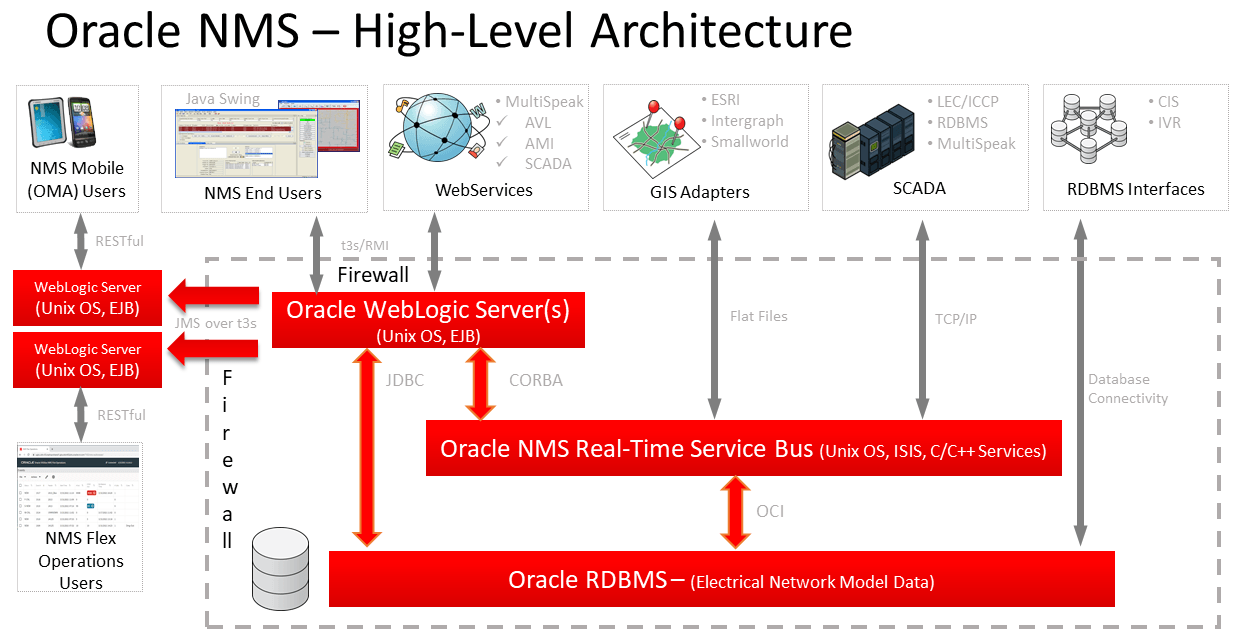
Tier 1: Rich Java Client / Flex Operations Client
Oracle Utilities Network Management System supports the following client operating systems:
• Windows 11 (Build 24H2)
• Oracle Linux 9.x
• Windows Server 2022+, 2025+ via Remote Desktop Services
Notes:
• Clients should have a monitor with a resolution of 1980x1080 or higher.
• Flex Operations is supported on tablets with a recommended minimum size of 10 inches.
Tier 2: Java Application / Unix Services Server
Oracle Utilities Network Management System supports the following Enterprise Java Beans application server:
• Oracle WebLogic Application Server
Oracle Utilities Network Management System supports the following Linux servers:
• Oracle Linux (Unbreakable Enterprise kernel or Red Hat Compatible kernel)
• Red Hat Enterprise Linux
Oracle Network Management System supports the following Virtual servers:
• Oracle VM Server Virtualization and Management running the Oracle Linux operating system
Note on Oracle Support Policy on VMWare: Refer to My Oracle Support knowledge base article 249212.1 for Oracle’s support policy on VMWare.
Notes:
• This instance of the Oracle WebLogic Application Server should be running in the GMT/UTC time zone. (The TZ environment variable should be "UTC".)
• This instance should not be shared with any NMS deployments running earlier versions of the code that did not yet support the UTC time zone.
Tier 3: Database Server
Oracle Utilities Network Management System supports the Oracle RDBMS Enterprise Edition Server.
Note: Oracle Locator, a standard component of all Oracle Database editions, is a required component of the database installation. See the Oracle Utilities Network Management System Installation Guide for details on ensuring that Oracle Locator has not been removed from your installation.
Notes:
• This instance of the Oracle Database should be running in the GMT/UTC time zone. (The TZ and ORA_SDTZ environment variables should be "UTC", and the database TIMEZONE value must be '+00:00'.)
• This database instance should not be shared with any NMS installations running earlier versions of the code that did not yet support the UTC time zone.
• NMS recommends the use of Oracle Enterprise Edition RDBMS partitioning, especially for models that intend to retain any significant operational history in the NMS RDBMS itself. Oracle NMS partitioning does require a separate Oracle EE RDBMS license (Oracle Partitioning). The default in the Oracle NMS licensed_product.dat.template is for partitioning to be enabled. If you have NOT licensed Oracle EE RDBMS Partitioning you can comment out the partitioning option and build your model without partitioning.
Operations Mobile Application and Flex Operations Client Device Support
The following operating systems are supported:
• Android 13.x+
• iOS/iPadOS 18.x+
• Windows 11 (Build 24H2)
Note: This release has been tested with the following:
• Dell Latitude 7440, x64 - 32GB i7: Windows 11 Pro, version 24H2 (OMA and Flex Operations)
• Samsung Tab A8 , Model Name: SM-X200, Android Version: 13 (OMA and Flex Operations)
• Dynabook Portege X40-J, x64 - 16GB i7: Windows 11 Pro, version 24H2 (Flex Operations)
• iPad Air (3rd generation), OS Version: 18.1.1, 64GB (OMA only)
• iPad Pro 12.9” Model MXFX2LL/A * iPadOS 18.7.2 (OMA and FlexOperations)
• iPhone 11 Pro Model MWCQ2LL/A iOS 17.2.1 (OMA only)
• Samsung Galaxy Tab S5e Model SM-T720 Android 11 (OMA and Flex Operations)
• Samsung Galaxy Phone S23 Ultra Model SM-S918U Android 16 (OMA only)
Supported Platforms Summary
Operating System, Database, and Java Application Server Support
Oracle Utilities Network Management System supports the following platforms.
Operating Systems | Compiler Version | OS Server Architecture | Application Server | Database Server |
|---|---|---|---|---|
Oracle Linux/ Red Hat Enterprise Linux Version 9.6+ | gcc 11.5.0 20240719 | x86 64-bit | WebLogic 14.1.2.0+ | Oracle 19.26+ Oracle 23.26+ |
Notes:
• Version Numbers: Version numbers marked with a “+” are the minimum version supported.
• To use Oracle Utilities Network Management System with Oracle Utilities Analytics, both must be on the same version of the Oracle RDBMS.
• The Oracle WebLogic Server used by Oracle Utilities Network Management System does not need to be co-located with the Unix services and can run on any of the platforms that are supported by Oracle for that WebLogic Server version.
• The Oracle RDBMS used by Oracle Utilities Network Management System does not need to be co-located with the Unix Services and can run on any of the platforms supported by Oracle for that RDBMS version.
Note: Oracle AI Database 26ai is currently available for Cloud and Oracle Engineered Systems platforms – for full list see MOS note 742060.1 or https://docs.oracle.com/en/database/oracle/oracle-database/index.html.
• Oracle Utilities Network Management System is tested and supported on the versions of Oracle Linux specified. Because Oracle Linux is 100% userspace-compatible with Red Hat Enterprise Linux, Oracle Utilities Network Management System is also supported on Red Hat Enterprise Linux for this release.
Third Party Products
The Bundled Third Party Products and the Required Unbundled Oracle and Third Party Products tables, which were previously included in this guide, can now be found in the Network Management System Licensing Information User Manual.