15 Reclassification Rule Configuration Using New User Interface
Auto Reclassifications enable users to automatically move or reclassify accounting balances from one account to another based on predefined business rules. An automated Reclassification process helps reduce manual journal preparation, improve consistency, and ensure that balances are reported under the correct financial categories. In AFCS, auto reclassification is typically used when source data is loaded to one account or classification but must be presented, analyzed, or reported under a different target classification. Instead of manually adjusting these balances each period, users can define reclassification rules that identify eligible balances and generate the required reclassification entries automatically.
Need for Reclassification
In an ideal scenario, every transaction would be accounted for correctly when it is created, with no need for reclassification. Upstream systems may not provide complete or fully accurate data, the full accounting context may not be available at the time of transaction creation, and accounting rules or chart of accounts structures may change over time. As a result, a classification that was valid when the transaction was created may later require correction. Because the correct account cannot always be determined upfront, reclassification is a core capability of a subledger solution. It provides a controlled and auditable way to correct accounting classifications, instead of relying on manual or ad hoc adjustments after the fact.
Existing Manual Process
Without an automated process, the detection and correction cycle becomes entirely manual, leading to several recurring challenges:
- Reactive detection — Analysts must review balance reports after close to identify misclassified balances. This manual review becomes difficult to manage as transaction volumes, ledgers, and entities increase.
- Inconsistent judgment — Without defined reclassification rules, the criteria for identifying an illogical balance and determining the corrective action may vary across analysts, teams, or accounting periods.
- Manual correction — Corrections are typically performed through manually entered journal entries, which increases the risk of keying errors, incorrect account selection, or incomplete adjustments.
- Limited auditability — Spreadsheet-based analysis and manual journal entries make it difficult to demonstrate that the process is consistent, controlled, and repeatable.
- Close-window pressure — Reclassification activities usually occur during the close window, alongside other critical close tasks. This increases the risk of errors, delays, or deferred corrections due to time constraints.
Automation Process
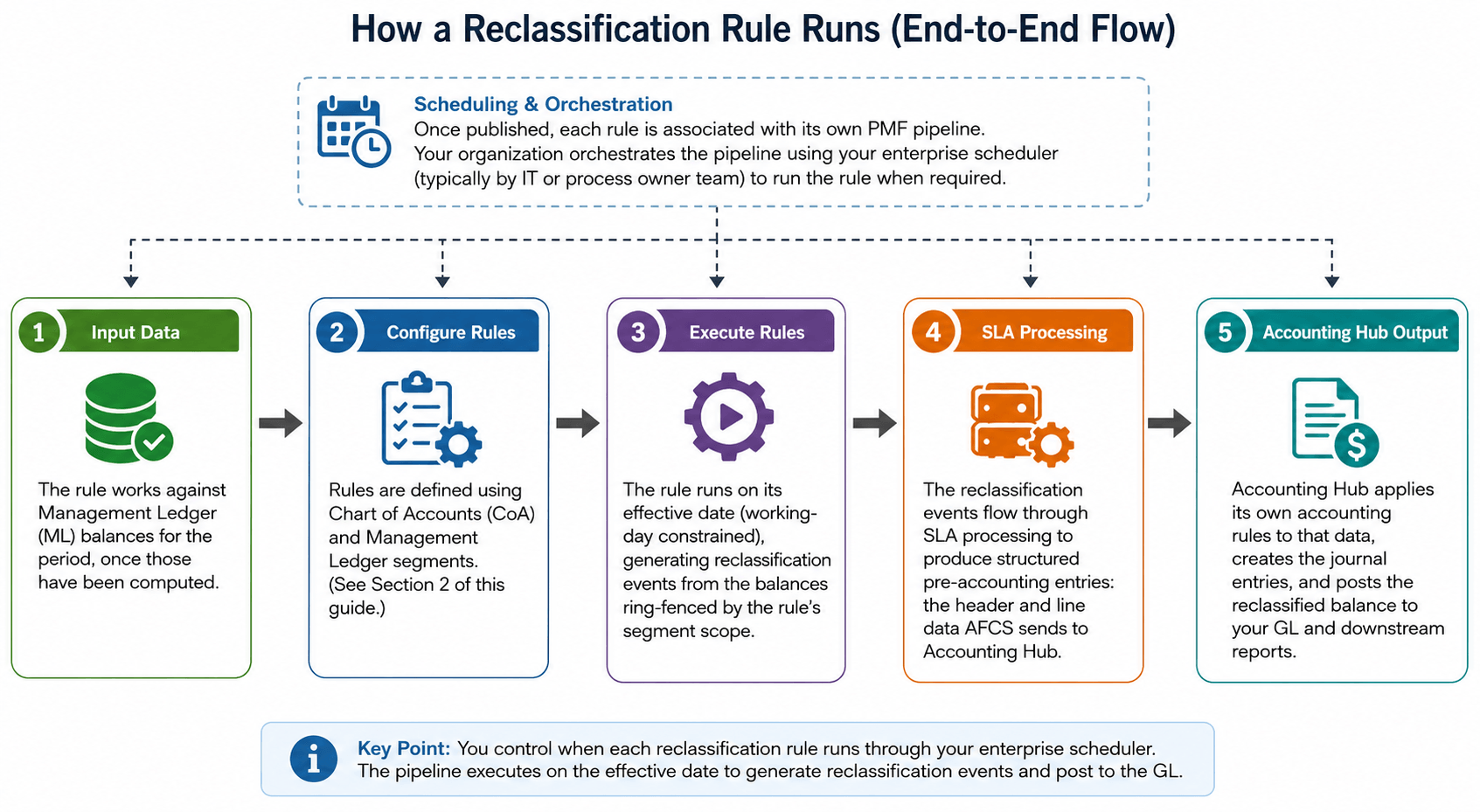
An automated and configurable reclassification capability replaces manual, post-close review with rule-based detection and controlled correction. The system applies predefined rules to identify balances that require reclassification, based on each user’s chart of accounts, accounting policies, and definition of an illogical or incorrect balance. Because the same rules are applied consistently, the process is repeatable and less dependent on individual analyst judgment. Corrections are generated through a controlled system process, creating a traceable audit trail from detection through accounting and GL posting. This reduces manual effort as transaction volumes grow and supports a faster, more reliable close process with stronger consistency and auditability.
Reclassification Rule Workflow
Figure 15-1 Reclassification Rule Workflow