Wide Area Network (WAN)
A Wide Area Network (WAN) is a large-scale network that often spans entire countries or global regions. Access to a WAN is typically leased from a service provider.
Cloud software WAN requirements should be determined by the business’s data pipeline needs. If demand on the point-of-sale system remains constant throughout the day, a WAN that can consistently provide sufficient bandwidth for this usage may be appropriate. However, if demand fluctuates between steady use and periods of high activity, the selected WAN must be able to accommodate the increased bandwidth required during peak times.
Point-of-sale software upgrades and deployments are events that require increased bandwidth.
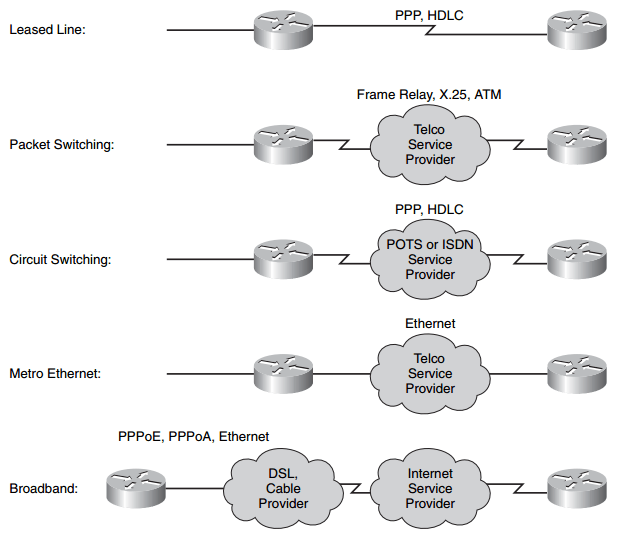
The selected WAN type should be able to handle all bandwidth-related activities to meet customer requirements. The following table and figure outlines various WAN connectivity options.
Table 7-1 WAN Connectivity Options
| WAN Type | Available Options |
|---|---|
| Leased Line | T1, E1, T3, E3 |
| Packet Switch | Frame Relay, Cell Relay/ATM |
| Circuit Switch | SONET/SDH, ISDN |
| Ethernet | VPLS, Metro |
| Broadband | Cable, Fiber Optic, DSL |
Figure 7-1 WAN Connectivity Illustration
- Point-to-Point
- Hub and Spoke (Star)
- Partial Mesh
- Full Mesh
Parent topic: Network Types