2 Hierarchy
The Simphony hierarchy organizes an Enterprise, its locations, and its configuration. It determines where configuration records are created, which locations can use them, and how location-specific differences are applied. Configuration can be managed in EMC, but the hierarchy is a Simphony system concept that affects configuration, transaction processing, reporting, and access throughout the Enterprise.
Hierarchy structure
An Enterprise contains properties, and each property can contain one or more revenue centers. Zones are optional groupings that can include properties, revenue centers, or other zones to organize shared configuration across the Enterprise.
Figure 2-1 Simphony hierarchy example
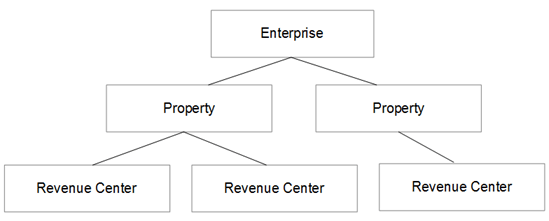
Table 2-1 Simphony hierarchy levels
| Level | Purpose | Examples |
|---|---|---|
|
Enterprise |
The Enterprise represents the organization's Simphony system and provides a central scope for shared configuration. |
Employee roles and menu item definitions that are shared across multiple locations. |
|
Property |
A property represents a place of business and contains one or more revenue centers. |
Tax rates and other configuration that differs by location. |
|
Revenue center |
A revenue center represents an outlet, such as a restaurant, bar, or retail shop, within a property. |
Order devices and outlet-specific transaction configuration. |
|
Zone |
A zone is an optional custom grouping used to manage common configuration across related properties or revenue centers. |
Regional taxes, price tiers, menus, brands, or concepts. |
Configuration scope
When you create a configuration record, the selected hierarchy level defines its scope. Choose the highest level that satisfies the business requirement to minimize duplicate configuration. For example, define a shared menu item at the Enterprise level when it applies broadly, and define or override it at a lower level when a property or revenue center requires a different value.
Not every module is available at every hierarchy level. The module and the record type determine which levels support configuration.
Inheritance and overrides
For modules that support inheritance, records configured at a higher level can be inherited by lower levels. A lower level can override an inherited record when it needs a different configuration. The effective record at a location is the closest applicable definition in the hierarchy.
Zones can provide an additional level of shared configuration. A property or revenue center can belong to multiple zones, so zone priority and record collisions require careful planning. See Inheritance and Overrides for details.
Use the hierarchy to plan configuration
-
Identify the locations that need the configuration.
-
Choose the highest hierarchy level that applies to all of those locations.
-
Use a zone when the same configuration applies to a group of related locations that do not share a single property.
-
Override an inherited record only when a lower-level location requires a different value.
Related topics