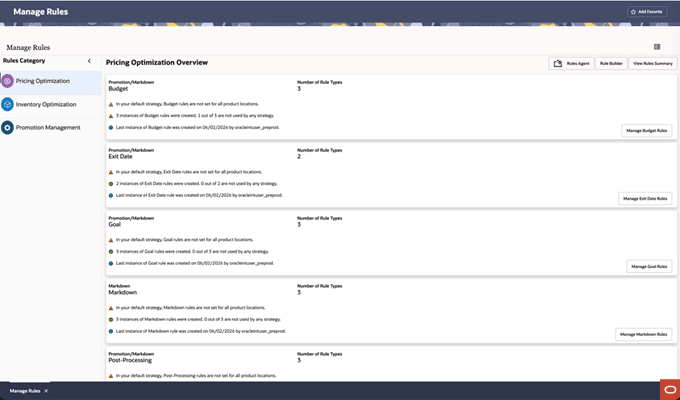
Pricing Optimization
Lifecycle Pricing Optimization (LPO) uses business rules to ensure that regular price, promotion, and markdown recommendations support the retailer’s pricing objectives. Rules can protect margin, control price changes, maintain competitive positioning, and help achieve inventory and sell-through targets.
Here are the pricing optimization rules:
- Promotion/Markdown: These rules define the constraints used to generate promotion and markdown recommendations. They include budget, pricing objective, sell-through target, exit date, temporal, pricing group, targeted offer, post-processing, promotion, and markdown rules. Together, they control factors such as available budget, promotion and markdown timing and depth, merchandise exit dates, inventory targets, no-touch periods, and coordinated pricing actions across related items.
- Regular Pricing: These rules guide initial and updated regular-price recommendations. They define requirements related to competitor pricing, cost changes, price ranges, margins, pack pricing, price ladders, and relationships among items, locations, or price zones. They can also establish revenue, margin, and volume objectives.
Regular Pricing rules can be forecast-based or non-forecast-based. Forecast-based rules use projected demand to optimize revenue, margin, or volume. Non-forecast-based rules use business information such as costs, competitor prices, margins, and price relationships. Rules Based Regular Pricing uses only non-forecast-based rules.
Refer to the Oracle Retail Lifecycle Pricing Optimization (LPO) User Guide for the complete list of LPO’s rules for Markdown/Promotion and Regular Pricing Optimization. The list of rules also can be re-referred from the PRO_OPTIMIZATION_RULES table.
Figure 11-2 Pricing Optimization