6 Run Overview and Management
Run Overview is the primary workspace for creating, monitoring, and managing Rules Based Regular Pricing runs. From here you can monitor run status across the portfolio, create new runs, copy existing runs, trigger optimization, compare runs, and finalize What-If results. This chapter describes the Run Overview workspace and the actions available from it.
Run Overview Workspace
Navigate to it from the LPO folders and links in the Oracle Home Experience using the Run Overview link.
-
Status Tiles, which provide a summary of runs by status and allow you to quickly filter the displayed runs.
-
Table of Runs, which displays detailed information about each run, including optimization status and key business metrics.
-
Contextual Panel, which provides additional insights into the selected run, including recommendation summaries and pricing impact information.
Together, these components provide a consolidated view of optimization activity and serve as the starting point for creating, managing, and reviewing pricing optimization runs.
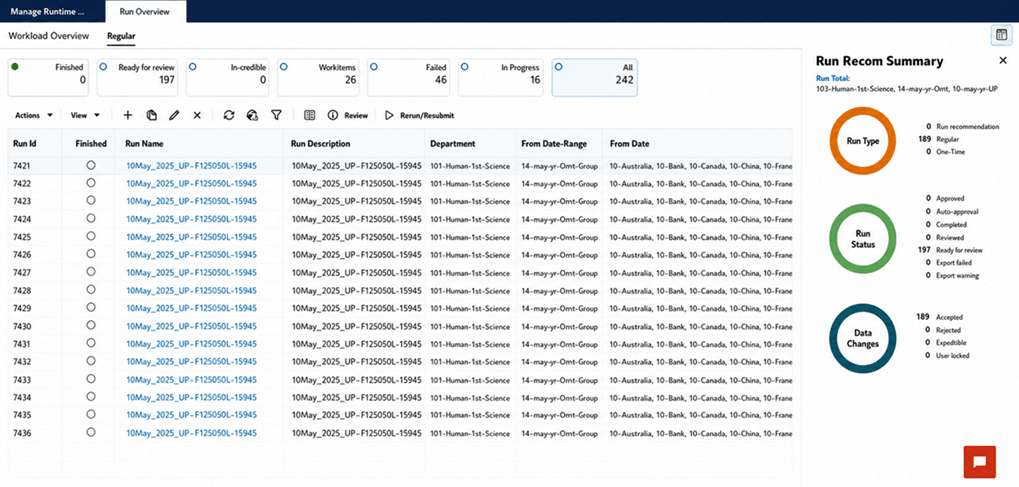
Figure 6-1 Run Overview – Regular
Status Tiles
The Status Tiles provide quick access to the number of runs by status - Finalized, Ready for Review, Infeasible, Worksheet, Failed, In Progress, and All and helps you quickly focus on runs that require attention.
By default, the Finalized tile is selected, showing the list of finalized runs. Clicking a specific tile filters the Table of Runs to display only the runs with the selected status. For example, if you click the Ready for Review tile, the table will show only the runs that are in Ready for Review status.
Figure 6-2 Run Overview - Status Tiles

Table of Runs
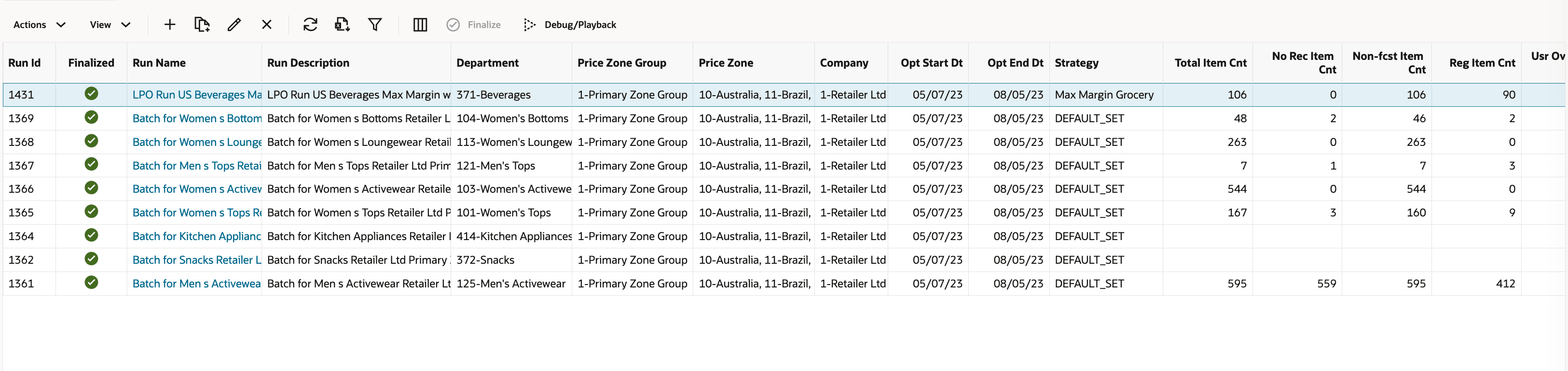
The Table of Runs is the operational center of Run Overview. Each row represents an optimization run and provides visibility into each run’s scope, strategy, status, and recommendation summary.
Use this table to compare optimization outcomes, monitor run progress, identify failed or infeasible runs, and access detailed run results.
See Appendix: Regular - Pricing Optimization Rules for further information.
Figure 6-3 Run Overview - Table of Runs
-
For Rules Based Regular Pricing runs, run-level metrics primarily summarize recommendation counts and run status. Forecast-dependent metrics, such as Revenue, Gross Margin, Sell-Through, and Volume, are populated only for Forecast-Based Regular Pricing runs and may be unavailable or not populated.
-
When the run is in Ready for Review status, clicking the run name in the overview screen automatically takes you to the Results stage. Otherwise, if the run is Worksheet status, the Results stage is disabled.
-
The table of runs also provides the information about the batch runs. Batch runs are prefixed with "Batch" in the run name, and the run status will say "Auto Run" when created.
-
You cannot individually optimize batch runs, as they are scheduled for optimization as part of the batch process.
-
If you want to execute batch optimizations on demand, you can use the Oracle Retail Process Orchestration and Monitoring Cloud Service (POM) UI to submit an adhoc batch job for optimization. Batch runs then execute at the frequency specified by the batch process.
-
The system refreshes the latest pricing, cost, competitor, merchandise, and other required input data before optimization.
-
If the batch run completes successfully, LPO displays the results and finalizes the run.
-
Click the Refresh button to update the table and run statuses.
Contextual Panel
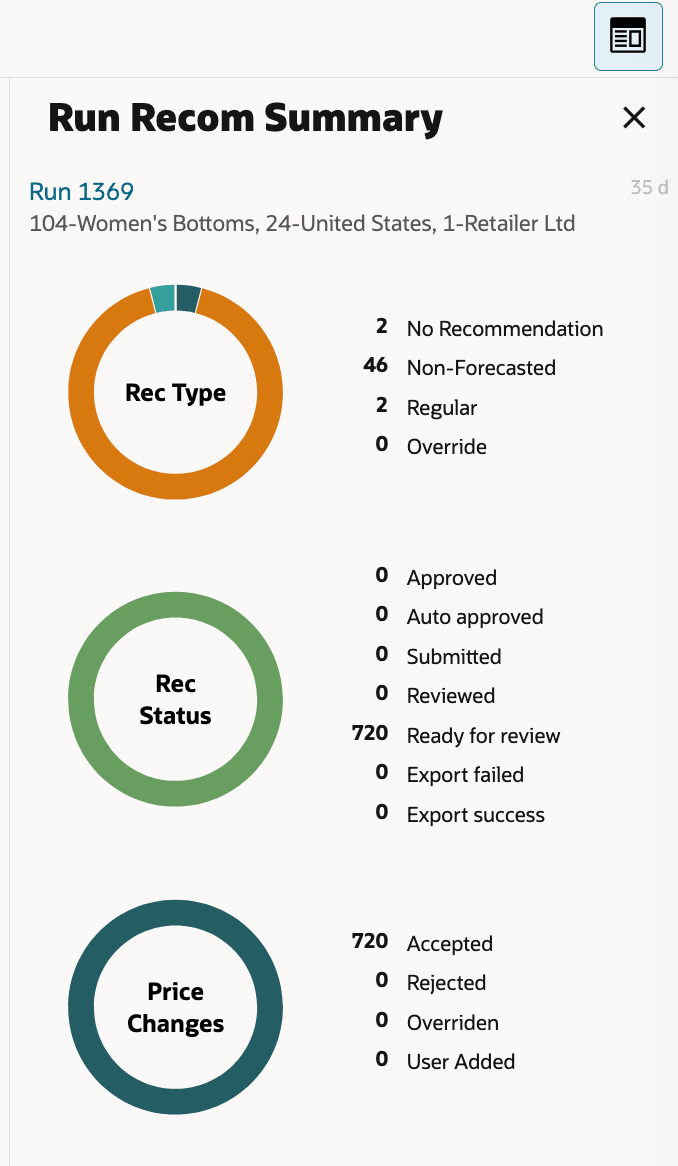
When you select a run in the Table of Runs, the Contextual Panel displays a summary of that run's parameters and status history, including the run scope, strategy, status log with timestamps, and a count of items in scope. No action can be taken from the Contextual Panel on the Run Overview workspace: use the Actions menu or open the run to take actions.
Figure 6-4 Run Overview - Regular - Run Recommendation Summary
Run Overview Actions
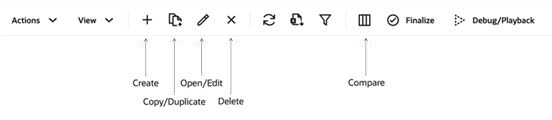
The following actions are available from the Actions menu on the Run Overview workspace.
Figure 6-5 Run Overview - Actions
Create a Run
A Pricing Manager (Analytical Super User) or Regular Pricing Manager can create a new run by clicking the Create icon. This opens the Run Overview tab, where you can configure a new optimization run. In this screen, you define the optimization scope, select a pricing strategy, and review the business rules that will be applied during optimization.
Copy/Duplicate a Run
To duplicate an existing run, select the desired run from the list on the Overview screen and click the Duplicate icon. You will be prompted to either continue with the existing effective week or select a new one from the drop-down list. The Scope stage in the Run tab will open, with all fields pre-populated using the inputs and data from the source run. Any existing results are not included.
The duplicated run appears in the list with a new Run ID and a Run Name prefixed with "Copy Of." All business rules from the source run are also copied. However, current pricing inputs, cost, competitor prices, and other optimization inputs are refreshed when the copied run is optimized.
Open/Edit Run
The Run Overview tab is used for both viewing and editing runs, providing access to the Scope, Strategy or Rules Summary, and Results screens. To edit or view an existing run, select it from the displayed list and click the Edit icon. You can open any run for viewing; however, you can only edit runs that you created and for which you have the appropriate roles (such as Pricing Manager (Analytical Super User) or Regular Pricing Manager), and only if the run status is not Running, Reviewed, or Submitted. All other runs open in read-only mode.
Delete a Run
You can delete runs based on their status and your permissions. To delete an existing run, select it from the displayed list and click the Delete icon. A user with Administrator permissions can delete any run except those with a status of Running. You can delete runs that you have created, provided they are not Running. You cannot delete runs created by another user or runs with an Auto Run status. You can select and delete multiple runs at once.
Compare Runs
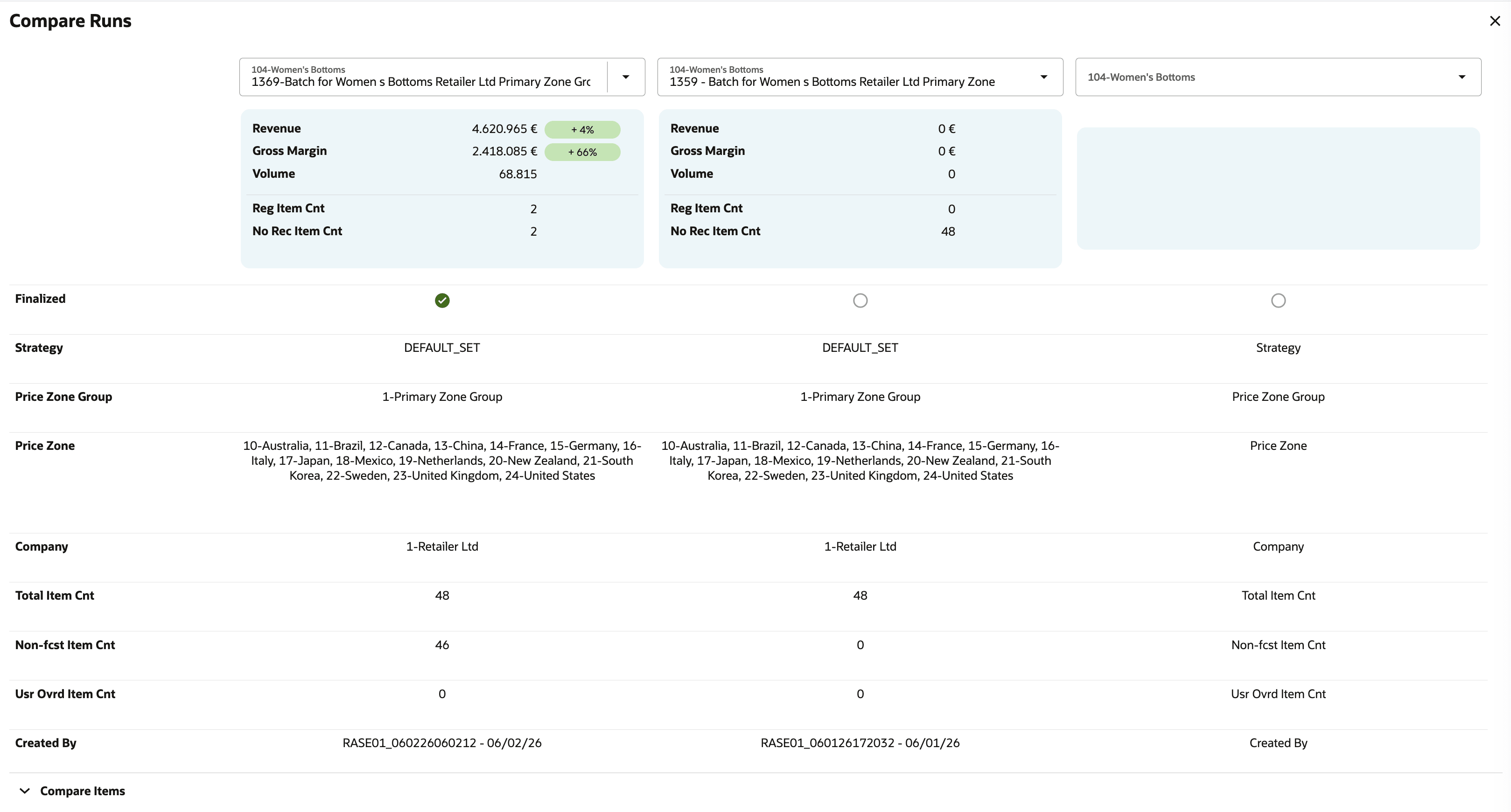
You can select one to three runs that share the same Merchandise Level and are in Ready for Review status, then click the Compare icon to initiate a comparison. The Compare Runs feature allows you to compare recommendations produced by different strategies or What-If scenarios. Depending on your implementation, available comparison metrics may include recommendation counts, price changes, violations, and forecast-dependent metrics where applicable.
Figure 6-6 Run Overview - Compare Runs
Finalize Runs
After optimizing a run, you can send its recommendations for further action by selecting the run and clicking the Finalize button, provided the results are satisfactory. When you finalize a run, the recommendations from the what-if run replace those from the corresponding batch run in the Manage Recommendations workspace.
If there is a conflict, meaning the new run to be finalized has the same scope as an existing finalized run, an alert appears, asking you to un-finalize the existing run first. Exercise caution when un-finalizing a run, as any approved recommendations will be removed from the export integration views.
Debug/Playback
You can select a run and click the Debug/Playback button to download a zip file containing relevant data for debugging a what-if run. These files help you troubleshoot discrepancies between environments (for example, Stage versus Prod) or when submitting a Service Request (SR), making it easier to identify and resolve issues quickly.
Run Tab and Process Train
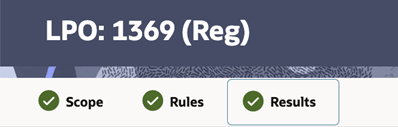
When you open or create a run from the Run Overview workspace, LPO opens it in a dedicated tab in the main workspace area labeled LPO: <Run ID>(Reg), where Reg indicates a Regular Pricing run.
Within the run tab, a Process Train appears at the top of the screen. The Process Train is a horizontal sequence of stage indicators showing where you are in the run workflow and allowing navigation between stages. For a Rules Based Regular Pricing run the Process Train stages are:
-
Scope: Define the run parameters including merchandise, location, season, effective week, and strategy.
-
Rules: Review the N/F rules applicable to the selected scope, including the Rules tab, Price Ladder tab, and Price Matrix tab.
-
Results: View price recommendations generated by the optimization engine.
Figure 6-7 Process Train