1 Introduction to Lifecycle Pricing Optimization
Retailers make thousands of pricing decisions throughout a product’s lifecycle. New products launch at a regular price, selected products are promoted to increase demand, slow-moving inventory may require markdowns, and customer segments may receive targeted offers. Making these decisions manually across large assortments is time-consuming and often results in inconsistent outcomes.
Oracle Retail Lifecycle Pricing Optimization (LPO) helps retailers make these decisions using demand forecasts or current operational data, optimization, machine learning, and business rules, as applicable.
LPO helps retailers answer questions such as:
- Which products should be promoted, and when should the promotion occur?
- How deep should a markdown be, and how can inventory be cleared while protecting profitability?
- What should the initial price be for a new item based on similar items?
- How should an existing item’s regular price change when costs, competitor conditions, or business rules change?
- Which products require attention based on in-season performance?
- Which customer segments should receive targeted offers?
LPO produces regular price, promotion, markdown, and targeted recommendations.
- Regular pricing can use forecast-based or rules-based optimization to establish an initial price or change an existing regular price.
- Promotions temporarily reduce prices, while markdowns permanently reduce prices to support inventory clearance.
- Recommendations are generated at configured merchandise and location or price-zone levels; targeted offers add customer-segment or individual-level specificity.
LPO evaluates pricing decisions across the product lifecycle so recommendations align with business objectives, inventory, demand, and planned retail events.
For information about administering LPO, see the Oracle Retail AI Foundation Cloud Services Administration Guide.
How LPO Works
At a high level, LPO converts business objectives into actionable pricing recommendations.
Depending on the optimization type, the process begins with demand forecasting or current operational data, together with business strategy definition. LPO then evaluates potential pricing opportunities, applies the applicable business rules and constraints, and generates recommendations designed to achieve the selected objective.
Business users review the recommendations and make permitted changes. Authorized users can then submit or approve reviewed recommendations for export or delivery to downstream execution systems.
The pricing lifecycle typically follows the process shown below:
Forecast Configuration (forecast-dependent types) -> Business Strategy -> Optimization -> Recommendations -> Review -> Execution
Table 1-1 Purpose of Each Stage in LPO
| Stage | Purpose |
|---|---|
| Forecast |
Estimates future customer demand and inventory outcomes. Required for forecast-dependent optimization types. |
| Strategy | Defines the overall business objective, establishes business constraints and pricing policies. |
| Optimization | Evaluates possible pricing scenarios based on the selected strategy and identifies the best solution. |
| Recommendations | Produces proposed pricing actions. |
| Review | Allows business users to validate recommendations; accept, reject, override, or add recommendations where supported; and mark the recommendations as Reviewed. |
| Execution | Allows authorized users to Submit or Approve reviewed recommendations for export or delivery to downstream pricing systems, depending on the configured integration. |
Throughout this process, LPO balances competing objectives such as revenue growth, gross margin protection, inventory clearance, and customer engagement.
Why Retailers Use LPO
Improve Revenue and Gross Margin Across the Product Lifecycle
- LPO recommends prices that align with the selected business objective, product lifecycle stage, demand conditions, and inventory availability.
- Rather than treating each pricing event independently, LPO evaluates the cumulative impact of pricing decisions across the entire lifecycle.
Improve Inventory Sell-Through
- Inventory levels are incorporated directly into optimization decisions.
- Products with excess inventory may receive more aggressive recommendations, while products with healthy demand may maintain higher price points.
- This helps retailers improve sell-through while reducing unnecessary margin erosion.
Respond to Changing Business Conditions
- Retail environments change constantly.
- Sales trends, inventory positions, costs, competitor activity, and customer behavior all influence pricing decisions.
- During scheduled batch or on-demand optimization runs, LPO evaluates the latest available sales, inventory, cost, competitor, and customer information, as applicable, and generates recommendations that reflect current business conditions.
Enable Customer-Centric Pricing
- Not all customers respond to pricing in the same way.
- LPO supports targeted recommendations that allow retailers to deliver personalized offers to specific customer segments without broadly discounting merchandise.
- This improves offer relevance while protecting overall profitability.
Improve Operational Efficiency
- Pricing decisions often require reviewing large volumes of data across multiple products, locations, and time periods.
- LPO automates much of this analysis, allowing pricing teams to focus on exceptions, business decisions, and strategic activities rather than manual calculations.
Pricing Optimizations Types
Retailers rarely use a single pricing strategy throughout a product’s lifecycle. A newly introduced product is managed differently from a seasonal item approaching end-of-life, and customer-specific offers often require a different approach altogether.
LPO supports multiple optimization types, each designed for a different pricing decision. The following sections help you identify the best fit for your business scenario.
Depending on the pricing event, users can create one of the following optimization types:
Table 1-2 Optimization Types in LPO
| Optimization Type | Description | Typical Business Scenario | Forecast Required |
|---|---|---|---|
| Promotion |
Optimizes promotional pricing by determining which eligible products should be promoted, when the promotion should occur, and the appropriate promotional depth. LPO considers demand forecasts, planned events, promotional objectives, and business constraints. |
A retailer is planning a Back-to-School, Holiday, or Weekend Sale and wants to determine the best promotional prices before the event begins. | ✓ |
| Markdown |
Optimizes markdown prices to sell through seasonal or excess inventory while balancing objectives such as margin recovery, inventory reduction, and sell-through targets. Recommendations are generated across one or more markdown periods until the inventory is cleared or the selling horizon ends. |
A fashion retailer needs to clear end-of-season apparel, or an electronics retailer wants to reduce inventory before new products arrive. | ✓ |
| Regular Pricing (Forecast-Based) |
Optimizes everyday selling prices using forecasted customer demand. LPO evaluates how price changes are expected to affect sales, revenue, gross margin, and volume, and recommends prices that best achieve the selected business objective. |
A grocery retailer wants to increase gross margin on coffee products, or a consumer goods retailer wants to maximize revenue while maintaining competitive prices. | ✓ |
| Regular Pricing (Rules-Based) |
Generates regular price recommendations based on configured pricing rules and business policies rather than demand forecasts. Recommendations consider constraints such as competitor pricing, pricing groups, price ladders, and inter item relationships. |
A retailer needs to implement a supplier cost increase, maintain competitive pricing, or apply corporate pricing policies where demand forecasts are not required. | X |
| Targeted Offer |
Generates personalized offers for selected customer segments or individuals. LPO uses customer behavior, demand forecasts, configured targeting criteria, deal type, channel, and discount information to recommend offers expected to produce the best redemption rate. |
A retailer wants to select the most relevant deal type, channel, and discount for a loyalty segment and maximize predicted redemption. | ✓ |
Note:
- Promotion and Markdown Optimization always uses demand forecasts because pricing decisions are evaluated over a future selling period. Forecast-Based Regular Pricing also requires a valid forecast configuration.
- Targeted Offer Optimization uses demand forecasts and customer segmentation to generate personalized recommendations. Unlike Promotion Optimization, which applies the same promotional pricing to all eligible customers, Targeted Offer Optimization tailors offers to specific customer segments or individuals based on configured business objectives and targeting criteria.
Choosing the Appropriate Optimization Type
The optimization type determines the workflow, available configuration options, and the results presented during the run.
Table 1-3 Choosing Optimization Type
| If your objective is to… | Use… |
|---|---|
| Optimize prices for an upcoming promotion | Promotion Optimization |
| Clear seasonal or excess inventory | Markdown Optimization |
| Improve regular prices using forecasted demand | Regular Pricing (Forecast-Based) |
| Generate regular prices based on business rules and pricing relationships | Regular Pricing (Rules-Based) |
| Maximize predicted offer redemption for selected customer segments or individuals | Targeted Offer Optimization. |
Regular Pricing has two distinct modes. Forecast-Based Regular Pricing uses demand forecasts and can apply Forecast (F) and Non-Forecast (N/F) rules. Rules-Based Regular Pricing uses current operational data and applies only Non-Forecast (N/F) rules.
Table 1-4 Regular Pricing Mode Comparison
| Dimension | Forecast-Based Regular Pricing | Rules-Based Regular Pricing |
|---|---|---|
| Forecast Dependency | Requires trained demand model and approved forecast. | None. No forecast setup required. |
| Rule Types Used | Forecast (F) and Non-Forecast (N/F) rules. | Non-Forecast (N/F) rules only. Forecast (F) rules included in the strategy are not applied. |
| Primary Decision Driver | Forecasted business outcomes | Business rules and constraints |
| Best Feasible Solution | Optional. | Enabled by default. |
| Typical Use Cases | Strategic pricing: new item introduction, season entry/exit, demand-driven pricing. | Operational pricing: competitor response, cost pass-through, margin guardrails, price consistency. |
Note:
To enable Rules Based Regular Pricing Optimization, set the RSE_CONFIG.PRO_LPO_REGULAR_LITE_ENABLED_FLG to Y from Manage Configurations.
How Optimizations Work Together
Although each optimization type serves a different purpose, they are not independent activities.
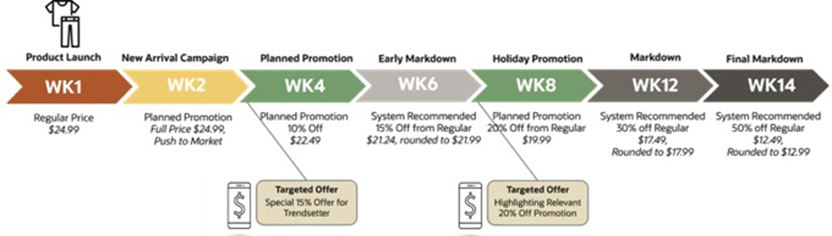
A typical product lifecycle may involve multiple pricing strategies:
- A product launches with a regular price.
- Promotional events are used to stimulate demand during the season.
- Markdowns are introduced as inventory clearance becomes a priority.
- Targeted offers are used to engage specific customer segments throughout the lifecycle.
Figure 1-1 Example Use Case