Adding an Action to the Premise Page
You can use VB Studio to add custom actions to the Action button on the Premise page, available in CX for Utilities Agent Service.
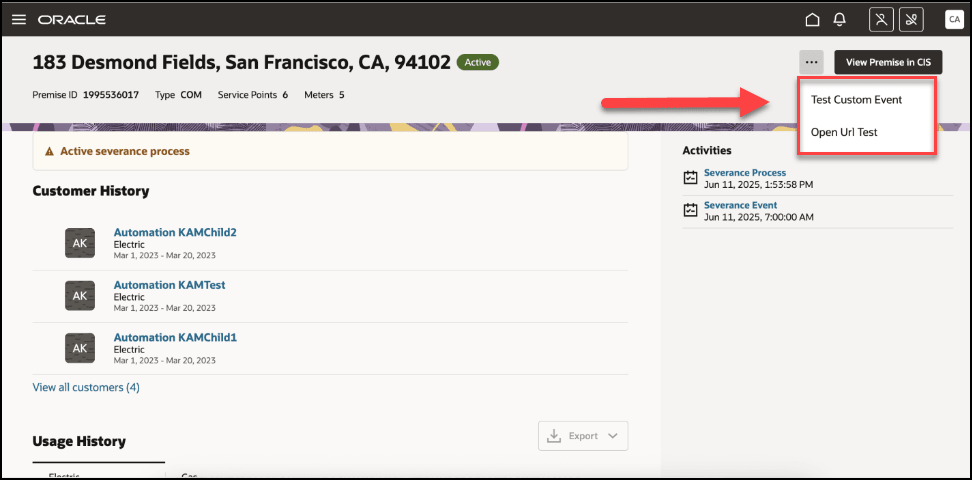
You can add these types of actions:
- Open URL action
- Navigate to page action
- Custom event action
This example shows how to add either an open URL action or a navigate to page action to the button.
This example assumes that the reader understands how to use VB Studio. For additional information, see:
-
Manage Premises in the Using CX for Utilities Agent Service Guide
-
The Visual Builder Studio library in the Oracle Help Center
-
Customizing Variables and Constants in the Extending Oracle Cloud Applications with Visual Builder Studio Guide
Example: Adding an Action Menu Item to the Premise Page
-
Log into CX for Utilities Agent Service as an administrator.
-
Click the menu at the top right of the page and select Edit Page in Visual Builder Studio.
-
Select your workspace and click Select. Note that you can also create a new workspace if needed.
-
In the App UIs panel, expand Oracle Utilities Advanced Care UI application and then navigate to main, then select main-premise-landing, and then click main-premise-landing-start.
- Select the Event and for premiseLandingPageMoreActionsEvent create an event listener and select an action chain which will implement your custom action.
- In the App UIs panel, expand Oracle Utilities Advanced Care UI application and then select e11y-user-action-template fragment underneath Fragments submenu.
-
Select the Variables sub-tab to display the constants and variables.
-
Click on the USER_ACTION_CONTEXT_LIST constant.
-
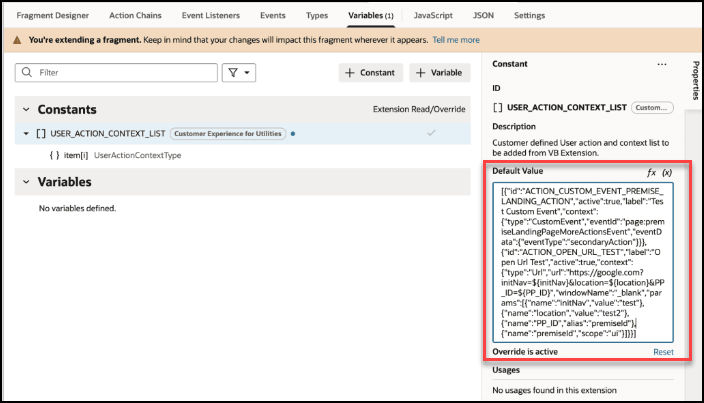
On the right side of the screen, enter your configuration in the Default Value field, as shown here:
- In the App UIs panel, expand Oracle Utilities Advanced Care UI application and then again expand main, then select premise-landing-page-start under the premise-landing-page submenu.
- Select the Variables sub-tab to display the constants and variables.
- Select the USER_ACTION_UI_PREMISE_LANDING_PAGE_MORE_ACTIONS constant.
- On the right side of the screen, enter the same ID strings in the Default Value field that were passed on the USER_ACTION_CONTEXT_LIST of e11y-user-action-template fragment. This code sample contains configurations for a custom action (ACTION_CUSTOM_EVENT_PREMISE_LANDING_ACTION) and also an open URL (ACTION_OPEN_URL_TEST):
[ { "id": "ACTION_CUSTOM_EVENT_PREMISE_LANDING_ACTION", "active": true, "label": "Test Custom Event", "context": { "type": "CustomEvent", "eventId": "page:premiseLandingPageMoreActionsEvent", "eventData": { "eventType": "premiseLandingPageEvent" } } }, { "id": "ACTION_OPEN_URL_TEST", "label": "Open Url Test", "active": true, "context": { "type": "Url", "url": "https://google.com?initNav=${initNav}&location=${location}&PP_ID=${PP_ID}", "windowName": "_blank", "params": [ { "name": "initNav", "value": "test" }, { "name": "location", "value": "test2" }, { "name": "PP_ID", "alias": "premiseId" }, { "name": "premiseId", "scope": "ui" } ] } } ] -
Preview your changes to verify that they look as you expected. This will launch a new tab with the Premise page. Validate that your new option is available, and that it navigates to the appropriate location.
-
When your changes are ready for use, complete the steps to publish your changes to your production environment.
Parent topic: Use Cases for Customer Experience for Utilities