Promotion Module
The Promotion module enables the utility to promote a program of their choice that is related to the available disaggregation categories: heating, cooling, water heating, appliances, lighting, and fridge. The module is designed to help the customer understand the cost and benefits of taking advantage of the program. Oracle Utilities Opower works directly with the utility to design the promotion module on the front of the report to be specific to the report promotion.
Appears in: Promotion Report
On this page:
Requirements
Utility Requirements
| Category | Description |
|---|---|
| Required Cloud Service | Energy Efficiency Cloud Service |
| Scale | Not applicable. |
Customer Requirements
| Category | Description |
|---|---|
| Billing Frequency | Monthly, bi-monthly, or quarterly. |
| Data Delivery Frequency | Not applicable. |
| Data Requirements |
To target the promotion to customers with a specific energy appliance or energy use pattern, the Oracle Utilities Opower platform requires data about how a customer uses energy in specific end-use categories such as heating or cooling. Minimum: The minimum requirement is to have average energy use data for households in a utility's region. This data is typically obtained from public data sources and is used as a baseline for the Home Energy Analysis survey. Customer responses to the survey can then be used to determine what appliances customers have or how their energy breaks down into specific categories, so that the promotion can be targeted to them. Recommended: The recommended approach is to use Oracle Utilities Opower data science models to generate more accurate appliance detection and disaggregation results. In this case, the data requirements include a combination of billed usage data, daily or subdaily AMI data, and weather data. Your Delivery Team will work with you to understand the specific requirements and help you identify the best approach for your situation. |
| Data History |
Depending on which Oracle Utilities Opower data approach is used, one of the following data history requirements may apply:
|
| Data Coverage | Depending on which Oracle Utilities Opower data approach is used, the data coverage requirements may include subdaily AMI data and temperature data points. |
| Supported Fuels | Electric-only, gas-only, dual fuel. |
User Experience
This image shows an example of a Promotion module featuring a hot water heater.
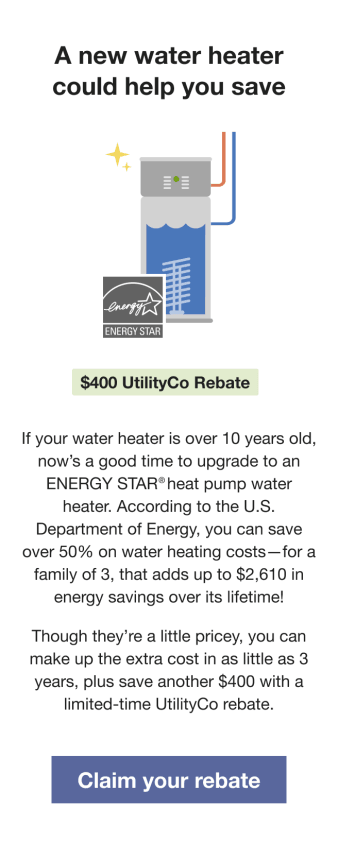
Header: Introduces the promotion and prepares the customer to learn how they can save.
Rebate or Discount: Highlights the amount the customer can save by taking advantage of the promotion.
Illustration: Provides a visual representation of the promotion.
Body Text: Describes the cost savings, energy efficiency, environmental benefits, and comfort improvements associated with the promotion.
Call to Action: Includes a button that directs the customer to access the promotion.
User Experience Variations
The user experience varies for customers depending on their energy use, service types, available data, costs, locale, and if the utility elects to promote an end use that is not the customer's largest end use category.
Heating and Cooling Combined
The combined heating and cooling messaging may include feel-good or community-oriented themes that emphasize the personal benefits of taking action. For example, a promotion might highlight how installing a smart thermostat helps manage heating and cooling without sacrificing comfort, including the ability to adjust settings from a smartphone. It may also emphasize potential cost savings and explain how reduced energy use can contribute to lowering greenhouse gas emissions.