Combine OCI Services by Application Component
Select the OCI service that best fits each independently deployed application component. A single application can combine components running on OKE, OCI Container Instances, OCI Functions, and OCI Compute.
In the following diagram, each vertical lane represents a separate service decision, not a required architecture.
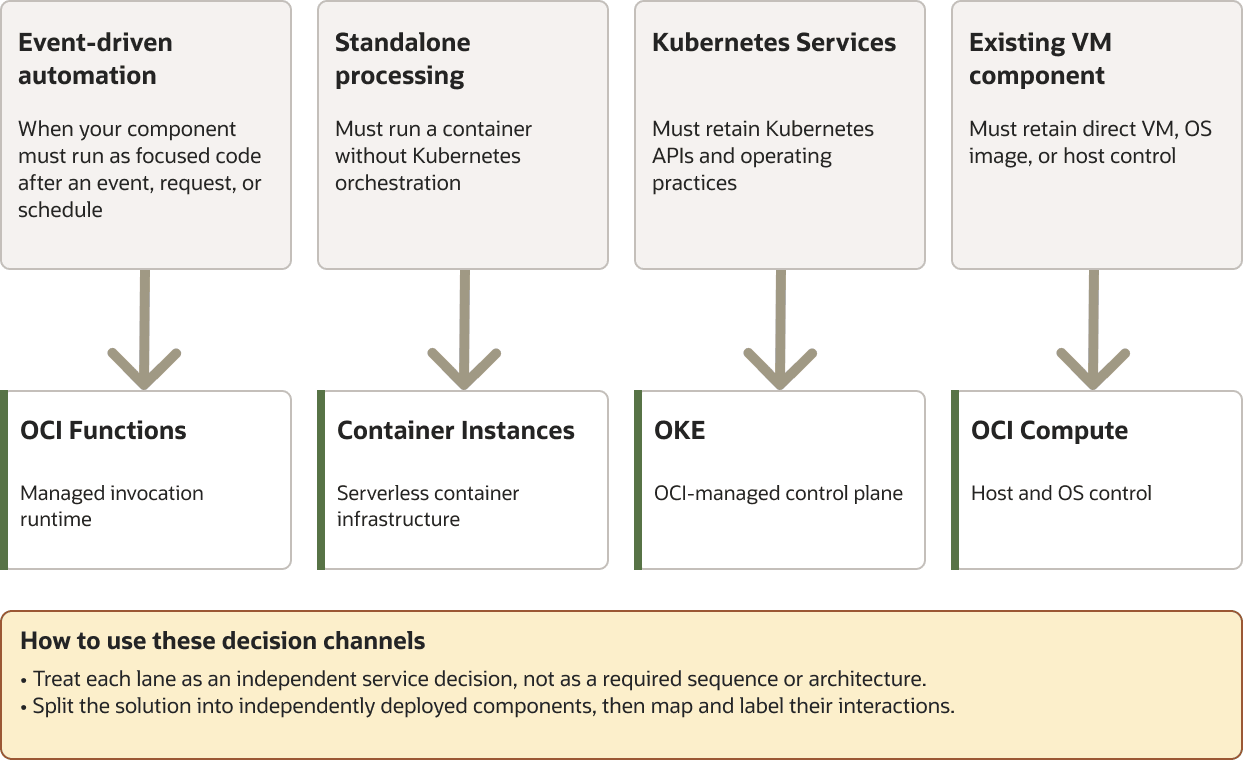
- Run Kubernetes-based application services on OKE and use OCI Functions for event-driven automation around those services.
- Use OKE for orchestrated application components and OCI Container Instances for standalone processing or delivery jobs that do not require Kubernetes.
- Retain an existing VM-based component on OCI Compute while placing new Kubernetes components on OKE and operational automation in OCI Functions.
Public Oracle customer stories provide examples of this component-level approach:
- Sisal uses OKE and OCI Functions to improve the speed of its web interface and application integration as part of its OCI migration.
- SoundHound uses OKE, OCI Functions, OCI API Gateway, GPUs, and other OCI services to support its voice AI platform and growth.
Learn More
- Event-driven processing with OCI Object Storage → OCI Events → OCI Functions → OCI Container Instances: Integrate Oracle Cloud Infrastructure Container Instances with Oracle Cloud Infrastructure Events Service (tutorial)
- Integrate OCI Queue, OCI Functions, and OKE: Optimize asynchronous workflows by integrating OCI Queue with OCI Functions
- OCI Container Instances + OCI Functions + OCI Monitoring: Autoscale Oracle Container Instances
- OKE integration with OCI Networking, OCI Identity and Access Management, OCI Vaultt, databases, and load balancing: Deploy serverless Kubernetes with OCI Kubernetes Engine virtual nodes
- CI/CD across OKE, OCI Functions, and OCI Compute: Understand modern app deployment strategies with OCI DevOps
Record the OCI Service Decision
Before detailed design, the application or platform team responsible for implementation should create a short record for each component in its architecture decision record, design document, or equivalent repository.
- Name the application component and describe its deployment unit: function code, container image, Kubernetes resources, VM, or self-operated Kubernetes platform.
- Record the selected OCI service and deployment model.
- State the hard requirements and tradeoffs that drove the selection, including why a more managed option did not meet the requirements when applicable.
- Identify your organization's operational responsibilities and the team accountable for them.
- List the required OCI integrations and the current documentation reviewed for supported configurations, limits, prerequisites, and regional availability.
- Record the cost assumptions and link to the current cost model.
The service decision is ready to carry into detailed architecture design when workload fit, operating responsibility, and material tradeoffs are explicit.