Find a Starting OCI Service for Your Workload
The decision flowchart uses those requirements to help identify a starting service. When a hard requirement conflicts with how the component is packaged today, the requirement should drive the choice.
Self-managed Kubernetes is evaluated only after OKE when a specific control-plane requirement remains unmet.
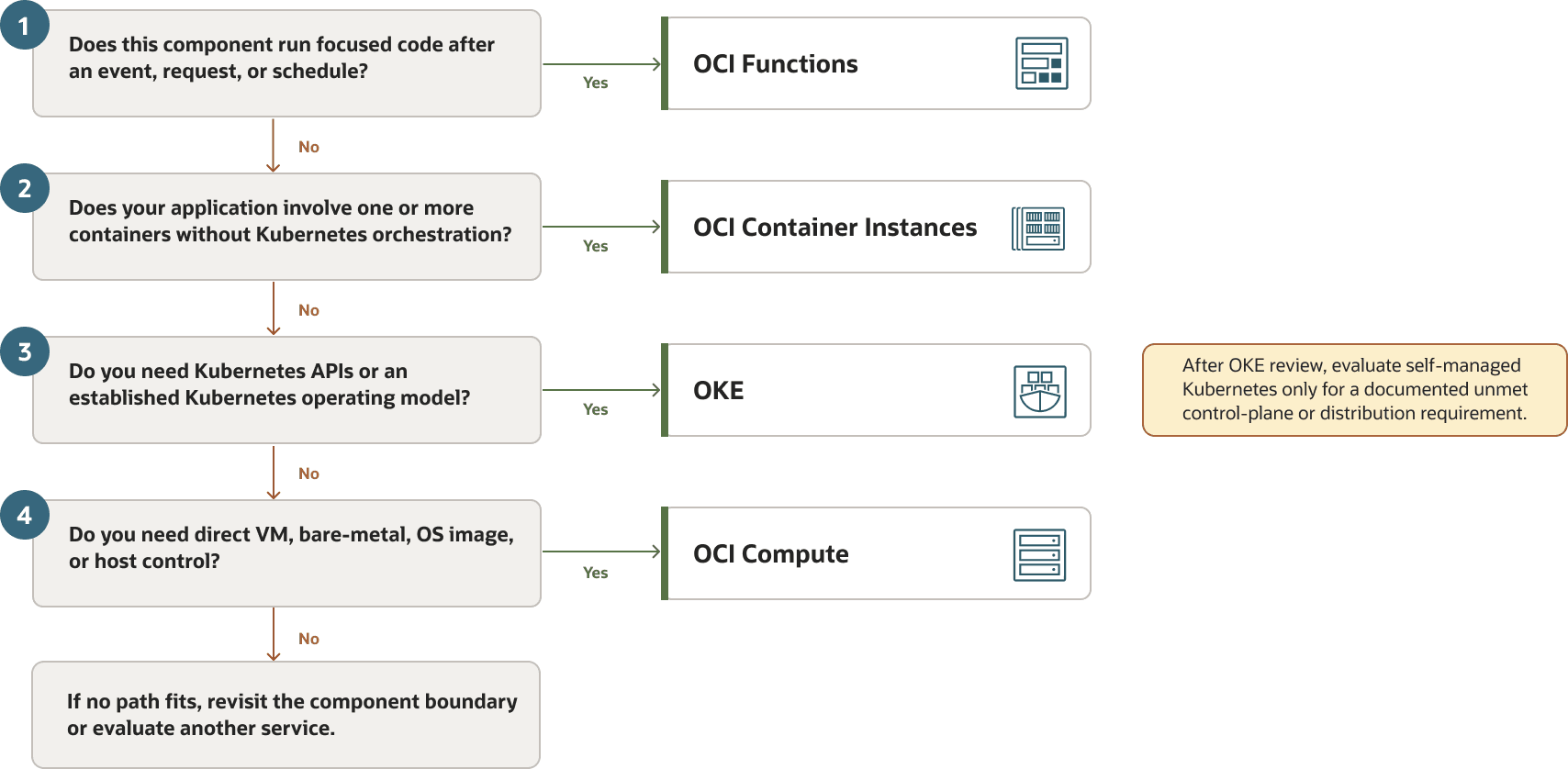
If no path fits cleanly, revisit the component boundary and document the unmet requirement. One application may use multiple OCI services, and the best fit may also fall outside the scope of this guide.
The following table can help you match a component’s requirements to a starting service. The sections that follow provide additional guidance and links to relevant documentation.
| Service or model | Start here when: | Your organization operates: | OCI provides: |
|---|---|---|---|
| OCI Functions | Focused code runs in response to an event, request, or schedule and fits the Functions execution model. | Code, dependencies, configuration, triggers, IAM policies, application behavior, and recovery logic. | A managed, on-demand Functions service and its runtime infrastructure. |
| OCI Container Instances | One or more containers need configurable compute and networking without Kubernetes orchestration. | Container images, resource and network configuration, restart behavior, availability, and scaling design. | Serverless compute infrastructure optimized for containers. |
| OCI Kubernetes Engine (OKE) | The application or platform requires Kubernetes APIs, orchestration, scheduling, policies, or ecosystem tooling. | Applications, Kubernetes workload configuration, and responsibilities associated with the selected worker model. | A fully managed Kubernetes control plane and virtual, managed, or self-managed worker choices. |
| Self-managed Kubernetes on OCI | A documented requirement justifies your ownership of the Kubernetes control plane or distribution. | The Kubernetes platform, control plane, etcd, upgrades, security, worker lifecycle, backup, recovery, and reliability. | OCI Compute, networking, storage, IAM, and integration services for the platform you operate. |
| OCI Compute | The workload requires direct VM, bare-metal, operating-system, image, or host control. | The operating system, patches, runtime software, application deployment, capacity, availability, backup, and recovery. | VM or bare-metal compute resources and the underlying OCI infrastructure. |
About OCI Functions
OCI Functions is a fully managed, on-demand Functions-as-a-Service platform. A function runs when invoked directly or by another service, event, request, or schedule. OCI manages the service runtime and scales execution in response to incoming requests, subject to service limits.
Typical Functions scenarios
- Event-driven processing: Run code when an OCI resource changes or when data arrives through services such as Events, Object Storage, or Streaming.
- API backends: Run focused request-handling logic behind OCI API Gateway without operating an always-on application server.
- Scheduled automation: Perform tasks such as tagging, notification, cleanup, or temporary-resource management on a defined schedule.
- Variable or intermittent work: Add execution capacity as invocations arrive instead of operating continuously provisioned runtime infrastructure.
- Independent parallel work: Divide files, messages, or data partitions into separate invocations that can run concurrently within service and tenancy limits.
Your organization's responsibilities
You own function code, dependencies, configuration, triggers, IAM policies, network design, error handling, and application behavior. You also determine whether duration, invocation method, concurrency, state handling, observability, and recovery requirements fit the service.
When another service may be a better fit
Consider another service when the process must run continuously, the team needs direct control of the container or host lifecycle, the workload does not fit the supported invocation model, or Kubernetes APIs and orchestration are required.
Learn more
About OCI Container Instances
Container Instances runs one or more containers on serverless compute optimized for container workloads. You select container images and configure the compute shape, resource allocation, networking, restart behavior, and other container settings without provisioning or maintaining servers.
Typical Container Instances scenarios
- APIs and web applications that do not require Kubernetes orchestration.
- Build and deployment jobs in continuous integration and delivery pipelines.
- Automation tasks for cloud operations.
- Data or media processing jobs.
- Development and test environments.
- A primary container and supporting containers that share a lifecycle.
Your organization's responsibilities
You own container images and dependencies, resource configuration, networking, secrets and IAM configuration, restart policy, application availability, and scaling design.
OCI manages the underlying server infrastructure used by the service.
When another service may be a better fit
- Evaluate OKE when the application requires Kubernetes APIs, controllers, policies, scheduling, service discovery, or ecosystem integrations.
- Evaluate OCI Compute when the team needs to administer the operating system or host software.
- Evaluate Functions when the primary unit of work is focused logic invoked by an event, request, or schedule.
Learn more
About OCI Kubernetes Engine
Kubernetes automates deployment, scaling, and management of containerized applications. OKE provides a fully managed Kubernetes control plane and lets you run applications on virtual nodes, managed nodes, or self-managed nodes.
An existing organizational commitment to Kubernetes can also matter. OKE provides a managed OCI path for teams that need to retain established Kubernetes APIs, skills, policies, delivery tooling, or ecosystem integrations.
Typical OKE scenarios
- Application platforms that expose Kubernetes APIs to development teams.
- Distributed applications that rely on Kubernetes scheduling, service discovery, policies, controllers, or operators.
- Microservices deployed and managed through Kubernetes-native delivery practices.
- AI and machine-learning workloads that use Kubernetes scheduling and supported GPU-based worker infrastructure.
- Organizations moving an existing Kubernetes operating model to OCI.
Your organization's responsibilities
You own application deployment, Kubernetes workload configuration, policies, namespaces, resource requests and limits, application availability, and add-ons or controllers not managed through OKE. Worker-infrastructure responsibilities depend on the selected worker model.
When another service may be a better fit
- Evaluate Functions or Container Instances when the application does not require Kubernetes.
- Evaluate self-managed Kubernetes only when a specific, documented requirement calls for control-plane or distribution ownership that OKE does not provide.
Choose an OKE Worker Model
The worker model determines how responsibility for worker infrastructure, capacity, maintenance, and host access is divided.
Self-managed OKE nodes retain an OCI-managed control plane and are distinct from self-managed Kubernetes.
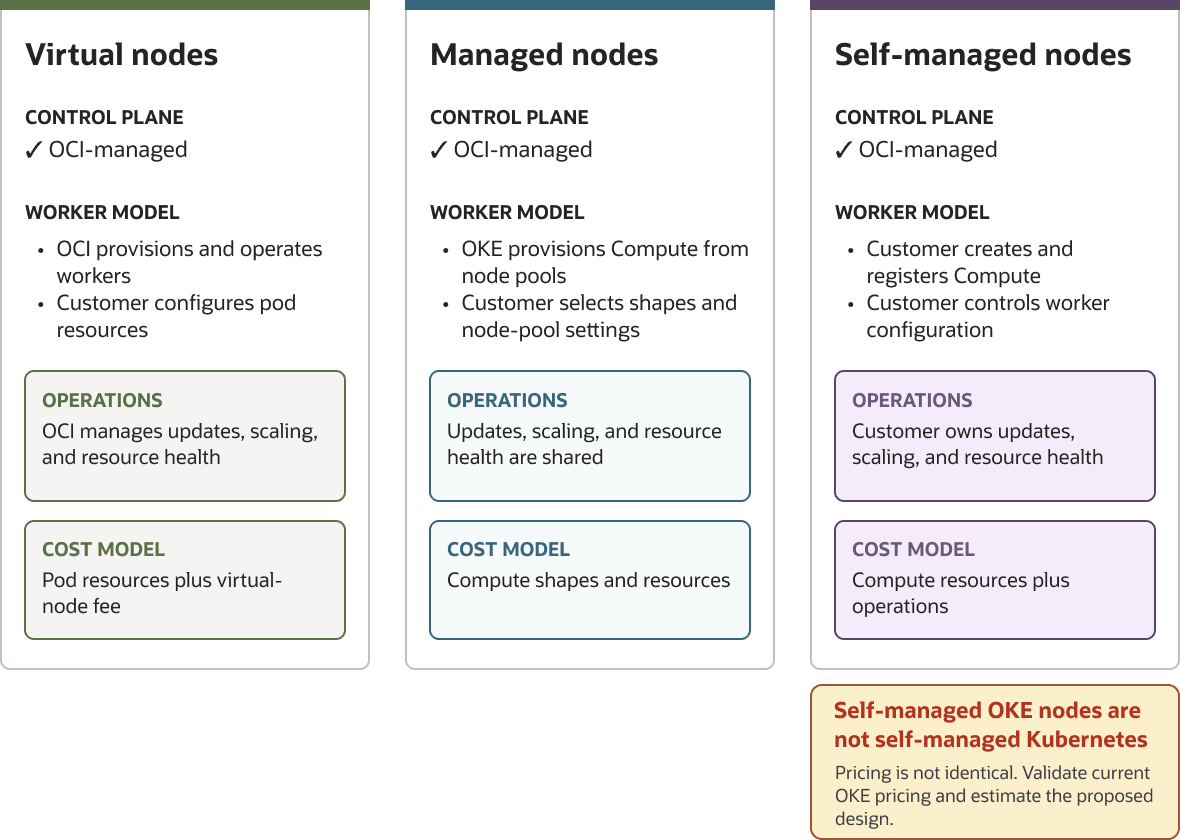
Cost model: Worker-model pricing is not identical. Managed and self-managed nodes use OCI Compute resources billed for the selected shapes and associated resources. Virtual nodes use a serverless, pod-level resource model and include a virtual-node fee. Enhanced-cluster fees can also apply. Review current OKE pricing and model the proposed design in the Oracle Cloud Cost Estimator.
- Virtual nodes: Fully managed by Oracle, available in enhanced clusters, and designed to reduce worker-node operations through pod-level resource consumption.
- Managed nodes: OCI Compute instances in your tenancy with shared operational responsibility. You manage capacity and worker-node lifecycle decisions through OKE node pools.
- Self-managed nodes: OCI Compute instances or instance pools you create, added to an enhanced OKE cluster. They are not grouped into OKE node pools, so node-pool functionality does not apply.
Learn more
About Self-Managed Kubernetes on OCI
OKE is Oracle's preferred managed Kubernetes service; self-managed Kubernetes is the exception for requirements that need deeper control or customization.
With self-managed Kubernetes, you deploy, operate, secure, upgrade, and recover the Kubernetes platform. OCI provides infrastructure and integration services, but it does not operate your Kubernetes control plane.
Typical self-managed Kubernetes scenarios
- A mandated Kubernetes distribution that OKE does not provide.
- A control-plane customization or governance requirement that cannot be implemented with OKE.
- You have an established Kubernetes platform you are operating, that your organization has explicitly decided to retain.
- A platform-engineering model that requires your ownership of cluster creation and lifecycle tooling.
Your organization's responsibilities
You are responsible for the Kubernetes control plane, etcd, upgrades, security patches, worker lifecycle, networking and storage integration, identity design, backup, recovery, observability, capacity, and cluster reliability. This path requires named engineering and operational ownership.
When another service may be a better fit
Use OKE when its managed control plane and worker choices meet the Kubernetes requirement. Using self-managed worker nodes with OKE is not a reason to operate a self-managed control plane.
Learn more
About OCI Compute
OCI Compute provides VM and bare-metal instances for deploying and running applications. It does not assume containers or Kubernetes. You can run traditional applications, custom software stacks, container runtimes, or you can operate your own platforms on Compute.
Typical OCI Compute scenarios
- Existing VM-based applications being moved without immediate re-architecture.
- Workloads requiring a particular operating system, custom image, host agent, kernel configuration, or administration model.
- Applications that require direct access to bare-metal, GPU, high-performance computing, or other specialized shapes.
- Commercial or legacy software with host-level installation and support requirements.
- You manage runtimes or other platforms that are not Kubernetes.
Your organization's responsibilities
You manage the operating system, software installation, patching, runtime, application deployment, instance configuration, capacity, availability, backup, and recovery. OCI manages the underlying cloud infrastructure and supplies the selected compute resources.
When another service may be a better fit
- Evaluate Functions when focused code can run on demand without infrastructure administration.
- Evaluate Container Instances when a containerized application does not require host administration or Kubernetes.
- Evaluate OKE when Kubernetes provides the required operating model.
Learn more