Processing New User Registration and Delegated Access Transactions
If the proxy goes through New User Registration to create a user ID, then the CTM transaction code NEW_USER_REGISTRATION is performed (this transaction code is delivered with your system). Once the proxy has entered constituent data and clicks the Submit button on the Proxy Terms and Conditions page, if a delegated transaction with a CTM transaction code exists, then the CTM Constituent Staging component indicates that a second transaction has been performed.
This example illustrates how the CTM Constituent Staging component looks like when NUR and DA are performed, and an EMPLID must be assigned (that is, Assign Proxy EMPLID = ‘Y’) but an EMPLID does not exist.
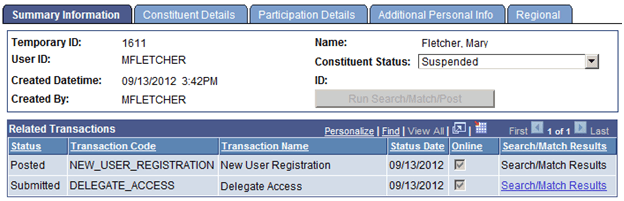
This example illustrates how the Constituent Staging component looks like when NUR and DA are performed, and an EMPLID must be assigned (that is, Assign Proxy EMPLID = ‘Y’), then an EMPLID is created.
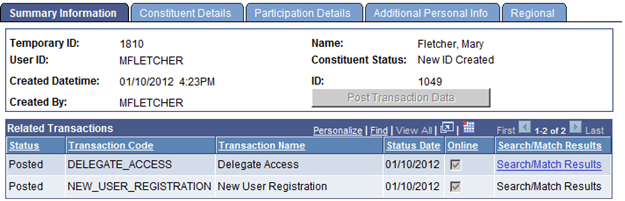
This example illustrates how the Constituent Staging component looks like when NUR and DA are performed by creating a user ID, and an EMPLID does not have to be assigned (that is, Assign Proxy EMPLID = ‘N’) to a delegated transaction.
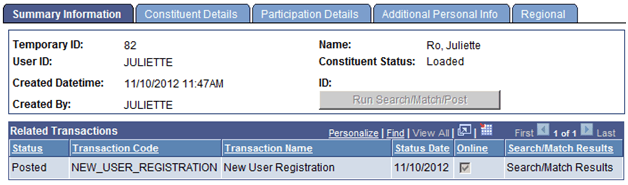
The CTM Transaction Code NEW_USER_TRANSACTION is performed only when the user creates a user ID through the New User Registration framework. If the user uses an existing user ID, a CTM transaction isn't involved. It is only during user ID creation time that the user may be asked to enter personal information. This information must first be stored in the CTM constituent staging records because an EMPLID doesn't exist for this user.