Defining Lease Types
To define lease types, use the Lease Types component (RE_LEASE_TYPE).
This topic provides an overview of lease types and discusses how to define lease types.
Understanding Lease Types
Lease types enable you to categorize leases for processing and reporting purposes. You may have many lease types, such as operating leases, warehouse leases, and subleases. You can also use lease types for statistical reporting. You can select a sublease type for a lease and run a report to track all subleases associated with a lease.
When you create a lease type, you associate it with a lease category. The lease category determines the processing of that lease type. For example, if you have a lease type of Reporting, the system recognizes that the lease associated with this lease type is for analytical reporting. No further processing occurs.
Lease Types Page
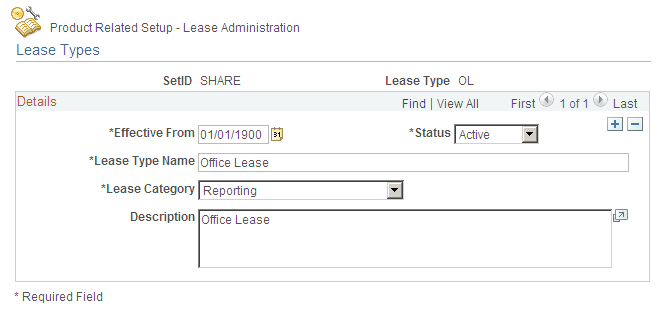
Use the Lease Types page (RE_LEASE_TYPE) to define lease types.
Navigation:
This example illustrates the fields and controls on the Lease Types page. You can find definitions for the fields and controls later on this page.
| Field or Control | Description |
|---|---|
|
Lease Category |
Select the lease category for the lease type. The category determines how to sort or report the various lease types. Values are: Reporting: No processing occurs. Sub Lease: When you create a sublease, you must enter the associated parent lease number. The system validates the Parent Lease field to ensure that a parent lease is associated with the sublease. |