The Closest Business Objective Page
The concept of the closest page is used to find the default objectives for an employee. It will be the objective page directly above them in the hierarchy.
-
If the department or position that the person is in has an objective page, then that will be their closest page. If not, then the system will use the department tree or position data, depending on the hierarchy defined, to climb up one level at a time until a published objective page is found.
-
Page owners are the individuals assigned to assemble business objectives for a given department or position. This group includes alternate editors since they too have access to update objective pages.
-
Page owners (and administrators) have access to published and non-published business objective pages.
-
Employees and managers who are not page owners have view-only access to published objective pages only.
-
If a business objective page is inactive, the system will bypass this page when looking for the closest page and climb up the hierarchy. In the chart to view other objective pages in the hierarchy, the Business Objectives link will not be displayed.
-
If a business objective page is not published, the system will stop climbing the hierarchy when looking for the closest page and display a message stating that the default page is not yet published.
-
If a business objective page is locked, the page owner or administrator cannot make any updates to the page. In the chart, the Business Objectives link is still displayed. Locked pages cannot be reassigned to a different owner or transferred.
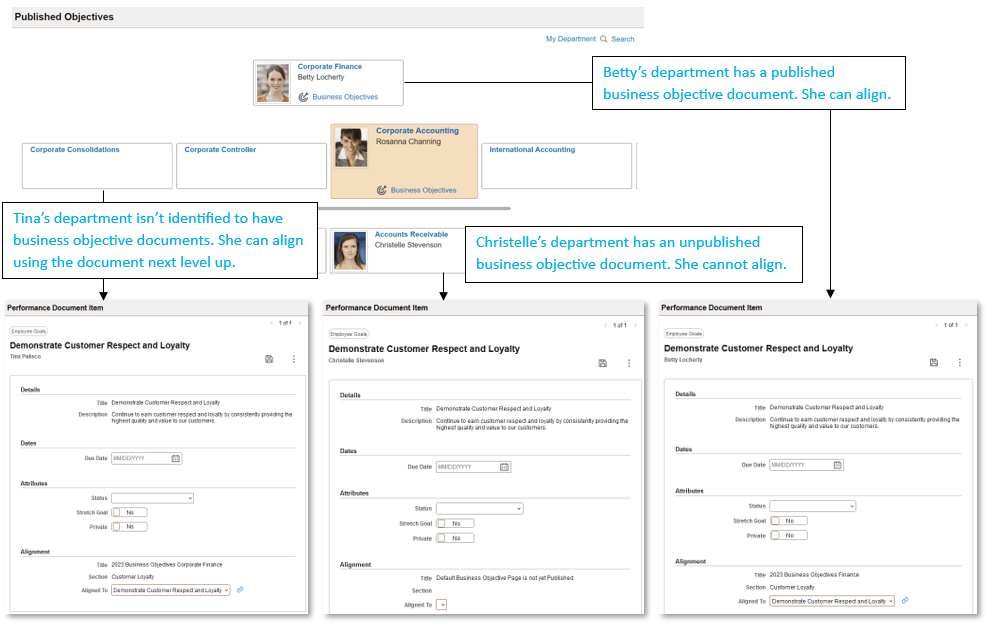
Review this example to see how the system determines if performance document items can be aligned to business objectives. Suppose that in Betty's organization:
-
Betty's department (Corporate Finance) has a published business objective page.
-
Tina is Betty's direct report. Her department (Corporate Consolidations) is not identified to have business objective pages. No business objective page is available.
-
Rosanna is Betty's direct report. Her department (Corporate Accounting) has a published business objective page.
-
Christelle is Rosanna's direct report. Her department (Accounts Receivable) has an unpublished business objective page.
Assuming that the setup for business objectives and performance documents to support alignment is completed:
-
Items from Betty's performance document can align with business objectives from the closest page, which is available in her department. Same with Rosanna.
-
Items from Tina's performance document can align with business objectives from the closest page, which is available in the department one level above hers.
-
Items from Christelle's performance document cannot be aligned. Her department has an unpublished page and the system is unable to identify the closest page for alignment.
This image illustrates examples of business objective alignment in performance documents based on the presence of the closest business objective page.