Accruing and Taking Long Service Leave
This section discusses each of the long service leave (LSL) entitlements and their respective absence takes. There are two absence entitlements and two pro rata entitlements—one of each for federal long service leave and other (or state-based) long service leave. They are LSL ENTWKF and LSL PROWKF for federal and LSL ENTWKO and LSL PROWKO for other (or state).
Long Service Leave Pro Rata and Entitlement—Federal
This scenario is based on 13 weeks LSL after 15 years of service. Pro rata balances transfer to entitlement on the completion of the first 15 years service and then annually.
The pro rata element LSL PROWKF accumulates the leave using variable LSL VR ENTWKF, which has a value of 0.86667 as the maximum yearly accrual value in weeks
15 years × 0.866667 weeks = 13 weeks (rounded)
When the absence calendar is run, the accrual value is deannualized depending on the calendar period frequency of the employee and the value passed to the LSL pro rata year-to-date _BAL and _ENT accumulators. Both accumulators have an initialize rule that transfers their balances to new instances. The initialize rule formulas are LSL FM PROWKF BMBR for _BAL and LSL FM PROWKF EMBR for _ENT. The formulas resolve to the value of system element PREV VALUE ACCM and add to the new instances.
The entitlement element LSL ENTWKF handles the transfer of the pro rata balances to entitlement using its formula LSL FM MVE P2EWKF, which:
-
Checks if the duration LSL DR DYS FR HIRE (days from hire) returns days more than or equal to variable LSL VR 15 Y IN D (15 years expressed in days, or 5, 478) and that the LSL ENTWKF_ENT accumulator is 0 (which indicates that nothing has been transferred to this life-to-date accumulator).
-
If duration does return more than 5,478 days and the entitlement _ENT balance is 0, the formula passes the value of 15 years of accrual to the entitlement and decrements the pro rata.
By the same method, the formula also transfers the pro rata _ADJ and _TKE balances to their respective entitlement accumulators.
-
If the conditions in step 2 are not met, the formula determines if the duration returns more than 5,478 days, and it verifies that the pro rata _ENT balance is more than or equal to 0.86667.
This condition indicates that another year's worth of pro rata leave has accrued. Because pro rata becomes entitlement annually after the initial 15 years transfer, the formula transfers the four pro rata balances to their respective entitlement balances by the same method.
Note:
In step 3, the formula checks the balance of the pro rata _ENT accumulator, because if it checked only for a non-0 balance in the entitlement accumulator after the initial 15 years transfer, subsequent transfers would occur every time the absence calendar runs instead of waiting for a year's worth of accrual in the pro rata accumulator.
The absence take, LSL TKEWKF, related to both the pro rata and entitlement absence elements (indicating that pro rata days can be used despite not having become entitlement yet), firsts looks to the entitlement balance to decrement absence units before looking to the pro rata balance to further decrement absence units (where the entitlement units are depleted).
The units (weeks) to decrement are resolved by the take's day formula, LVE FM WKF ABS NPH. The formula checks the scheduled hours or partial hours for each day and converts them to fractions of a week because the units by which to decrement the leave balances are weeks. The formula does this by dividing all hours returned by the day formula by LVE FM WK STD HRS. The day formula LVE FM WKF ABS NPH:
-
Checks for scheduled and partial hours, and if there are partial hours, the system returns the fraction of the week the hours represent then rounds them.
Partial hours ÷ Standard weekly hours = Fraction of week absent
6 ÷ 40 = 0.15
The formula includes variable LVE VR WKS ABSENT, which holds the cumulative value of the results of the day formula as it resolves for each day in the leave period. It starts as 0. In this example, its value after the resolution for day 1 would be 0 + 0.15 = 0.15.
-
If there are no partial hours but there are scheduled hours, it converts the hours to a fraction of a week (0.2 for an eight-hour day) and then checks for a decimal value in the User Defined 1 field on the Absence Event Input Detail page.
If there is any value, it halves the value of the fraction of a week and adds the value to LVE VR WKS ABSENT. Assuming this to be the case after processing the second day, LVE VR WKS ABSENT is:
Day 1 + Day 2 = 0.15 + (0.2 / 2) = 0.25 weeks = LVE VR WKS ABSENT
-
If there are no partial hours but there are scheduled hours and there is no halving, the formula adds the scheduled hours—already converted to a fraction of a week—to LVE VR WKS ABSENT.
Day 1 + Day 2 + Day 3 = 0.15 + (0.2 / 2) + 0.2 = 0.45 weeks = LVE VR WKS ABSENT
The units returned become the paid units (DAY COUNT PD) and unpaid units (DAY COUNT UNP) depending on available absence entitlement weeks and pro rata weeks. The positive input for this absence take are earnings LSL and LWOP. The units for these earnings are formulas LVE FM WK DCP HRS and LVE FM WK DCUP HRS, respectively. The formulas multiply the DAY COUNT PD and DAY COUNT UNP (both in weeks) by the standard weekly hours so the system can pay the leave in hours.
Note:
Any value in the decimal field halves the fraction of a week. You can use this to take twice as long a leave period at (weeks per day) ÷ 2, which is effectively half pay per week.
Long Service Leave Pro Rata and Entitlement—Other (State)
This scenario is based on 13 weeks LSL after either 10 or 15 years of service, depending on the state. Pro rata balances transfer to entitlement on the completion of the first 10 or 15 years service and then annually.
For the Australian Capital Territory, New South Wales, Queensland, Victoria, and Western Australia the accrual is 0.866667 weeks per year where:
15 years × 0.866667 weeks = 13 weeks (rounded)
For South Australia and Northern Territory the accrual is 1.3 weeks per year where:
10 years × 1.3 weeks = 13 weeks
The accrual is granted for whole months only so the formula grants the accrual if the hire day value is in the calendar period (and the hire date is not in the period).
This diagram shows when the accrual is and is not granted. The letter N indicates not granted (because the hire day is not in the period). You need to distinguish between hire date and hire day.
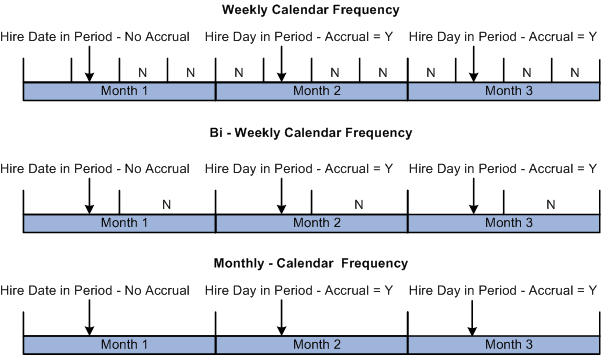
The pro rata element LSL PROWKO accumulates the leave using entitlement formula LSL FM ACCR FMTH which:
-
Determines if the employee's hire date is in the calendar period; if it is, it stops.
-
If the hire date is not in the period but the hire day is, a full month's accrual is due so the formula retrieves the employee's state from array AUS AR EE JOBJR.
-
Checks bracket LSL BR ACCRUAL, and using the employee's state, retrieves either 0.866667 or 1.3—the annual value.
-
Divides the accrual by 12 to get the monthly accrual and passes it to the pro rata _ENT and _BAL accumulators
-
The annual value is deannualized to the absence calendar frequency and that amount of entitlement.
The absence take, LSL TKEWKO, related to both the pro rata and entitlement absence elements (indicating that pro rata days can be used despite not having become entitlement yet), firsts looks to the entitlement balance to decrement absence units before looking to the pro rata balance to further decrement absence units (where the entitlement units are depleted).
The units (weeks) to decrement is resolved by the formula LVE FM WKO CALC, which does the same thing as LSL TKEWKF's day formula LVE FM WKF ABS NPH. The formula LVE FM WKO CALC is not, however, LSL TKEWKO's day formula. It is called by LSL TKEWKO's day formula, LVE FM WKO ABS ST, which has to check the state before resolving the daily hours into the take's number of weeks.
The formula LVE FM ABS ST determines whether the state value is NSW, QLD, or TAS and the day is not a public holiday; if that is the case, it resolves the day's hours into a fraction of a week using LVE FM WKO CALC. If the day is a public holiday in one of those states, the formula does not resolve the day's hours.
If the state is not NSW, QLD, or TAS, the day's hours are resolved by LVE FM WKO CALC, regardless of whether the day is a public holiday.