Step 3: Specifying Data Source Parameters

Access the Feed Publishing Wizard - Select Data Source Parameters page (click the Next button on the Feed Publishing Wizard - Select Data Source page).

This example illustrates the fields and controls on the Feed Publishing Wizard - Select Data Source Parameters page. You can find definitions for the fields and controls later on this page.
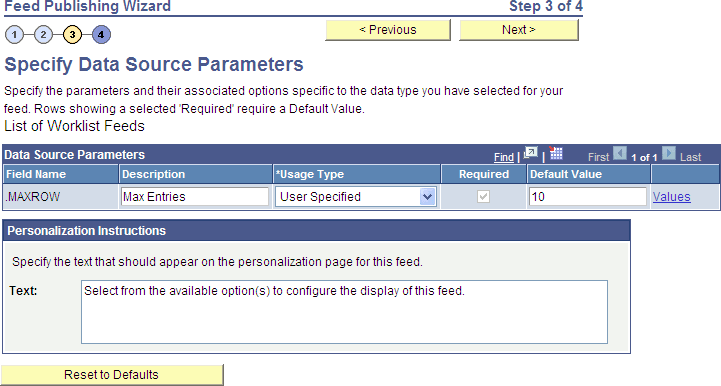
Feed Publishing Wizard - Select Data Source Parameters page

Use the Select Data Source Parameters page to configure each data source parameter, such as the parameter's description, usage type, and default value. Each data source parameter can have one value only. Required parameters must have a default value assigned.

Note:

This page is accessible only when you are building a feed definition with a data source that allows modification of one or more data source parameters.

Field or Control Description

Field Name

Displays the name of the data source parameter.

Description

Displays a description of the data source parameter.

Usage Type

The usage type defines how the parameter gets a value at runtime:

  • Admin Specified: Select to allow administrative users to specify values to configure the feed definition for their user community or communities. The value of an administrator-specified parameter can be derived as follows: as a system default value, as an administrator-configured value, or as a pure runtime value. The following list describes each method for deriving the value of an administrator-specified parameter listed in their order of precedence when the feed is requested:

    1. Runtime value: Runtime values are values passed in using what the industry refers to as “query parameters” of the feed request. Runtime values are not stored.

      Specifically, this means that a standard feed URL can also include a data source parameter and its value in the form of a query parameter (that is, &PARAM=value). A standard feed URL will already include some query parameters that are consumed by the feed runtime engine to generate the feed document. Additional query parameters, such as data source parameters, can be passed on to the data source itself—for example, to a PeopleSoft query, to a worklist, and so on.

      For example, if a PeopleSoft query included a field named DAYS and this field was also defined as a query prompt, then the feed URL could be formed with a runtime value to provide the value for this prompt: http://myserver.example.com:8920/PSIGW/HttpListeningConnector/feeds/RealtimeQueryFeed?FEED_ID=MY_FEED&PORTAL_NAME=EMPLOYEE&NODE_NAME=PSFT_TRN&To=PSFT_TRN&DAYS=60

    2. Administrator-configured value: Administrator-configured values can be specified by configuring the feed through the My Feeds page. Administrator-configured values are stored as feed personalization data.

    3. System default values: System default values can be specified on this page at design time, and are stored with the feed definition.

    4. Empty values: Provides the correct empty value according to the parameter's data type. For example if the parameter is a number, then 0 would be provided; for a string, "" would be provided.

  • Fixed: Select to enter a fixed value for the data source parameter. This value is stored with the feed definition.

  • System Variable: Select to assign a system variable as the data source parameter value. The actual value of the parameter is determined at runtime.

    For example, suppose that you specify %DateTime as the system variable for a parameter named Timestamp. When the feed is requested, the Timestamp parameter is populated by the current value of %DateTime.

  • User Specified: Select to allow end users to specify values to personalize the feed definition for their own use. The value of an user-specified parameter can be derived as follows: as a system default value, as a user-configured value, or as a pure runtime value.

    Note: User personalization does not apply to feeds published as public and a warning message is issued when the feed definition is saved.

    The following list describes each method for deriving the value of a user-specified parameter listed in their order of precedence when the feed is requested:

    1. Runtime value: Runtime values are values passed in using what the industry refers to as “query parameters” of the feed request. Runtime values are not stored.

      Specifically, this means that a standard feed URL can also include a data source parameter and its value in the form of a query parameter (that is, &PARAM=value). A standard feed URL will already include some query parameters that are consumed by the feed runtime engine to generate the feed document. Additional query parameters, such as data source parameters, can be passed on to the data source itself—for example, to a PeopleSoft query, to a worklist, and so on.

      For example, if a PeopleSoft query included a field named DAYS and this field was also defined as a query prompt, then the feed URL could be formed with a runtime value to provide the value for this prompt: http://myserver.example.com:8920/PSIGW/HttpListeningConnector/feeds/RealtimeQueryFeed?FEED_ID=MY_FEED&PORTAL_NAME=EMPLOYEE&NODE_NAME=PSFT_TRN&To=PSFT_TRN&DAYS=60

    2. User-configured value: User-configured values can be specified by personalizing the feed through the My Feeds page. User-configured values are stored as feed personalization data.

      Users can select a value from a prompt, or they can manually enter their own value if no prompt values are available. To define the list of valid prompt values, click the Values link. This list of prompt values and the default value are stored with the feed definition.

    3. System default values: System default values can be specified on this page at design time, and are stored with the feed definition.

    4. Empty values: Provides the correct empty value according to the parameter's data type. For example if the parameter is a number, then 0 would be provided; for a string, "" would be provided.

Required

A data source parameter is defined as required in the application class for the feed data type. This check box is selected but disabled except for user-specified parameters. All required parameters should be assigned a default value before proceeding to step 4 in the wizard.

Default Value

Enter the default value for the data source parameter. The data type of the value you enter should be the same as the parameter’s data type. However, the entered value is not type checked by the Feed Publishing Wizard; the type should be checked by and any errors reported by the application class for the feed data type.

Consider these guidelines when entering a default value:

  • If you select User Specified as the usage type and the data source parameter is a required value, you must enter the default value that will appear before a user enters a value. If the data source parameter is not a required value, you do not have to enter a default value.

    If you select a default value when defining prompt values on the Feed Publishing Wizard - Specify Data Source Parameter Values page, that default value populates this field.

    If you select User Specified as the usage type, you can also enter a system variable as the default value. For example, to make the current date the default value for a user-specified date parameter, enter a default value of %Date.

  • If you select System Variable as the usage type, you must enter a supported system variable to use as the data source parameter value. You can use the Look up Value button to access the following list of supported system variables:

    Supported System Variables Supported System Variables

    %AuthenticationToken

    %ClientDate

    %ClientTimeZone

    %ContentID

    %ContentType

    %Copyright

    %Currency

    %Date

    %DateTime

    %DbName

    %DbServerName

    %DbType

    %EmailAddress

    %EmployeeID

    %HPTabName

    %IsMultiLanguageEnabled

    %Language*

    %Language_Base

    %MaxInterlinkSize

    %LocalNode

    %Market

    %MaxMessageSize

    %NavigatorHomePermissionList

    %Node*

    %PasswordExpired

    %Portal*

    %PrimaryPermissionList

    %ProcessProfilePermissionList

    %RowSecurityPermissionList

    %RunningInPortal

    %ServerTimeZone

    %Time

    %UserDescription

    %UserID

    * The language code, portal name, and node name passed in through the query parameters of the request are used as the values for %Language, %Portal, and %Node respectively. If the request does not contain these parameters, then the corresponding system variable’s value will be used.

  • If you select Fixed as the usage type, you must enter the fixed value if this is a required parameter.

Values

Note: The Values link is displayed for parameters with an associated translate table, Yes/No type of parameters, or if you select User Specified as the usage type.

Click Values link to access the Feed Publishing Wizard - Specify Data Source Parameter Values page.

Text

Note: If you select User Specified as the usage type, the Personalization Instructions group box is displayed.

Use the Text field to enter custom personalization instructions for the feed. These personalization instructions appear on the personalization page of the feed.

Note: Personalization instructions must be translatable.

Specifying Prompt Values for Data Source Parameters

Access the Feed Publishing Wizard - Specify Data Source Parameter Values page (click a Values link on the Feed Publishing Wizard - Select Data Source Parameters page).

This example illustrates the fields and controls on the Feed Publishing Wizard - Specify Data Source Parameter Values page. You can find definitions for the fields and controls later on this page.
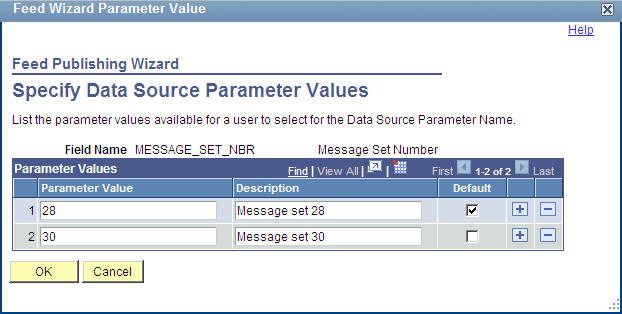
Feed Publishing Wizard - Specify Data Source Parameter Values page

Use the Specify Data Source Parameter Values page to specify the prompt values that are displayed to users when they personalize the feed.

For Yes/No type of parameters and for parameters associated with a translate table, you cannot modify or add to the values listed on this page. However, for user-specified parameters, you can add, edit, or delete value-description pairs. In addition, you can specify the default value for the data source parameter.

Field or Control Description

Parameter Value

Specify the parameter value.

Field or Control Description

Description

Provide an optional description of the parameter value.

Field or Control Description

Default

Select one value as the default value. If the parameter is required, then a default value is required; otherwise, it is optional.