Using JSMCAPI Broadcast with MCF Supervisor Console
Access the JSMCAPI Broadcast page using the following navigation path:
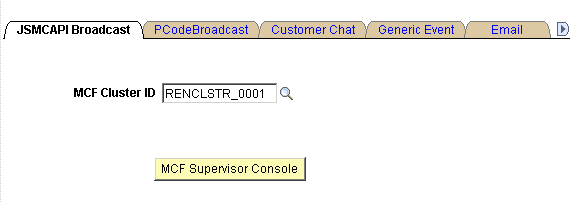
This example illustrates the fields and controls on the JSMCAPI Broadcast page. You can find definitions for the fields and controls later on this page.
| Field or Control | Description |
|---|---|
|
REN Server Cluster ID |
Select the REN server cluster on which to test the MCF Supervisor console. Note: The MCF Supervisor console is specific to the REN cluster Id selected. |
|
MCF Supervisor Console |
Click to initiate the supervisor console. Note: To demonstrate the MCF Supervisor console, you must have MCF servers, both queue and log servers, running and communicating with the specified REN server cluster. |
After you click MCF Supervisor console, a new browser window appears that displays the sample supervisor console.
Note:
To enable the new browser window to appear, disable any pop-up blocking software for your browser.
MCF Supervisor Console
Access the MCF Supervisor console using the following navigation path:
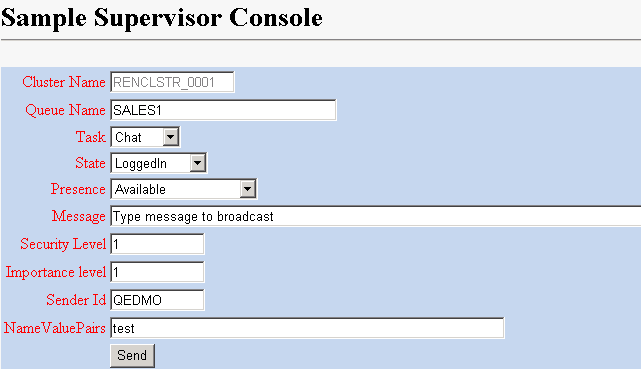
This example illustrates the fields and controls on Sample Supervisor Console. You can find definitions for the fields and controls later on this page.
| Field or Control | Description |
|---|---|
|
Cluster Name |
Displays the REN server cluster on which to test broadcast. |
|
Queue Name |
Enter the name of the queue that is in the specified cluster. Note: Enter the queue name only when you want to broadcast the message to a particular queue. |
|
Task |
Select the task. Values are email, chat, voice, generic, and none. |
|
State |
Select the state of the agent. Note: If the state of the agent is LoggedIn when the broadcast message is being sent by the supervisor, the agent receives the broadcast message using Agent console. |
|
Presence |
Select the presence. Note: If the agent is logged out, the presence should be inActive. The broadcast message is received only when the agent is currently logged in to the queue on which broadcast is sent. |
|
Message |
Enter the message that you want to broadcast. Note: To view the broadcast message that is sent by the supervisor, use the Agent console sample page. Select the same REN cluster that is used by the supervisor to broadcast, and the broadcast message is displayed on the Agent console. |
|
Security Level |
(Optional) Enter the security level. |
|
Importance Level |
(Optional) Enter the importance level. |
|
Sender Id |
(Optional) Enter the sender ID. Use this option only when you want the sender ID to appear as something other than the ID that actually sent the message. |
|
NameValue Pairs |
Enter the name and value pairs to configure your data. Note: These name-value pairs are concatenated as a string. You can define any name-value parameters for your application and send them in the name-value pair string. The JSMCAPI passes the same as a string to the console. Your particular application needs to process that string accordingly. |
Note:
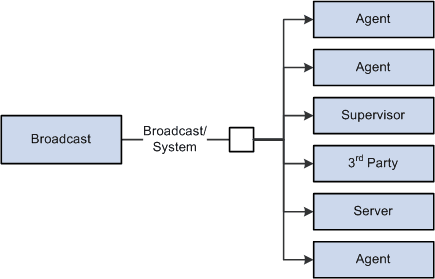
For a system-wide or a cluster-wide broadcast, the broadcast message from the supervisor is sent to all agents, as well as the supervisors who are logged in to the cluster that is specified by the supervisor. The system-wide broadcast is same as cluster-wide broadcast because a JSMCAPI supervisor knows only the cluster it is operating on.
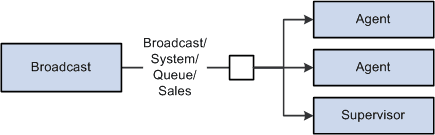
For a queue-wide broadcast, the broadcast message from the supervisor is sent to all agents who are currently logged in to the queue that is used by the supervisor to broadcast the message. This assumes that the queue is in the same cluster as the supervisor who is sending the broadcast message.
For agent-wide broadcast, the broadcast message will be sent to all agents who are currently logged to any queue in the same cluster as the supervisor who is sending the message.
The following diagram illustrates queue-wide broadcast of notifications.
The following diagram illustrates cluster-wide broadcast of notifications.
The following table describes the combinations:
| Type of Broadcast | Cluster | Queue | Agent Login State | Agent Activity State | Broadcast Audience and Description |
|---|---|---|---|---|---|
|
JSMCAPI |
Not specified |
Not specified |
Not specified |
Not specified |
This is a cluster-wide broadcast. All agents on Cluster_1 will receive the broadcast. |
|
JSMCAPI |
Cluster_1 |
Not specified |
Not specified |
Not specified |
Same as the preceding. All agents on Cluster_1 will receive the broadcast. |
|
JSMCAPI |
Cluster_1 |
SALES |
Not specified |
Not specified |
All agents subscribing to SALES will receive the broadcast. This assumes that SALES is on Cluster_1. |
|
JSMCAPI |
Cluster_1 |
SALES |
Logged |
Not specified |
All agents who are logged (active and inactive) to sales will receive the broadcast. This assumes that SALES is on Cluster_1. |